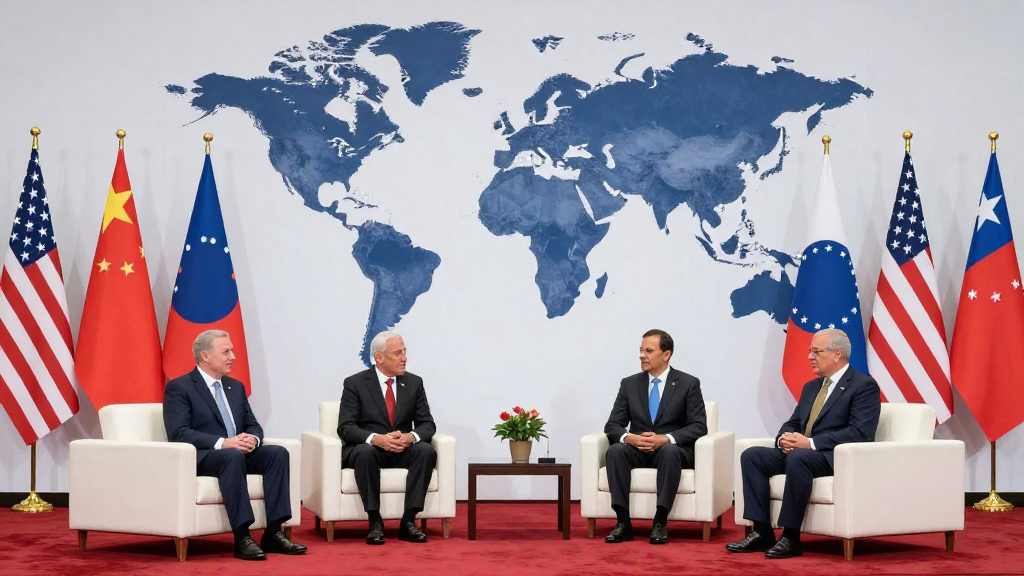
The world’s most consequential economic gathering in years opened Monday in Evian-les-Bains, France, as three crises that will directly shape manufacturing costs, energy prices, and technology supply chains arrived simultaneously at the G7’s doorstep. With a potential US-Iran peace agreement that could reopen the Strait of Hormuz set to be signed as early as this weekend, a 15 percent universal import tariff legally expiring July 24, and a critical-minerals emergency that Europe’s own data shows has already cost each of its affected economies an estimated $1.5 trillion, the 52nd Group of Seven summit carries stakes that have few recent parallels.
Trump Declares a Iran Deal Largely Done
Speaking from the Oval Office on Thursday, President Donald Trump announced that the United States had reached what he described as a “great settlement” with Iran — “subject to the finalization of documents” — and said the Strait of Hormuz would be reopened “as soon as we have it signed.” Trump said Vice President JD Vance and special envoy Steve Witkoff would represent the United States at any signing ceremony, which he suggested could happen in Europe “maybe over the weekend.” South China Morning Post reported that a senior Iranian official indicated overnight that a deal is likely, with Geneva being floated as a possible signing location. Iran’s foreign ministry confirmed the deal under discussion includes a memorandum of understanding as a first phase, before broader nuclear negotiations would begin within 30 to 60 days.
The conflict itself began February 28, when the United States and Israel launched military attacks on Iran. Iran retaliated by disrupting transit through the Strait of Hormuz — the waterway that carries roughly 20 million barrels of oil per day, representing about one-fifth of global petroleum consumption, according to the US Energy Information Administration. The Brookings Institution described the resulting supply disruption as the largest supply-side shock to hit global energy markets since the 1973 Arab oil embargo. If the Hormuz reopening holds, oil analysts at Goldman Sachs have projected a barrel price correction of $12 to $18 within the first two weeks — a relief rally that would ease headline inflation across every G7 economy.
The Section 122 Tariff Cliff
Simultaneously, the Section 122 universal 15 percent tariff — imposed by executive order in February — faces a legally mandated expiration on July 24 unless Congress acts. The Congressional Research Service confirmed the statutory mechanism in a brief released last week, noting that extending the measure would require affirmative legislation that the current Senate arithmetic makes unlikely to pass. Canadian Prime Minister Mark Carney told reporters in Evian that his country was “preparing for every scenario,” adding that Canadian businesses had already begun renegotiating supply contracts to account for the tariff’s potential disappearance. European Commission President Ursula von der Leyen said the EU had prepared a $340 billion retaliatory package that would be “immediately activated” if the tariff window closed without a broader trade framework in place.
The tariff cliff creates a paradox for US exporters: companies that pre-sold inventory anticipating the tariff’s continuation are now facing a potential windfall if it lapses, while those that adjusted supply chains in anticipation of its permanence face stranded costs. Financial markets have priced a 62 percent probability of a short-term extension of 90 days, according to futures data compiled by the CME Group, but that leaves a 38 percent risk of abrupt cost recalibration across global supply chains in less than five weeks.
The Rare-Earth Crisis and Structural Economic Damage
Perhaps the most durable of the three crises is the one that predates the Iran conflict. The critical-minerals emergency — driven by Chinese export restrictions on rare earth elements, gallium, germanium, and graphite that were intensified in April — has already inflicted an estimated $1.5 trillion in cumulative economic damage across G7 economies, according to data published by the European Commission’s Joint Research Centre. German Chancellor Friedrich Merz told fellow leaders that the automotive sector in his country had reduced production by 11 percent year-on-year specifically due to semiconductor shortages linked to the mineral restrictions.
The OECD released its June Economic Outlook simultaneously with the summit’s opening, cutting its global growth forecast to 2.8 percent for 2026 — down from 3.4 percent in 2025 — with a warning that a prolonged Hormuz disruption could drive that figure as low as 2.1 percent. Stefano Scarpetta, the OECD’s chief economist, said the downside scenario would “tip some economies into, or close to, recession” and keep inflation elevated well into 2027. “A longer-lasting shock would keep inflation higher, weaken investment, and raise unemployment across the advanced economies,” Scarpetta said in the report’s foreword.
British Prime Minister Keir Starmer, hosting the summit alongside French President Emmanuel Macron, framed the gathering in explicitly economic terms. “The choices made here in the next 48 hours will determine whether global growth recovers to 3.1 percent next year, or collapses toward two percent — and whether the industries of the future are built in G7 nations or elsewhere,” Starmer told reporters. Japanese Prime Minister Shigeru Ishiba added that his country’s manufacturing sector was operating at 74 percent capacity utilization — the lowest since the 2011 Fukushima disaster — directly due to component shortages rooted in the minerals supply disruption.
Analysts at the Peterson Institute for International Economics noted that the simultaneous resolution of two of the three crises — a Hormuz reopening and a tariff extension — could restore approximately 0.6 percentage points of global growth by the fourth quarter of 2026, but warned that the rare-earth crisis had introduced structural supply-chain vulnerabilities that no diplomatic agreement could quickly reverse. “Even if the Hormuz opens this weekend and the tariff extends for 90 days, the damage to the critical-minerals supply chain has introduced a new normal of higher input costs that will persist for years,” said Dr. Emily Tanner, a senior fellow at Peterson. “G7 governments are now being forced to choose between accepting higher inflation and accepting deindustrialization — and so far, neither side has found a politically viable answer.”