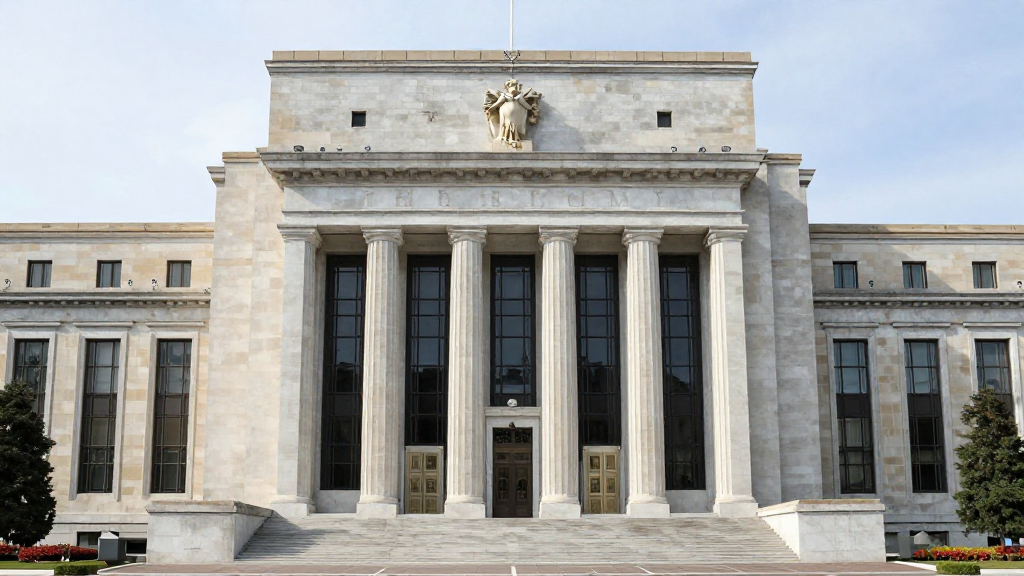
The world’s three most powerful central banks ended June 2026 pointing in radically different directions, exposing a fracture in the global monetary order that analysts say has no recent parallel. While the Federal Reserve held rates steady for the fourth consecutive meeting, the European Central Bank broke ranks and hiked for the first time since 2023, and the Bank of Japan pressed ahead with its gradual tightening program — each institution responding to its own domestic imperatives rather than any coordinated global strategy. The result is a landscape of synchronized divergence that is sending shockwaves through currency markets, sovereign debt, and emerging economies already struggling with the fallout from the Iran war energy shock now in its fourth month.
The Fed Holds, But the Guard Has Changed
The Federal Open Market Committee voted unanimously on June 17 to keep its benchmark rate in a range of 3.5% to 3.75%, a decision that carried no surprises. What dominated headlines was what the statement did not contain: all language indicating a bias toward future rate cuts was stripped from the policy communiqué, replaced by a stark acknowledgment that “uncertainty remains elevated” and that the committee would monitor incoming data “carefully.” The change was subtle in wording but seismic in implication — it marked the formal end of the Fed’s two-year easing cycle and opened the door to hikes if inflation reaccelerates. Officials through their closely watched “dot plot” grid removed their prior outlook for a rate cut this year and indicated that a hike is possible before December.
The shift carries extra weight because it unfolded in Kevin Warsh’s first meeting as Federal Reserve chairman. Taking over from Jerome Powell in May, Warsh wasted no time signaling a departure from his predecessor’s communication style. He declined to submit his own dot to the Summary of Economic Projections, a highly unusual move for a sitting chairman, and told reporters at his inaugural press conference that the dot plot tool is “not helpful in the conduct of policy” and would face review by year-end. “I suspect by year-end there will be a review about communication broadly, press conferences, dots, meetings, and the like,” he said. “I do not want to prejudge the outcomes there, but I am pretty open-minded about what they could be.” Based on the 18 of 19 responses in the dot plot, the median rate forecast for end-2026 now stands at 3.8%, up from 3.4% in March, with nine of 19 participants expecting at least one hike this year.
The ECB Breaks Ranks as Energy Prices Spiral
Six days before the Fed’s decision, the European Central Bank made a move that markets had anticipated but still greeted with sharp volatility: a quarter-point rate hike to 2.25%, the first increase since the ECB began cutting in 2024. The catalyst was unmistakable. “The war in the Middle East is generating inflation pressures, and the decision to raise rates is robust across a range of scenarios mapping out how the shock might evolve and affect the medium-term outlook for the euro area,” the ECB’s Governing Council said in a statement that named the Iran conflict explicitly. The war, which crossed the 100-day mark in June, has closed the Strait of Hormuz to normal traffic, destroyed energy production infrastructure across a swathe of the Persian Gulf, and pushed Brent crude above $94 per barrel — a level that translates almost immediately into higher costs for manufacturers, transporters, and consumers across Europe.
ECB President Christine Lagarde, speaking at the press conference following the June 11 decision, underscored that the institution was not following the Fed’s script. “We are not pre-committing to a particular rate path,” she said, leaving the door open to further increases if the energy shock deepens. “The full implications of the war for medium-term inflation and growth will depend on the intensity and duration of the energy price shock, as well as the scale of its indirect and second-round effects.” The ECB simultaneously downgraded its growth forecasts, cutting its 2026 projection for the euro zone to just 0.8%, barely above recession territory, while lifting its inflation forecast to 3% for the year — a full percentage point above its 2% target. The combination of slower growth and persistent inflation, sometimes called “stagflation,” puts the ECB in an especially uncomfortable position: tightening into weakness to prevent energy costs from becoming entrenched in wages and prices.
The BOJ Charts Its Own Course as Global Fallout Mounts
The Bank of Japan, which began gradually unwinding its ultra-loose policy in late 2025, continued on its measured path even as its peers pivoted. The BOJ raised its short-term policy rate to 0.75% in June, the fifth increase in a tightening cycle that has been watched intently by global investors who spent a decade borrowing cheaply in yen to fund carry trades across higher-yielding currencies. The yen’s appreciation — it strengthened roughly 6% against the dollar between January and June 2026 — has been a source of friction between Tokyo and Washington, where the strong dollar has become both a political symbol and an economic burden for U.S. exporters.
For emerging market economies, the simultaneous tightening by the ECB while the Fed signals openness to future hikes creates a particularly toxic combination. Dollar funding costs rise as the Fed tightens or maintains elevated rates, while currencies of commodity-importing nations come under pressure as the euro strengthens against the dollar. Many central banks in Asia and Latin America now face the unenviable choice of following the Fed’s trajectory and crushing domestic demand, or defending their currencies and importing the inflation that the ECB and the Iran energy shock are exporting. Capital flows that sustained investment in developing economies throughout 2024 and 2025 are already reversing, with the Institute of International Finance reporting outflows from emerging market debt and equity funds totaling $47 billion in the eight weeks ending June 20 — the largest such exodus since the 2022 global tightening cycle.
The diverging paths of the three biggest central banks are not merely a technical monetary phenomenon. They reflect deeper structural differences in how each economy is absorbing the Iran war energy shock, how embedded inflation has become in domestic wage and price-setting, and how much political latitude each central bank enjoys in an election year. Warsh’s Fed is navigating a soft landing narrative with inflation decelerating toward target. The ECB is fighting an energy-imported inflation shock that its own rate cuts from 2024 and 2025 left it poorly positioned to counter. The BOJ is unwinding a decade of emergency policy while managing a yen that is strengthening at a pace its export-dependent economy cannot easily absorb. For global markets, the era of relying on central bank forward guidance as a stable anchor has definitively ended, replaced by something far more volatile: three institutions making independent judgments based on incompatible domestic conditions, with the accumulated shocks of the past three years making the usual playbook for navigating synchronized global tightening largely useless.