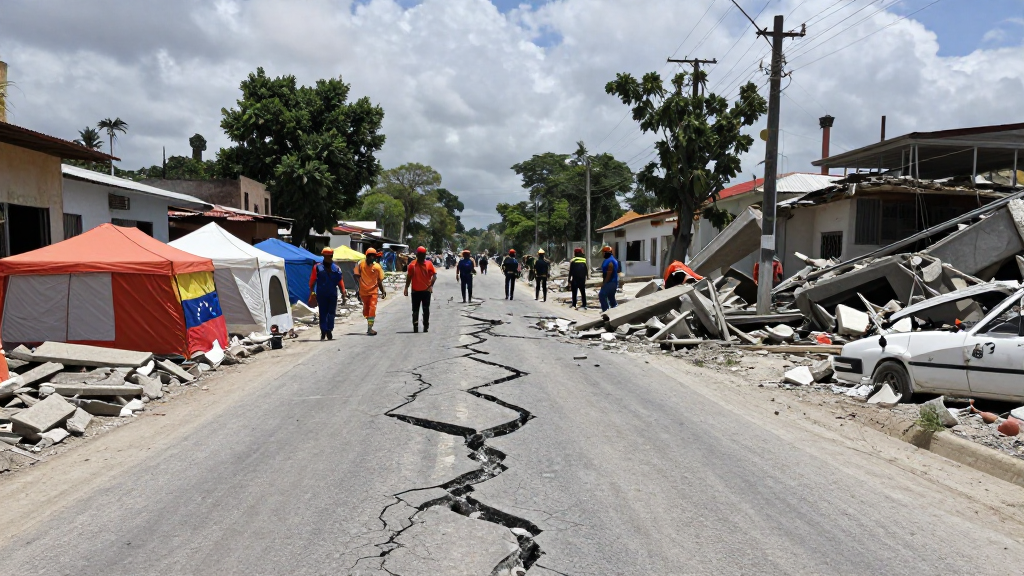
International aid agencies rushed assistance to Venezuela on Thursday following a pair of devastating earthquakes that struck the capital Caracas on Wednesday, killing at least 164 people and injuring hundreds more as rescue workers combed through the rubble of collapsed buildings.
The twin quakes, measuring magnitudes of 7.2 and 7.5 on the Richter scale, struck less than a minute apart, according to the United States Geological Survey. The second tremor was centered near the coastal town of Osia, approximately 45 kilometers southwest of the capital. At least 11,000 people have been displaced, with shelters established across the capital’s metropolitan area, the UN Office for the Coordination of Humanitarian Affairs reported.
The Venezuelan government declared a national emergency and issued an international appeal for assistance. President Nicolás Maduro addressed the nation late Wednesday, saying his administration would accept “all aid that arrives from whatever country, without political conditions.” International rescue teams from Mexico, Spain, and Chile were among the first to deploy, with additional crews confirmed from Colombia, Peru, and Argentina. The UN confirmed it was rapidly mobilizing search-and-rescue teams through its emergency coordination mechanisms.
UN Agencies Deploy Rapid Response Teams
The United Nations confirmed Thursday that it was rapidly deploying aid, support, and rescue teams to Venezuela through its emergency coordination mechanisms. UN agencies on the ground included the International Organization for Migration, which activated its emergency response protocols, and the UN Population Fund, which began coordinating maternal health support for affected shelters.
World Vision International warned that the true scale of the disaster was still emerging, with communications disrupted across several districts of the capital. “We are still learning about the full impact,” the organization said in a situation report. UNICEF said it was working to deliver emergency supplies including clean water, therapeutic feeding for young children, and psychosocial support to families displaced by the disaster.
The UN Security Council held an emergency session Thursday to discuss the disaster alongside other regional crises, marking one of the fastest-ever convenings on a Western Hemisphere emergency. The International Federation of Red Cross and Red Crescent Societies issued an emergency appeal for $15 million to fund its operations in Venezuela over the next three months.
Geopolitical Context and Long-Term Recovery Concerns
The earthquakes struck at a sensitive moment for Venezuela, which remains under international sanctions that complicate the receipt of foreign assistance. The United States Treasury’s Office of Foreign Assets Control maintains broad sanctions on the Maduro government, though general licenses have historically allowed humanitarian aid to flow unimpeded. Whether the current licensing framework will cover the scope of assistance required remains an open question among relief officials.
International humanitarian law experts noted that the scale of displacement would likely require sustained international engagement over months, not weeks. “Earthquakes of this magnitude in urban areas create long-term displacement crises that outlast the initial headlines,” said one UN official who asked not to be named because they were not authorized to speak publicly before the Security Council briefing.
The Venezuelan military has been deployed to support search-and-rescue operations, though access to some affected areas has been slowed by disrupted road infrastructure and power outages affecting an estimated 2.3 million residents in the greater Caracas metropolitan area, according to figures cited by the Venezuelan electric workers’ union.
Regional and Global Response Grows
Neighboring countries moved quickly to offer assistance. Colombian President Gustavo Petro authorized the deployment of a 60-person urban search-and-rescue team, while Mexico’s Secretariat of Foreign Affairs confirmed a military cargo plane carrying medical supplies and rescue equipment departed Mexico City early Thursday. Spain’s Agency for International Development Cooperation said a specialized rescue unit was being readied for deployment pending clearance from Venezuelan authorities.
The European Union’s humanitarian response arm, DG ECHO, said it was in contact with its field partners and that an initial emergency allocation of €500,000 had been approved to fund shelter, water, and sanitation assistance for up to 5,000 families. China’s Foreign Ministry said Beijing was preparing a $5 million emergency grant to be disbursed through the Chinese Red Cross, which maintains a partnership agreement with its Venezuelan counterpart.
World Health Organization Director-General Tedros Adhanom Ghebreyesus said the organization had activated its emergency medical teams framework and was coordinating with Venezuelan health authorities to ensure hospitals overwhelmed by the casualty influx could receive specialized surgical support. The Pan American Health Organization said it had deployed an incident management team to Caracas to support health sector coordination.
The focus now shifts to the coming 72 hours as international rescue teams gain full access to the most heavily damaged districts. Officials at the UN said the window for finding survivors in collapsed structures was narrowing, and that logistics bottlenecks — particularly at Simón Bolívar International Airport outside Caracas — represented the single greatest risk to an effective response. What happens at that airport in the next two days will largely determine whether the international response reaches those who need it most.