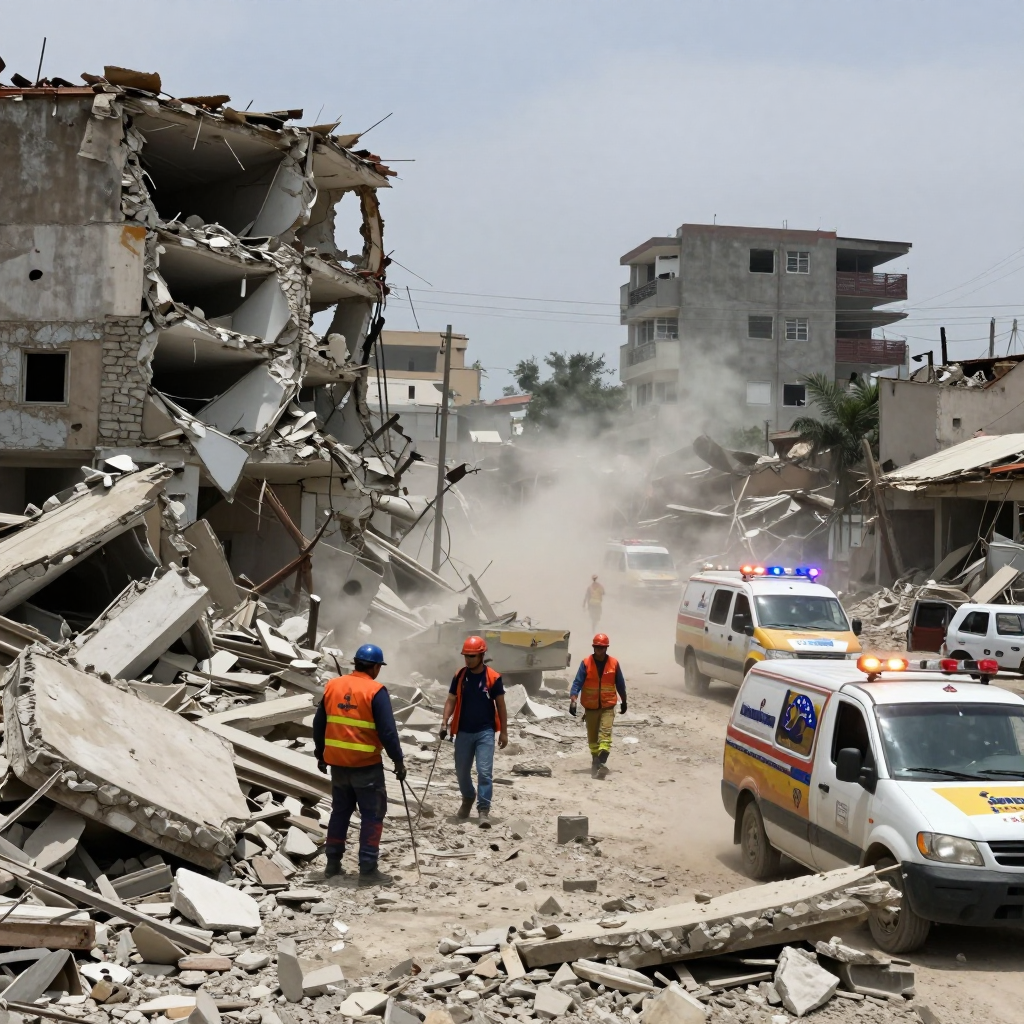
CARACAS, Venezuela — Twin earthquakes struck Venezuela on Thursday, killing at least 589 people and injuring more than 4,300, as international rescue teams from Mexico, Brazil, Cuba and the United States rushed to join the search for thousands still missing beneath the rubble, officials said Friday. The back-to-back tremors collapsed more than 250 buildings across the capital Caracas, the coastal city of La Guaira and surrounding areas, overwhelming hospitals already operating beyond capacity.
The president of Venezuela’s National Assembly, Jorge Rodríguez, said rescue workers were racing against time to reach survivors trapped under collapsed structures. “This is the time to save lives. This is the time to rescue people. This is the time to assist those who are at this moment trapped beneath the rubble of all the buildings, apartment blocks, shopping centers, bridges and roads that were damaged and directly struck the people,” Rodríguez said in a statement broadcast on state television.
International Rescue Efforts Under Way
Mexico, Brazil, Cuba and the United States all dispatched emergency response teams within hours of the disaster, according to Venezuela’s Health Ministry. The U.S. Treasury Department simultaneously granted Iran a 60-day sanctions exemption allowing crude oil sales in U.S. dollars — a policy shift that will unlock billions of dollars in revenue for Iran’s oil sector and which analysts said was part of a broader diplomatic quid pro quo following the U.S.-Iran ceasefire agreement signed earlier this month.
The tremors, which struck in quick succession on Thursday afternoon, were felt across a wide arc of northern Venezuela. La Guaira, the country’s main port city and a hub for imports, suffered the heaviest damage, with entire residential blocks reduced to debris. Local hospitals reported being overwhelmed by the influx of casualties, prompting the Health Ministry to issue an urgent appeal for medical supplies.
Diplomatic Friction Over Sanctions Relief
The U.S. decision to grant Iran the sanctions exemption drew immediate criticism from Republican lawmakers who said the administration was rewarding Tehran without sufficient verification of its nuclear commitments. Senator Jim Risch of Idaho, the ranking Republican on the Senate Foreign Relations Committee, said the move “handed the regime a financial lifeline without a single concrete verification mechanism in place.” The exemption, effective immediately, permits Iran to sell crude oil and petrochemicals in U.S. dollar transactions for the first time since the Trump administration withdrew from the Joint Comprehensive Plan of Action in 2018.
Analysts at the Center for Strategic and International Studies said the timing of the exemption was not coincidental. “This is clearly designed to stabilize the nuclear negotiations by removing the most immediate economic pressure point,” said a senior fellow who tracks Iranian sanctions policy. “The question is whether the 60-day window is long enough to lock in a permanent agreement.”
Regional Security Tensions Rise
Meanwhile, the International Maritime Organization announced Friday that it had paused its evacuation of thousands of stranded sailors from the Persian Gulf after an unknown projectile struck a Singapore-flagged cargo vessel in the Strait of Hormuz on Thursday. U.S. officials said Iran had fired on the ship; Iranian authorities have not claimed responsibility, but the attack came hours after the Islamic Revolutionary Guard Corps warned that vessels must coordinate passage through the strait with Iran’s Navy.
In the eastern Mediterranean, Israeli airstrikes killed two people and wounded a third in southern Lebanon on Friday, according to Lebanon’s National News Agency. Israeli forces also bulldozed and burned homes in the town of Markaba. Israeli Prime Minister Benjamin Netanyahu and Defense Minister Israel Katz said Israeli forces would maintain an indefinite presence in southern Lebanon, Syria and the Gaza Strip — a position that directly contradicts the U.S.-Iran ceasefire agreement, which obligates Israeli forces to withdraw from Lebanese territory. Lebanese and Israeli diplomats agreed to extend their Washington negotiations for a fourth day; Hezbollah is not a party to those talks.
Ceasefire Framework Under Strain
The parallel crises are testing the durability of the ceasefire framework negotiated in Bürgenstock, Switzerland, earlier this month. That agreement established a 60-day timeline for Iran to provide full access to its nuclear facilities to International Atomic Energy Agency inspectors and for the United States to remove selected sanctions. The Hormuz incident and the Israeli strikes on Lebanon have raised fresh questions about whether the agreement’s enforcement mechanisms are sufficiently robust to hold across multiple fronts simultaneously.
The IAEA said its director general, Rafael Mariano Grossi, was in Tehran on Friday for meetings with Iranian officials. A spokesperson said Grossi would press for “immediate and unfettered access” to the Fordow and Natanz enrichment sites as a condition for maintaining the sanctions relief pathway. What happens in those talks — and whether Iran grants the inspections access demanded by Washington — will determine whether the ceasefire survives its first critical month.