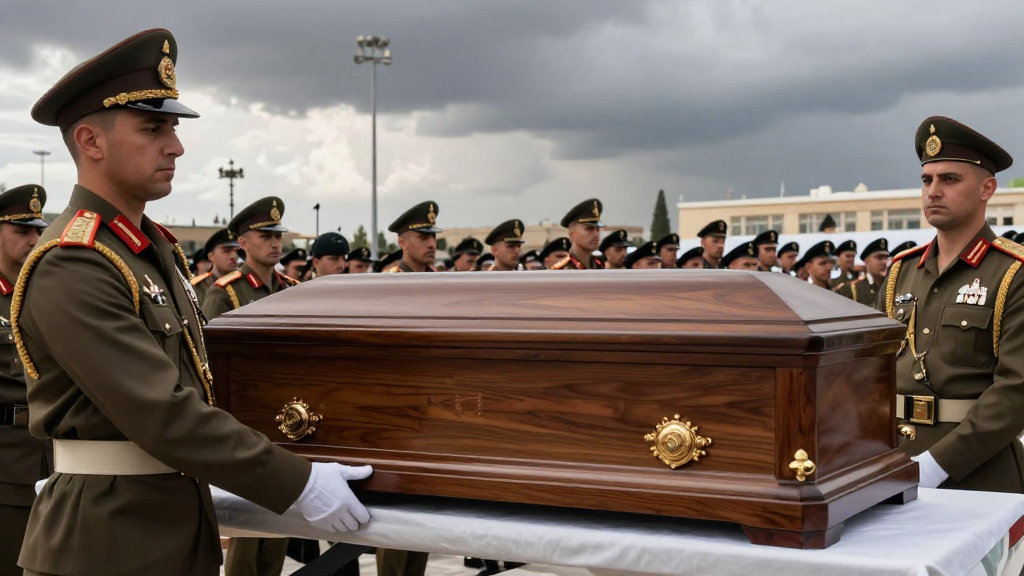
Iran held a state funeral in Tehran on Saturday for top military commanders and nuclear scientists killed during the country’s 12-day war with Israel, drawing more than one million mourners onto the capital’s Azadi Street as crowds chanted anti-American slogans and trampled the flags of Israel and the United States. The ceremony for General Hossein Salami, the head of Iran’s Islamic Revolutionary Guard Corps, and General Amir Ali Hajizadeh, who led the Guard’s ballistic missile program, underscored the deep wounds left by the brief but devastating conflict.
Funeral Procession Draws Massive Crowds in Tehran
Caskets draped in the Iranian flag were loaded onto military trucks and driven along Azadi Street as part of a procession that state media described as the largest public gathering in Tehran in years. Images broadcast by Iranian state television showed mourners packed shoulder-to-shoulder, many weeping openly. In some sections of the crowd, demonstrators set ablaze small flags of Israel and the United States. The outpouring of grief was matched by a stream of anti-Western rhetoric from speakers addressing the crowd from a raised platform.
“The blood of our martyrs has lit the flame of resistance across the entire Islamic world,” a senior IRGC commander told the crowd, his voice amplified across the boulevard. State broadcasters reported that at least 200 people required medical attention for heat exhaustion during the procession, underscoring the scale of the gathering on a day when temperatures in Tehran exceeded 38 degrees Celsius.
US-Iran Doha Talks End in Stalemate Over Hormuz and Frozen Funds
The funeral came hours after indirect US-Iran talks in Doha, Qatar, concluded without a breakthrough, leaving the two sides with no clear path to de-escalation. American and Iranian officials met through intermediaries after the fighting ceased, with Qatar and Oman acting as mediators. The discussions centered on two interlocking demands: Iran wants access to billions of dollars in frozen funds held abroad, while the United States and its partners are pressing for guarantees that Iran will not again threaten navigation through the Strait of Hormuz, the world’s most critical oil chokepoint.
Neither side offered public concessions. A spokesperson for the US State Department said the talks had been “businesslike and professional” but acknowledged that “significant gaps remain.” Iranian Foreign Ministry spokesman Esmail Baghaei struck a more defiant tone, saying Tehran would not accept “preconditions or diktats” and warning that Iran’s patience on the Hormuz issue was “not infinite.”
Trump Claims Credit for Spare Khamenei; Critics Voice Skepticism
Speaking from Washington, former President Donald Trump claimed that he had personally intervened during the conflict to prevent what he described as an attempt to target Supreme Leader Ayatollah Ali Khamenei. “I saved Khamenei,” Trump told reporters. “He was going to be taken out. It would have been a very ugly ending for him, and I made sure it didn’t happen.” The claim could not be independently verified, and Iranian state media made no mention of any such intervention.
The juxtaposition of Trump’s remarks with the funeral imagery proved awkward for the administration, which has sought to present itself as a broker of stability in the Gulf even as Israel pressed its military campaign against Iranian nuclear sites. Critics in Congress were quick to note the contradiction: the White House had backed Israel’s offensive, which killed the very commanders Iran was now burying.
What Happens Next
International mediators are expected to push for a second round of talks in the coming weeks, though no date has been set. The key question remains whether the two sides can reach a preliminary agreement on releasing frozen Iranian assets — an issue that carries domestic political weight for Tehran — without providing political cover for further escalation. For now, the IRGC is rebuilding its command structure around officers untested in wartime, a transition that analysts say will define Iran’s military posture for months to come. World oil markets, which surged during the conflict, have retreated but remain sensitive to any new disruption at Hormuz.