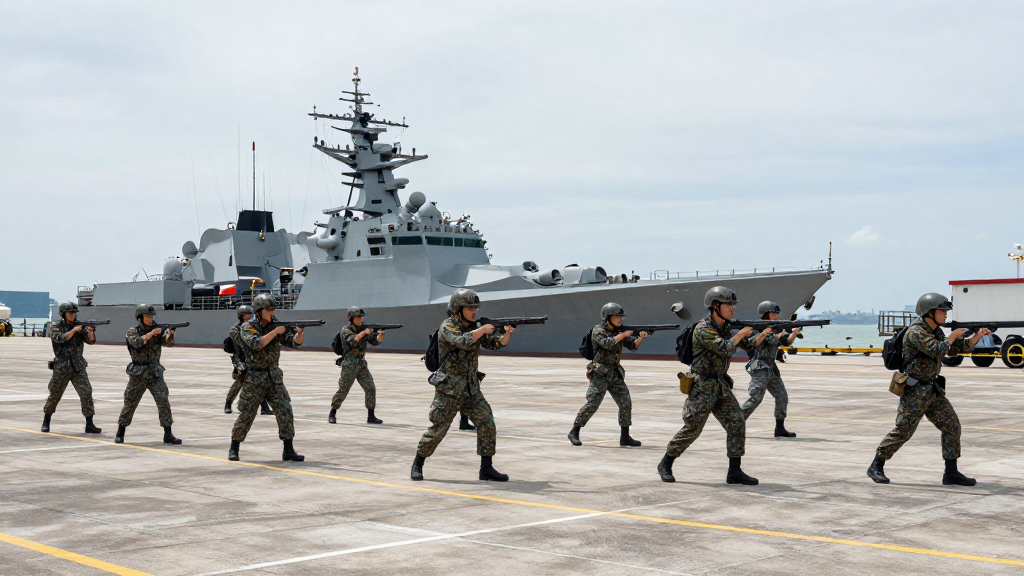
Japan fired a surface-to-ship missile from Philippine territory on Thursday in what military analysts called the first overseas offensive missile launch by Tokyo’s Self-Defense Forces in eight decades, as China simultaneously deployed its Liaoning aircraft carrier and a Type 055 guided-missile destroyer to waters east of Luzon in a direct counter-demonstration to the allied exercises unfolding across the South China Sea.
The back-to-back military salvos — Japan’s live-fire test and China’s carrier drill — turned the final day of this year’s Balikatan exercises into the most charged single day of the 2026 Indo-Pacific security calendar, with two of the region’s most consequential actors revealing the depth of their strategic rivalry through parallel displays of precision firepower and naval projection.
Japan’s Historic Missile Launch
It took less than six minutes for Japan’s Type 88 surface-to-ship missile to strike a decommissioned Philippine warship 75 kilometers off the coast of Ilocos Norte, according to the exercise command. The target was hit at a range considered well within the envelope of the system Tokyo has steadily expanded the operational authority to deploy since landmark security legislation passed in 2014. The Tomahawk cruise missile, launched from a US Army Typhon system positioned on Philippine soil for the first time since its deployment more than two years ago, struck a separate target at a range of approximately 630 kilometers.
The volley of missiles — fired from sites in the far northern Philippines by Japanese, American and Filipino troops — brought the 2026 Balikatan exercises to a thunderous close and underscored the breadth of the security integration taking shape among the three allies. This year’s drills were notably unprecedented in scope, with live-fire ranges spanning the Ilocos coast, the South China Sea approaches and areas in close proximity to Taiwan.
“The message of the exercise is clear,” said Chris Gardiner, chief executive of the Institute for Regional Security in Canberra. “‘Not today’ — now is not the time to use force against the Philippines or to change the status quo around Taiwan.”
China’s Carrier Group Response
China’s People’s Liberation Army had announced on Friday that a naval fleet had held exercises in waters east of Luzon — the northernmost major island of the Philippines — led by the Type 055 guided-missile destroyer Zunyi. The drills were described as “a necessary action taken in response to the current regional situation,” language that regional governments widely interpreted as a direct reference to the Balikatan exercises launching the same week.
The Liaoning aircraft carrier, which has completed multiple modernization cycles, appeared among approximately 14 large naval vessels in satellite imagery circulated online, according to analysts monitoring the exercise. The PLA’s Southern Theatre Command, which oversees South China Sea operations, said the fleet had operated in formation as part of a coordinated deterrence demonstration.
Japan’s foreign ministry summoned the Chinese ambassador in Tokyo on Thursday to register a formal protest over what it described as “dangerous escalation of military activity in proximity to allied exercises.” A ministry spokesperson said the missile launch was “defensive in nature and fully consistent with international law.”
Strategic Architecture Redrawn
The overlapping exercises reflect a structural realignment of Indo-Pacific security architecture as nations adapt to a more assertive Chinese footprint in disputed waters. This year’s Balikatan was the largest in the exercise’s history, with participating forces operating across an arc stretching from Luzon through the South China Sea to areas near Taiwan — a geographic spread that officials said was deliberately designed to stress-test the interoperability of the three allies’ command structures.
Analysts at the International Institute for Strategic Studies said the parallel deployments this week demonstrated how the region’s security dynamics had moved from “symbolic coordination to operational integration.” They noted that China’s decision to position a carrier formation in near-direct response to allied drills signaled a willingness to use maritime presence as a political instrument at a time when diplomatic channels between Washington and Beijing remain strained.
Japan’s missile launch drew immediate condemnation from Beijing, with Chinese state media describing it as evidence of “neo-militarism.” Yet Japanese and American officials have argued the exercise and its enhanced scope represent a proportional and transparent response to growing regional instability — and one that serves as a deterrent rather than a provocation. Admiral John Aquilino, commander of US Indo-Pacific Command, said the exercises had demonstrated “the power of integrated deterrence” and shown that Japan’s enhanced regional role was “not theoretical but operationally real.”