In the most significant escalation of Mali’s security crisis in years, rival armed groups including Al-Qaeda-linked jihadists and Tuareg separatists launched a series of coordinated attacks across multiple cities, including the capital Bamako, exposing the fragility of the military government’s grip on power and raising fears of a broader regional collapse.
A Nation Under Coordinated Assault
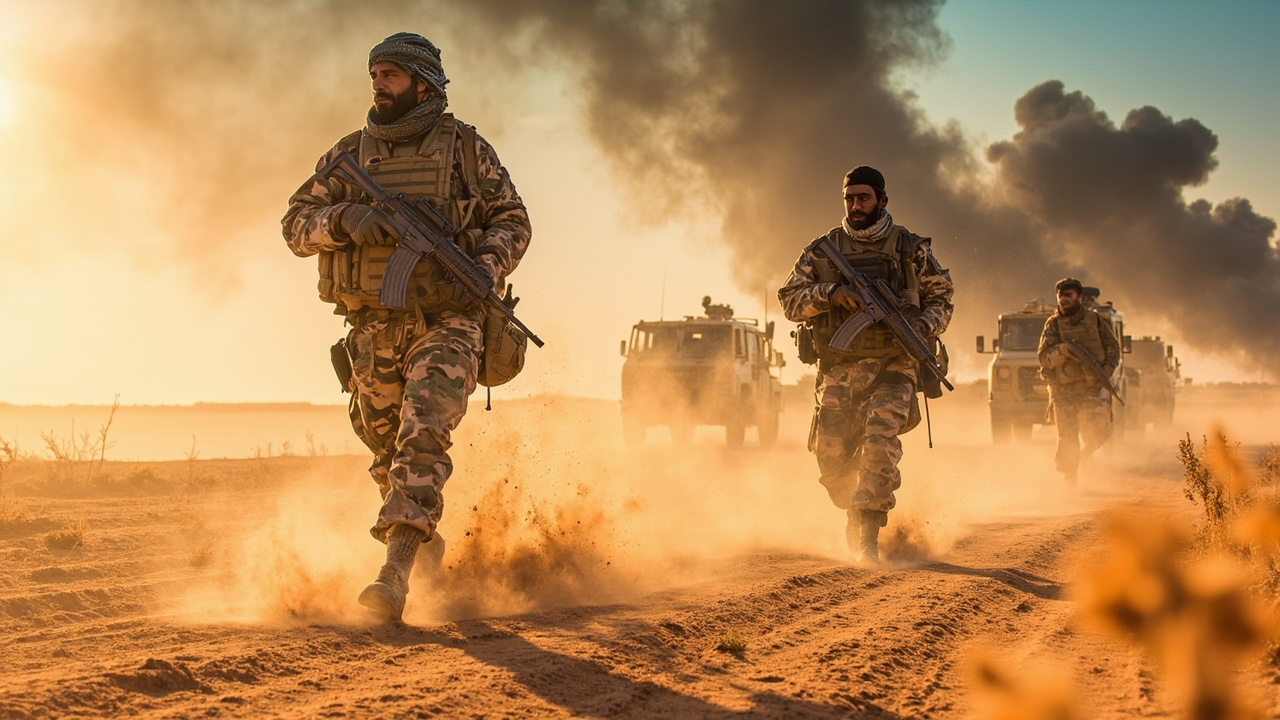
The attacks, which began on Thursday and continued through the weekend, represent an unprecedented level of coordination between armed groups that had previously operated independently or even in opposition to each other. The Jama’at Nusrat al-Islam wal-Muslimin (JNIM), Al-Qaeda’s affiliate in the Sahel, joined forces with Tuareg separatist movements to target military installations, government buildings, and civilian infrastructure across at least six regions.
Witnesses in Bamako described heavy gunfire and explosions near the international airport and a major military barracks on the outskirts of the city. The capital, long considered a relative safe haven in a country wracked by a decade of insurgency, had not experienced attacks of this magnitude in years.
“We heard explosions starting around 4 AM. The shooting went on for hours. The military blocked all the main roads. We could see smoke rising from the direction of the airport,” said Amadou Diallo, a resident of the Banconi neighbourhood in Bamako’s eastern outskirts.
Unholy Alliance: Jihadists and Separatists Unite
Perhaps most alarming for regional and international observers is the tactical alliance between groups with fundamentally different ideologies. JNIM, which seeks to establish an Islamic state governed by a strict interpretation of Sharia law, has historically clashed with Tuareg separatists who demand an independent or autonomous Azawad in northern Mali.
Security analysts say the convergence of these groups reflects a shared immediate enemy: the military junta that seized power in coups in 2020 and 2021, and which has pivoted Mali away from its traditional Western partners toward closer ties with Russia’s Wagner Group, now rebranded as the Africa Corps.
“This is a marriage of convenience against a common foe,” said Dr. Amina Sow, a Sahel security expert at the Institute for Security Studies in Dakar. “Both groups see the junta as weakened — its Russian backers are distracted by the war in Ukraine, and its military campaigns in the north have stalled. The calculation is that divided, they struggle; together, they can overwhelm.”
Casualties and Humanitarian Impact
The full death toll remains unclear, but initial reports from hospital sources and local officials suggest dozens of military personnel and civilians have been killed. The Malian military has acknowledged “terrorist attacks” in several locations but has released limited information, consistent with its tight control of domestic media reporting.
The United Nations Office for the Coordination of Humanitarian Affairs (OCHA) warned that the attacks have displaced thousands of civilians, adding to the already dire humanitarian situation in a country where over 8.6 million people require assistance. Aid organisations reported that supply routes to the north had been cut, threatening food and medical supplies to communities already facing severe food insecurity.
Regional and International Response
The attacks have sent shockwaves through the wider Sahel region. Neighbouring Burkina Faso and Niger — both of which have experienced their own military coups and face active jihadist insurgencies — placed their security forces on high alert. The Economic Community of West African States (ECOWAS) convened an emergency session to discuss the deteriorating situation.
France, the former colonial power whose troops were expelled by the junta in 2022, issued a statement expressing “grave concern” about the security collapse. The United States State Department condemned the attacks and called for “a return to civilian-led governance as the foundation for lasting security.”
Russia’s foreign ministry blamed the attacks on “the failure of Western counter-terrorism policies” and reaffirmed its support for the Malian government. However, sources within the security community suggest that the Wagner/Africa Corps contingent in Mali has been significantly reduced due to commitments in Ukraine, weakening the junta’s military backbone.
The Wagner Factor and the Hollow Promise of Security
Mali’s military government came to power promising to restore security after years of perceived failure by civilian leaders and their French and UN partners. The expulsion of French forces and the MINUSMA peacekeeping mission was framed as a reclaiming of sovereignty. In their place, the junta turned to Russia’s Wagner Group, which deployed an estimated 1,000 fighters to support Malian forces.
Yet the security situation has deteriorated markedly since those decisions. Jihadist groups have expanded their territorial control, now governing or influencing an estimated 40 percent of Malian territory. The alliance with Russia has come at a steep cost — both financial and in terms of civilian casualties, with multiple investigations linking Wagner forces to massacres and human rights abuses in central Mali.
“The junta sold the population a narrative: Russia would bring security where France and the UN had failed. Three years later, the jihadist threat has only grown, and now the country faces a multi-front war against
an unprecedented alliance of armed groups. The promise has proven hollow,” said Paul Melly, a consulting fellow at Chatham House’s Africa Programme.
What Comes Next
Security analysts warn that the coordinated attacks may mark the beginning of a new and more dangerous phase in Mali’s conflict. The demonstrated ability of ideologically opposed groups to cooperate tactically suggests that the threat to the state has evolved beyond what the military regime is prepared to handle.
The coming weeks will be critical. If the armed groups maintain their coordination and press their advantage, Mali could face a scenario where the government controls only major urban centres while vast swathes of the country fall under the governance of a patchwork of jihadist and separatist administrations.
For the international community, the crisis poses a difficult dilemma: how to address a humanitarian catastrophe and a growing terrorist threat in a country whose government has explicitly rejected Western partnership. The answer, so far, has remained elusive.
Sources: Al Jazeera, BBC, Reuters, NPR, The Guardian, UN OCHA, Institute for Security Studies, Chatham House