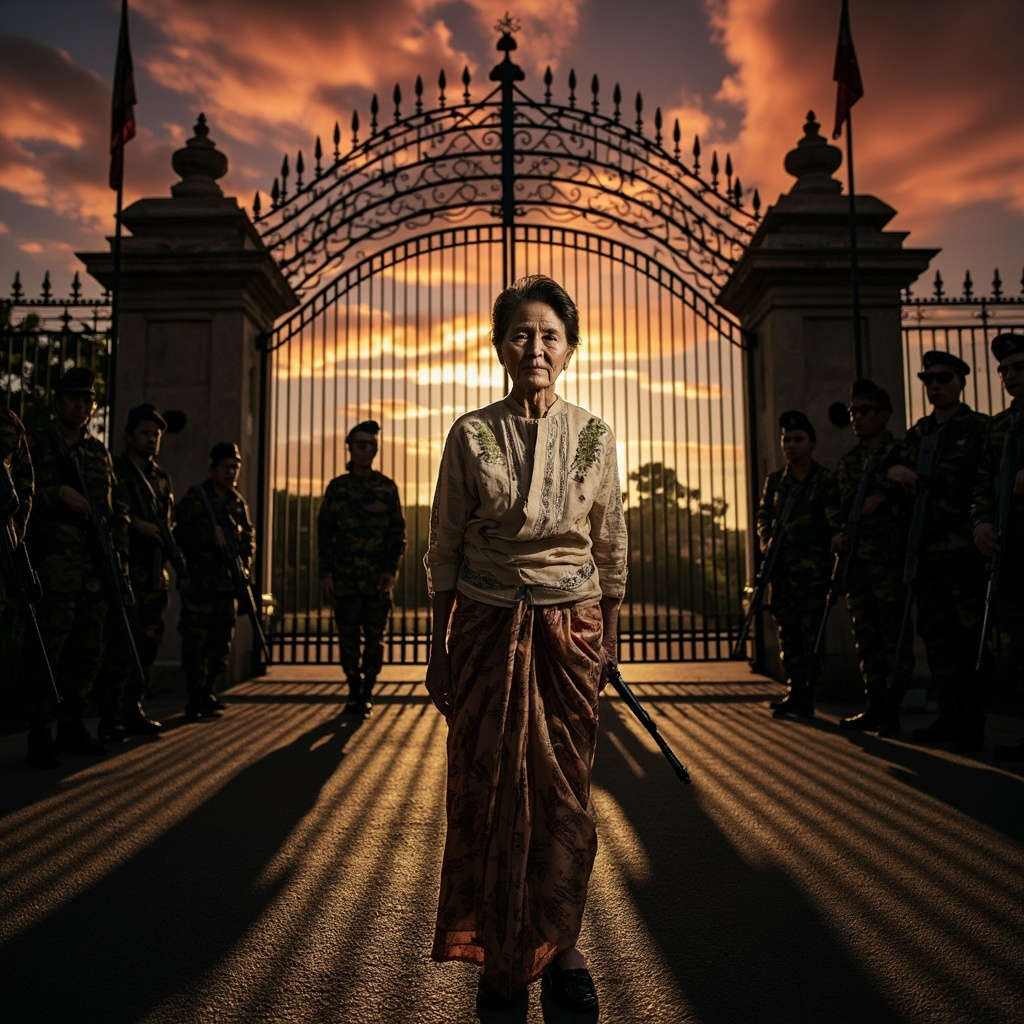
Myanmar’s military junta announced on Wednesday that deposed civilian leader Aung San Suu Kyi has been moved from prison detention to house arrest, a move that has drawn cautious international attention amid ongoing civil conflict.
From Prison to House Arrest
Myanmar’s military authorities confirmed that Aung San Suu Kyi, the 80-year-old Nobel Peace Prize laureate who was ousted in the February 2021 coup, has been transferred from a prison facility to house arrest. The move comes as part of a broader prisoner amnesty announced by the ruling State Administration Council, timed to coincide with a Buddhist religious holiday.
Suu Kyi had been held in solitary confinement at a purpose-built detention facility in the capital, Naypyidaw, since being sentenced to a total of 27 years in prison on multiple charges ranging from corruption to violating COVID-19 protocols. International observers have consistently condemned the charges as politically motivated.
Conditions of the Transfer
According to military officials, Suu Kyi was moved to a government residence under armed guard. While house arrest represents a relative improvement over prison conditions, rights groups emphasize that she remains entirely cut off from political life and the outside world. Her legal team has been denied access to her for months, and her communications are strictly controlled.
The junta has not specified the duration of the house arrest or whether it signals any broader political shift. Analysts remain skeptical that the move indicates genuine liberalization, pointing to the military’s continued brutal crackdown on pro-democracy forces across the country.
Ongoing Civil War
Myanmar remains engulfed in a devastating civil conflict that has killed tens of thousands since the 2021 coup. The military has faced coordinated resistance from a patchwork of ethnic armed organizations and the pro-democracy People’s Defense Forces (PDF), which emerged in response to the junta’s violent suppression of peaceful protests.
In recent months, anti-junta forces have made significant territorial gains in northern Shan State, Rakhine State, and parts of central Myanmar. The military has responded with increasingly indiscriminate air strikes and village burnings, displacing over 3 million people according to United Nations estimates.
International Reaction
The United Nations Special Rapporteur on Myanmar issued a statement urging the international community not to interpret the house arrest transfer as meaningful reform. “Aung San Suu Kyi remains arbitrarily detained,” the statement read. “This is a cosmetic gesture by a regime that continues to commit widespread atrocities against its own people.”
The United States, European Union, and ASEAN bloc have maintained sanctions against the junta, though diplomatic efforts to resolve the crisis have stalled. China and India, Myanmar’s largest neighbors, continue to engage with the military leadership while managing refugee flows and border security concerns.
What Happens Next
With Suu Kyi sidelined and her National League for Democracy party effectively banned, Myanmar’s political future remains deeply uncertain. The military has announced plans for elections in 2027, but critics dismiss the timeline as a sham designed to legitimize continued military rule.
For millions of Myanmar citizens displaced by fighting, the fate of one elderly politician offers little comfort. Yet Suu Kyi remains a powerful symbol of democratic hope for many inside the country, and her continued detention — even in modestly improved conditions — underscores the junta’s refusal to entertain genuine political dialogue.