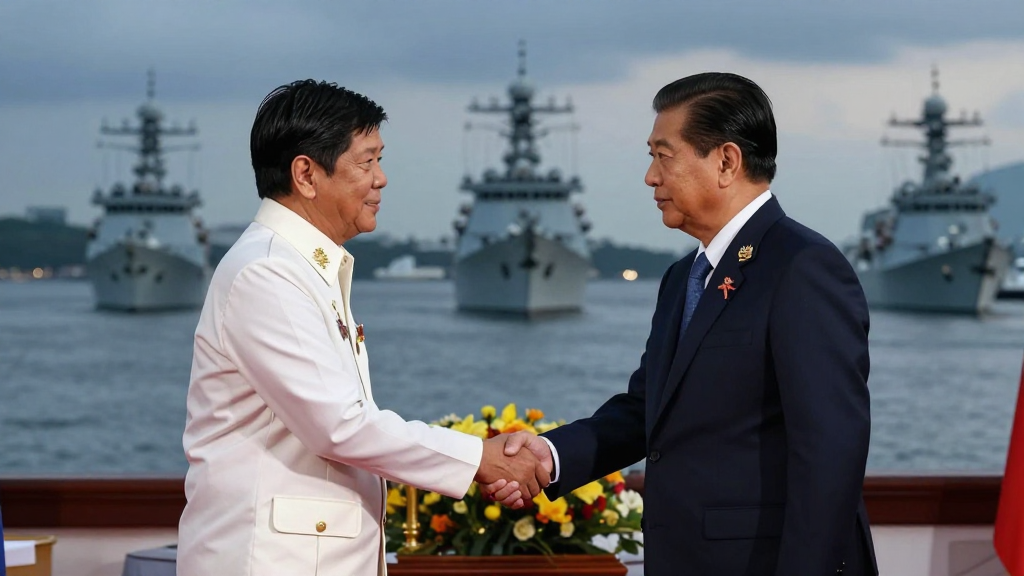
President Ferdinand Marcos Jr. of the Philippines and Vietnamese President To Lam declared South China Sea peace a “non-negotiable” shared interest on Monday, as the two nations elevated their diplomatic relationship to an enhanced strategic partnership during Lam’s two-day state visit to Manila.
The announcement, made at a joint press conference at Malacanan Palace, marked the first-ever state visit by a Vietnamese Communist Party leader to the Philippines. The leaders signed multiple bilateral agreements covering defense cooperation, maritime security, trade, and people-to-people exchanges, officials said.
South China Sea Peace Declared Non-Negotiable
Speaking alongside Lam, Marcos said the elevation of the partnership “reaffirms Vietnam’s unique and enduring position as the sole strategic partner of the Philippines in Southeast Asia.” Both leaders reaffirmed that maintaining peace, stability, and freedom of navigation in the South China Sea “remains non-negotiable” for both nations.
“We always wish to work closely with the Philippines to further elevate our strategic partnership to a greater height with ever increasing substance, comprehensiveness and effectiveness,” Lam said through an interpreter.
The visit falls one week before the 50th anniversary of the establishment of diplomatic relations between Hanoi and Manila on July 12, and comes 10 years after the two nations first upgraded ties to a strategic partnership in 2016, driven largely by shared concerns over China’s assertive behavior in the South China Sea.
ASEAN Chairmanship Tests Regional Unity
The timing of the announcement is significant. The Philippines holds the rotating ASEAN chairmanship in 2026 and has made the conclusion of a South China Sea Code of Conduct a centerpiece of its diplomatic agenda. Foreign Secretary Maria Theresa Lazaro publicly targeted a year-end deal, while privately acknowledging that fundamental definitions — including what constitutes self-restraint — remain unresolved after nearly a decade of negotiations.
Analysts close to the process regard a binding 2026 agreement as unlikely, given the gap between Manila’s insistence on UNCLOS-consistent, legally binding language and Beijing’s preference for a looser, non-binding framework.
ASEAN remains internally divided on the issue. Thailand has pressed for pragmatic re-engagement with Beijing, while Vietnam and the Philippines have sought to preserve language consistent with international law. Malaysia has signaled it will block any code language that references China’s own maritime boundary claims in ways that would legitimize Beijing’s sweeping U-shaped line.
China’s Foreign Ministry said Beijing viewed the Philippines-Vietnam partnership as “a bilateral matter” but warned that “external forces” should not interfere in regional disputes. The United States welcomed the announcement, with a State Department spokesperson saying enhanced ASEAN unity “strengthens the rules-based order in the Indo-Pacific.”
Military Cooperation Deepens Amid Tensions
Beyond the diplomatic declaration, the two nations signed a new defense cooperation agreement that includes provisions for joint coast guard patrols, information sharing on maritime violations, and port calls by naval vessels. The accord builds on a 2024 maritime cooperation framework and comes as both nations face escalating confrontations with Chinese vessels in disputed waters.
The Philippines has reported more than 40 incidents involving Chinese coast guard ships at Scarborough Shoal and Second Thomas Shoal this year. Vietnam has documented a sharp increase in Chinese survey vessels operating near its offshore oil blocks in the central South China Sea.
Regional security analysts said the timing of the Lam visit and the elevation of the partnership reflected a broader realignment in Southeast Asian defense thinking, with traditional ASEAN neutrality giving way to more explicit balancing behavior.
The enhanced strategic partnership builds on a 2024 maritime cooperation framework that included provisions for real-time maritime information sharing between the Philippine Coast Guard and Vietnam Fisheries Coast Guard.
“The era of strategic hedging is giving way to something more direct,” said one analyst at a Manila-based think tank who tracks South China Sea developments. “Both Manila and Hanoi have concluded that the cost of ambiguity now exceeds the cost of alignment.”
The enhanced strategic partnership builds on a 2024 maritime cooperation framework that included provisions for real-time maritime information sharing between the Philippine Coast Guard and Vietnam Fisheries Coast Guard.