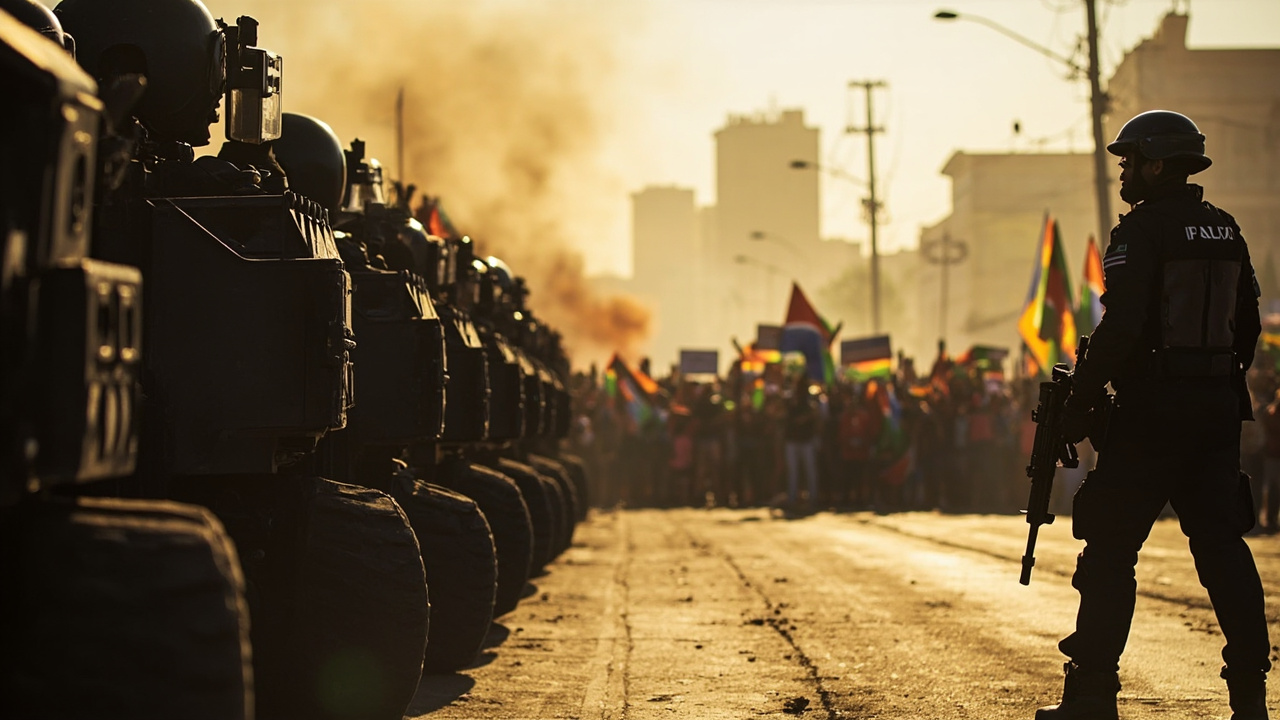
South African cities deployed security forces across key provinces on Tuesday as anti-immigration protests swept through Johannesburg, Durban and Cape Town, with authorities scrambling to prevent violence on the day an ultimatum from activist groups demanding the expulsion of undocumented migrants took effect. Police and the South African National Defence Force were visible on major thoroughfares as authorities warned that any outbreak of xenophobic violence would be met with the full force of the law.
President Cyril Ramaphosa met with protest organisers on the eve of the demonstrations in a bid to reduce tensions, urging participants to exercise their right to protest “without intimidation, threats or ultimatums.” More than three million documented foreign nationals live in South Africa, according to official figures, though advocacy groups estimate hundreds of thousands more are in the country without valid papers. Police said they had arrested roughly 50,000 migrants since January on immigration violations.
Authorities Clear Transit Camps Ahead of Demonstrations
In Durban, workers dismantled white tents housing mostly Malawian migrants as authorities raced to clear transit camps before the demonstrations began. The city’s central business district was largely shut down, with most shops locked and security personnel patrolling the streets. Police said five people were arrested in Johannesburg’s Soweto township for allegedly looting a shop owned by a foreign national, and five more were detained in Hammarsdale, KwaZulu-Natal, for breaking into a tuck shop.
South African police said approximately 25,000 migrants had been repatriated since the beginning of the year, the majority from other African nations. Malawian authorities confirmed roughly 7,000 of their nationals had been returned under an accelerated voluntary repatriation programme. The clearance of the Durban camp was underway as officials sought to prevent migrants already displaced by earlier threats from being caught up in Tuesday’s protests.
The government of Zambia said it was preparing to receive an unspecified number of nationals following the demonstrations. “Some foreign nationals who live in South Africa are here lawfully,” Ramaphosa wrote in a weekly newsletter published before the protests. “They are working, studying, raising families, investing in our economy and contributing positively to our society. They too are entitled to the protection of our laws and our Constitution.”
International Rights Groups Warn of Climate of Fear
Human rights organisations said the protests had already driven a climate of fear among migrant communities in the weeks leading up to the demonstrations. Several advocacy groups said they had documented cases of targeted harassment, including physical assaults and the burning of informal settlement structures, in areas where protest organising had been most intense. The United Nations High Commissioner for Refugees called on South African authorities to uphold their international obligations and protect all residents regardless of status.
The ultimatum issued by the activist group March and March had set June 30 as a deadline for undocumented migrants to leave the country voluntarily, a demand the government publicly rejected as unlawful. Ramaphosa reiterated that immigration enforcement was the exclusive preserve of the state and warned that “the right to protest and freedom of expression do not allow people to threaten or intimidate others, or to engage in acts of vandalism or violence.”
The protests drew condemnation from several African governments whose nationals were among those most at risk. Mozambique’s foreign ministry summoned the South African ambassador to protest the targeting of Mozambican migrants in previous incidents. Nigerian officials said they were monitoring the situation closely and preparing contingency plans for their citizens who wished to return.
Security Operation Carries Steep Financial Cost
The government operation to secure major cities was estimated to cost approximately R600 million, according to figures cited by officials, reflecting the scale of concern about potential unrest. Security analysts noted that the simultaneous deployment of police and defence force assets was unusual outside of declared states of emergency and underscored the severity of the threat assessment.
Johannesburg’s normally bustling central business district wore an eerie calm as marchers gathered at designated points under heavy police surveillance. In Cape Town, authorities closed several roads near parliament as a precautionary measure. The South African_rand weakened against major currencies in early trading, with analysts citing investor jitters over the political instability as a contributing factor.
Regional observers warned that the protests risked damaging South Africa’s international standing at a moment when the country was seeking increased foreign direct investment. The timing was particularly delicate given ongoing negotiations over a major infrastructure investment package with European partners, they noted. Government officials said Ramaphosa would address the nation following the conclusion of Tuesday’s demonstrations to outline next steps.