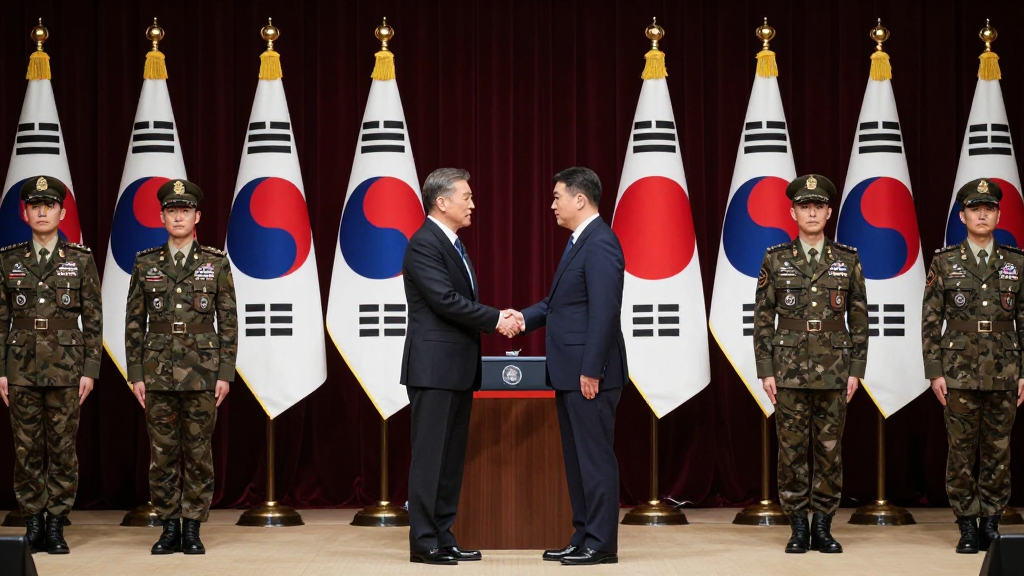
South Korea and Japan have agreed to expand bilateral defense cooperation across artificial intelligence, maritime security and joint exercises, their defense ministers announced Sunday, marking the first standalone bilateral meeting between the two countries defense chiefs in eleven years.
South Korean Defense Minister Ahn Gyu-back hosted Japanese Defense Minister Shinjiro Koizumi in Seoul for a two-day visit that produced a joint statement reaffirming both nations commitment to the complete denuclearization of the Korean Peninsula. The agreement comes just days after North Korea conducted tests of a new multiple rocket launcher system and special mission warheads under the direct supervision of leader Kim Jong-un.
Restoring Defense Diplomacy After a Decade
Koizumis visit to Seoul was the first by a Japanese defense minister primarily for bilateral talks since 2015. The two ministers agreed to regularize reciprocal visits and meetings, effectively restoring shuttle diplomacy between the defense authorities of the two countries.
“This meeting represents a significant step forward in our bilateral security relationship,” Koizumi said during a joint press conference. “We have agreed to expand cooperation not only in traditional security domains but also in emerging fields such as artificial intelligence and advanced defense technologies.”
The ministers welcomed the resumption of a bilateral maritime search and rescue exercise for the first time in approximately nine years. They agreed to further develop the exercise protocol to prepare for a wider range of maritime emergencies, including potential incidents in the East China Sea and waters surrounding the Korean Peninsula.
North Korea Tests Escalate Regional Tensions
The deepening of Seoul-Tokyo defense ties comes against a backdrop of accelerated weapons testing by North Korea. On June 25, North Korea fired multiple projectiles between 7:27 a.m. and 8:20 a.m., according to South Koreas Joint Chiefs of Staff. The tests included an upgraded 240mm-caliber 24-tubular multiple rocket launcher system, special mission warheads for tactical ballistic missiles, and extended-range shells for a 155mm self-propelled howitzer.
South Korean defense officials faced criticism over a delayed public disclosure of the launch. Colonel Lee Kyung-ho, deputy defense ministry spokesperson, defended the military response in a press briefing. “South Korea and the United States detected and tracked in real time multiple projectiles launched by North Korea, maintaining close coordination for all contingencies,” Lee said. “We ask people not to undermine the dedication of South Korean and U.S. service members through political interpretations.”
Local media had raised questions about whether the delayed announcement indicated a gap in intelligence-sharing between Washington and Seoul. Ahn and Koizumi reaffirmed the importance of trilateral coordination with the United States to ensure seamless information-sharing on North Korean military activities.
Acquisition and Cross-Servicing Agreement Remains Unresolved
While the meeting produced significant agreements on exercises and technological cooperation, a proposed Acquisition and Cross-Servicing Agreement between the two countries was not formally on Sundays agenda. Such an agreement would allow the two militaries to provide each other with logistical supplies and services, including fuel, food and ammunition.
Japan has repeatedly expressed interest in concluding the ACSA with South Korea. Officials indicated the issue may have been discussed informally despite its exclusion from the official agenda. South Korean President Lee Jae Myung has acknowledged the potential strategic value of such an agreement but has said unresolved historical issues between South Korea and Japan limit Seoul ability to accept it at this time.
Koizumis trip included a visit to the Black Eagles aerobatic unit at Wonju Air Base in Gangwon Province, following earlier refueling support provided by Japans Air Self-Defense Force at Naha Air Base in Okinawa when the Black Eagles traveled to a defense exhibition in Saudi Arabia. The two ministers agreed to expand exchanges between South Koreas Black Eagles and Japans Blue Impulse aerobatic teams as a symbolic gesture of improving bilateral defense ties.
The meeting followed an earlier encounter between Ahn and Koizumi on the sidelines of the Shangri-La Dialogue in Singapore in late May. Sundays agreement establishes a framework for regular defense ministerial meetings going forward, a structure that analysts say will help manage the complex security challenges facing Northeast Asia.