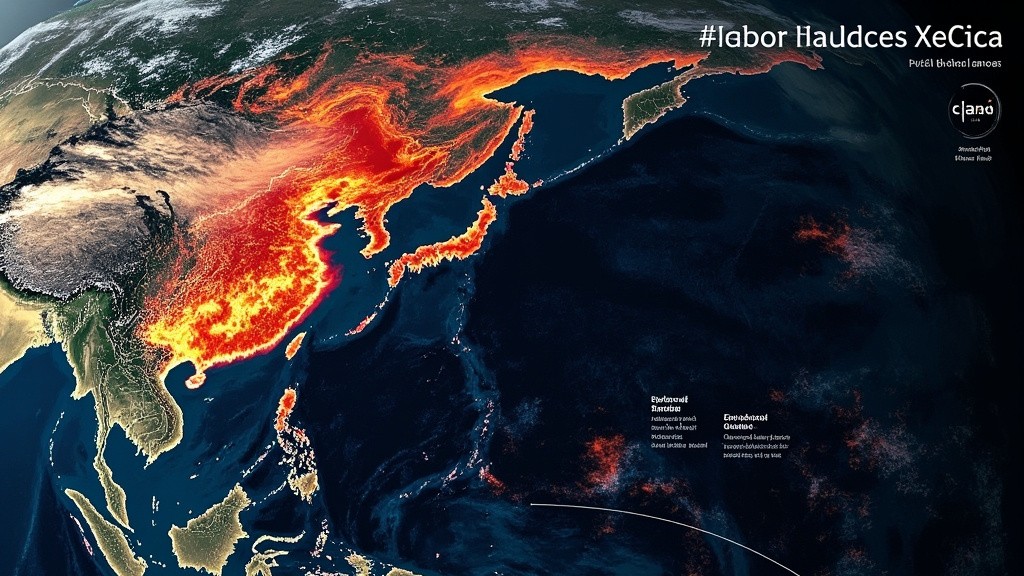
Scientists at the National Oceanic and Atmospheric Administration confirmed on May 12, 2026, that the El Niño Southern Oscillation has entered its strongest phase since instrument records began in 1950, triggering a cascade of extreme weather events across the Pacific basin and prompting emergency declarations in at least six countries.
The declaration, issued after a sustained period of sea surface temperature anomalies exceeding 2.5 degrees Celsius above the long-term average in the Niño 3.4 region, places the current event in a category that researchers have only theorised about in climate models. The previous strongest El Niño, recorded in 1997–98, peaked at approximately 2.3 degrees Celsius above average and caused an estimated $36 billion in global damages.
> “We are in uncharted territory. The atmospheric coupling we’re seeing between the Pacific warm pool and the Walker circulation is stronger than anything in the observational record.”
> — Dr. Kevin Trenberth, distinguished scholar, National Center for Atmospheric Research
The Pacific warm pool — a vast body of anomalously warm water stretching from the International Date Line to the coast of South America — has expanded eastward by approximately 4,000 kilometres since January, according to satellite-derived sea surface temperature data published by the Japan Meteorological Agency. This eastward expansion is the primary mechanism driving the intensified rainfall patterns now affecting Indonesia, Australia, and the western coast of South America.
Quantifying the Anomaly
The scale of the current warming has prompted a recalibration of the Oceanic Niño Index, the standard metric used by NOAA to classify El Niño events. Events are typically categorised as weak (0.5–0.9°C), moderate (1.0–1.4°C), strong (1.5–1.9°C), or very strong (≥2.0°C). The current anomaly, sustained for three consecutive three-month overlapping periods, has exceeded 2.5°C.
| Metric | Value |
|—|—|
| Niño 3.4 anomaly (May 2026) | +2.6°C |
| Duration above 2.0°C | 9 months |
| Pacific warm pool eastward expansion | ~4,000 km |
| Countries with emergency declarations | 6 |
| Estimated 2026 global agricultural losses | $18–24 billion |
| Australian wheat production reduction | −34% |
| Indonesian palm oil output reduction | −22% |
| Peruvian anchovy catch reduction | −67% |
Australian Bureau of Meteorology officials said the country’s winter wheat crop, which accounts for approximately 12 percent of global exports, is now projected to decline by more than a third from the five-year average. The Murray–Darling Basin, which supplies irrigation water to roughly 40 percent of Australia’s agricultural production, has received less than 30 percent of its typical rainfall since March.
Regional Impacts and Government Responses
Indonesia’s National Disaster Mitigation Agency reported that more than 340,000 people have been displaced by flooding in Java and Sulawesi since late April, with the capital Jakarta experiencing its most severe inundation since 2013. President Prabowo Subianto authorised the deployment of military engineering units to reinforce flood barriers along the Ciliwung River.
In Peru, the Ministry of Production declared a 90-day emergency in the northern anchovy fishing grounds after catch volumes fell to their lowest May level in four decades. The anchovy fishery is a critical input for global fishmeal production, which in turn supports aquaculture operations across Southeast Asia and salmon farming in Norway and Chile.
> “The biological productivity of the Humboldt Current system has collapsed. We’re seeing mass mortality events in seabird colonies that depend on anchovy schools. This is an ecological shock, not just an economic one.”
> — Dr. Patricia Majluf, marine biologist, Peruvian Centre for Marine Studies
The government of Papua New Guinea, where highland regions have experienced crop failures due to frost damage at altitudes that typically remain frost-free, requested international food assistance on May 11. The United Nations World Food Programme confirmed it was pre-positioning emergency grain stocks in Port Moresby.
Climate Context and Outlook
Climate researchers cautioned against interpreting the current event as a permanent shift in baseline conditions, but several noted that the intensity was consistent with long-term projections of El Niño behaviour under sustained global warming. A 2024 study published in Nature Climate Change found that the probability of “extreme El Niño” events — defined as anomalies exceeding 2.0°C — had approximately doubled since the pre-industrial era.
NOAA’s Climate Prediction Centre said in its May monthly outlook that there was a 75 percent probability the current event would persist through the Northern Hemisphere autumn, with a 45 percent probability of extending into the early winter. If the event does persist into December, it would overlap with the peak of the Atlantic hurricane season and the North American winter storm season, creating compound weather risks that emergency management officials in the United States described as “unprecedented in modern planning horizons.”
The Australian government, which has already activated its National Drought Response Framework for the third time in five years, announced on May 12 that it would seek emergency authorisation to import wheat from Argentina and Ukraine to stabilise domestic flour prices. The decision marks the first time Australia has been a net wheat importer since the 2007–08 global food price crisis.
Sources: National Oceanic and Atmospheric Administration; Japan Meteorological Agency; Australian Bureau of Meteorology; Indonesian National Disaster Mitigation Agency; Peruvian Ministry of Production; United Nations World Food Programme; Nature Climate Change (2024).