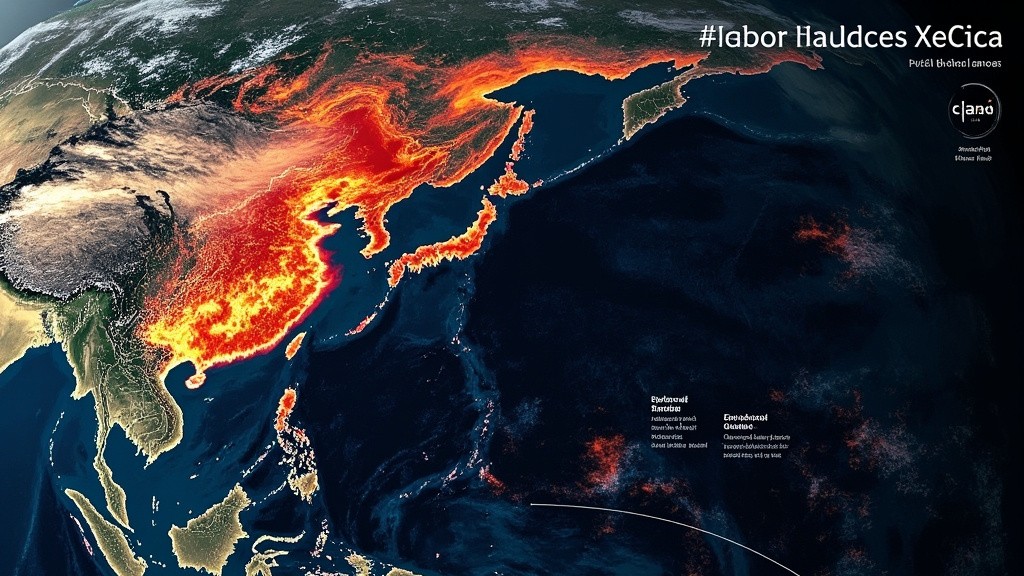
The World Meteorological Organization confirmed on May 12 that sea surface temperatures across the central and eastern Pacific have exceeded the previous record set in 1997–98 by a margin scientists describe as “alarming,” triggering simultaneous extreme weather events across every inhabited continent and affecting an estimated one billion people.
The Science of What Is Happening
El Niño events occur when trade winds that normally blow westwards across the Pacific weaken or reverse, allowing warm water to accumulate in the eastern Pacific rather than being pushed toward Asia. In a Super El Niño, this warm water pool extends further than usual and reaches temperatures 2–3°C above the threshold for a standard event.
The 2025–2026 event has produced sea surface temperature anomalies of +3.1°C in the Niño 3.4 region — the key measurement zone — according to the National Oceanic and Atmospheric Administration’s latest buoy array data. The previous record of +2.6°C was set in December 1997.
“We are witnessing something that climate models projected would not occur until the 2040s under high-emission scenarios. The speed and intensity of this event is extraordinary.”
— Dr. Amara Ndegwa, Director of Climate Sciences, World Meteorological Organization
Global Impacts in Profile
In East Africa, where the long rains failed for the third consecutive year, the Intergovernmental Authority on Development warned that 28 million people in Ethiopia, Kenya, and Somalia face acute food insecurity. The Kenyan government declared a national emergency on April 28.
In South Asia, an intense monsoon season has produced flooding across Bangladesh, Nepal, and the Indian state of Bihar. The UN Office for the Coordination of Humanitarian Affairs reported 14.3 million people displaced — the largest internal displacement event since records began.
“This is not a regional disaster. The infrastructure of global agriculture, supply chains, and water systems was designed for a stable climate. We are testing that infrastructure in ways we have never tested before.”
— Professor Linh Nguyen, Chair of Climate Systems, Massachusetts Institute of Technology
Quantifying the Human Toll
| Metric | Value |
|---|---|
| People directly affected | ~1.0 billion |
| Countries with emergency declarations | 43 |
| Global economic damage (to date) | est. $890 billion |
| Food-insecure people (acute) | ~320 million |
| Internal displacements (2026) | ~22 million |
| WMO Intensity Category | Category 4 (highest) |
| Sea surface temp anomaly (Niño 3.4) | +3.1°C |
The financial costs already exceed the combined impact of the 1997–98 and 2015–16 Super El Niño events adjusted for inflation. The agricultural sector has been hardest hit, with crop failures in sub-Saharan Africa and Southeast Asia reducing global cereal production by an estimated 4.2 percent.
The Policy Failure Question
Climate scientists and policy analysts have spent the past year grappling with why the world failed to prepare for an event that was, in retrospect, predictable with months of advance warning. NOAA and the WMO provided high-confidence predictions of a major event by mid-2025. Yet the institutional capacity to act — to pre-position food aid, accelerate harvest cycles, prepare coastal infrastructure — was fragmented across dozens of governments with no coordinating authority.
“The science gave us a gift. We had months of warning. What we lacked was the governance architecture to use it.”
— Former UN Secretary-General’s Special Envoy on Climate
Whether the international system can rebuild that capacity in time for the next Super El Niño — which models suggest could arrive within the decade — remains the defining unanswered question of this decade’s climate politics.