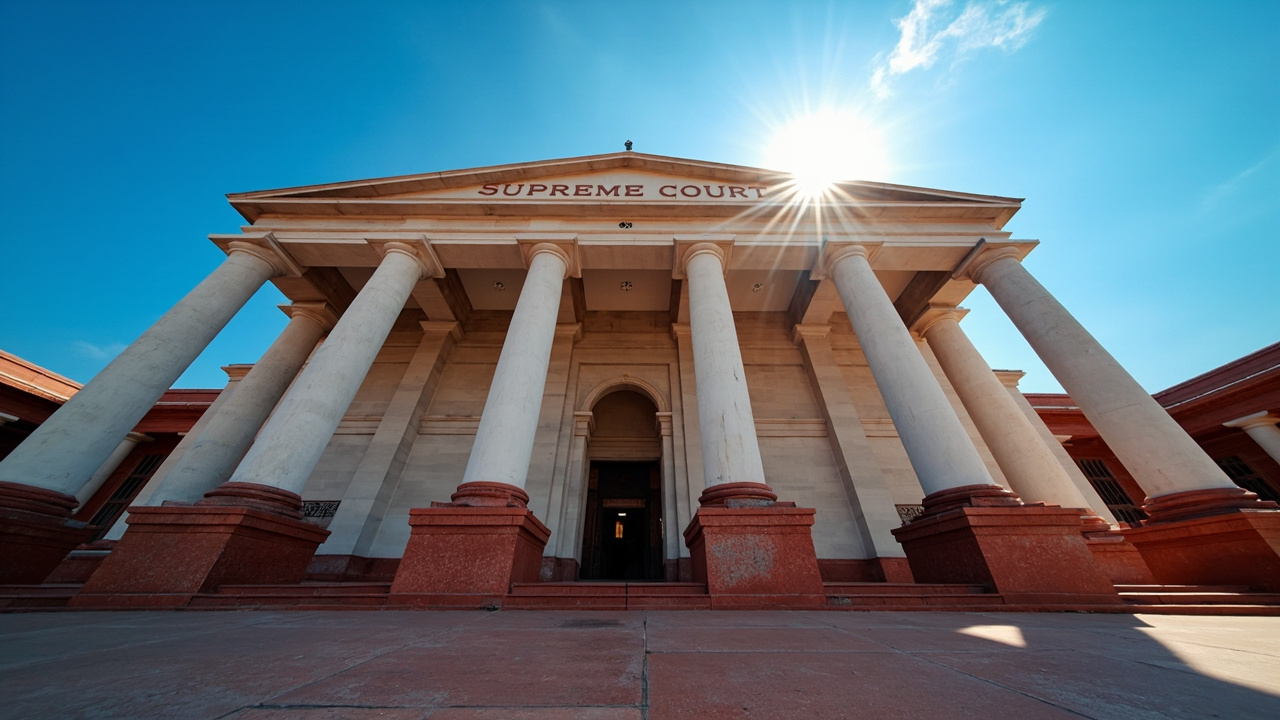
India’s Supreme Court on Saturday dismissed the Trinamool Congress’s petition challenging the Election Commission’s deployment of central government staff at West Bengal vote-counting centres, delivering a significant setback to Mamata Banerjee’s party 36 hours before results are declared on May 4.
Court Rules EC Circular ‘Not Incorrect’
A three-judge bench headed by Chief Justice Sanjiv Khanna ruled that the Election Commission’s circular appointing central government employees as counting supervisors was “not incorrect” and did not violate any constitutional provision. The ruling clears the way for the deployment of central staff across West Bengal’s districts for counting day on Monday.
Attorney General R. Venkataramani, representing the Election Commission, argued that the administrative decision was within the commission’s powers under Article 324 of the Constitution to ensure free and fair elections.
The Election Commission has wide powers under Article 324 to take all necessary steps to ensure free and fair counting. The circular in question is within those powers and does not warrant judicial interference at this stage.
— Supreme Court order, May 3, 2026
TMC Reaction and Political Fallout
TMC leader Derek O’Brien called the ruling “disappointing but not unexpected,” saying the party would accept the court’s verdict. “We respect the Supreme Court. Our lawyers will study the full order and advise accordingly,” O’Brien told reporters outside the court complex.
The TMC had filed an urgent petition arguing that replacing state government employees — many of whom have served in counting supervisor roles for years — with central staff who report to the Union government created a “structural bias” in favour of the BJP.
What happened today is a political earthquake in West Bengal. The Supreme Court has, in effect, endorsed the central government’s right to appoint counting supervisors in a state where it is a contesting party. That’s unprecedented.
— Prof. Sabyasachi Basu, political analyst, Jadavpur University
What Happens on May 4
With the legal route exhausted, all eyes now turn to counting day on Monday. The Election Commission has deployed micro-observers in addition to central staff, and has mandated live-streaming of vote-counting across the majority of West Bengal’s districts.
The commission also announced that representatives from all major political parties would be given “real-time access” to count data through a secure digital portal, a measure designed to address transparency concerns raised by the TMC.
Votes were cast on April 22 and 29 across 18 states in India’s 2026 assembly elections. West Bengal, which accounts for the largest single block of seats going to the polls this cycle, is seen as a bellwether for national political sentiment ahead of the 2027 general elections.
Key Takeaways
- The Supreme Court dismissed TMC’s petition, ruling the EC’s central staff deployment was lawful
- The ruling clears the way for central government employees to supervise vote counting on May 4
- TMC accepts the verdict but raises continued concerns about the fairness of the process
- Exit polls predict a significant BJP gain; the TMC is fighting to retain its majority
- Live-streaming and a digital data portal aim to provide transparency assurances to all parties
Background
West Bengal’s 2026 assembly elections were conducted in two phases on April 22 and April 29, with a turnout of approximately 78 percent. The BJP contested on a platform of economic development and infrastructure investment, while the TMC emphasised its track record on social welfare schemes.
The legal battle centred on a technical but consequential question: who controls the counting process? Under India’s electoral framework, state government employees typically serve as counting supervisors, supervised by Election Commission observers. The EC’s April 30 circular unilaterally changed this arrangement in West Bengal.
The Supreme Court’s Saturday ruling settles the question. What remains is the political battle — and on that front, the TMC and the BJP are preparing for a result that could redefine the political map of eastern India.