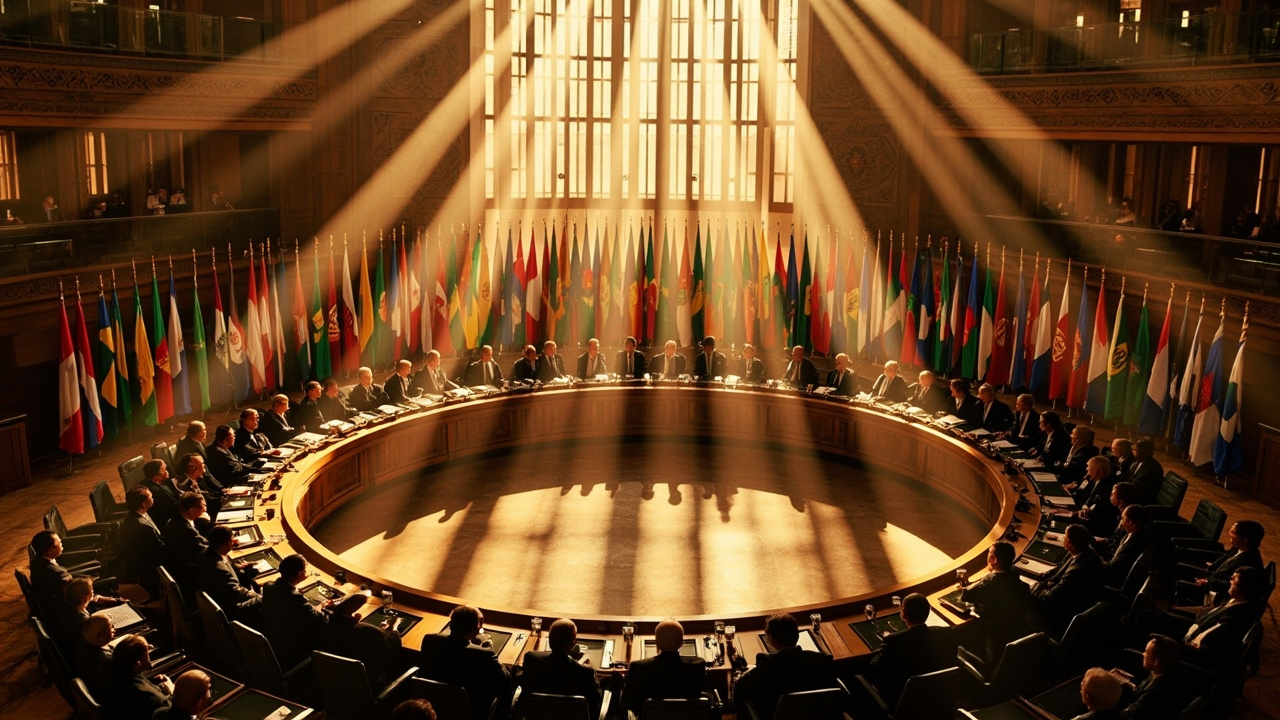
JOHANNESBURG, South Africa — When the G20 summit opens in Johannesburg in late 2026, it will convene leaders from economies representing 85 percent of global GDP — and almost none of them will be aligned on the fundamental question of the decade: what should replace the liberal international order that defined the post-Cold War era? The fractures that were once theoretical have become concrete fault lines running through the world’s most powerful institutions, alliances, and trade relationships.
November 2026 finds the G20 less as a coordinating body and more as a spectacle of managed disagreement — a global stage where competing visions of the world order perform their divergence in public while cutting private deals behind closed doors.
The Core Fracture: West vs. the Rest
The deepest split at Johannesburg will be between the United States and its allies on one side, and a loose but increasingly coordinated coalition of BRICS+ nations on the other. This division is not simply ideological — it reflects genuine disagreements about the rules of the global economy. Washington wants to preserve the dollar’s reserve currency status while using secondary sanctions to enforce its own foreign policy objectives. Beijing and Moscow want a multipolar financial architecture in which the dollar is one of several reserve currencies and multilateral institutions reflect genuinely distributed power.
“We are not trying to replace the dollar. We are building infrastructure that makes the dollar’s weaponisation irrelevant. When you can settle trade in your own currency through a system you control, sanctions become a paper tiger.” — Senior BRICS official, speaking on condition of anonymity, April 2026
The European Dilemma
For Europe, the Johannesburg summit represents a moment of painful self-reckoning. The European Union arrives with its own proposal for a “structured multipolar engagement” framework — a concept that would give BRICS+ nations formal seats in economic governance discussions in exchange for adherence to baseline rules on labour standards, environmental regulations, and human rights. The proposal is diplomatically elegant but practically weak: it offers a seat at a table that the BRICS+ nations increasingly view as obsolete.
Germany faces a particularly acute dilemma. The German automotive and industrial sectors depend heavily on Chinese market access, while the German foreign ministry remains committed to the transatlantic relationship with Washington. These two imperatives are increasingly in tension — the United States has explicitly warned European allies that cooperation on technology export controls will be conditional on their willingness to take harder positions on Chinese investment in European critical infrastructure.
Middle Powers Chart Their Own Course
Perhaps the most significant development heading into Johannesburg is the degree to which middle powers have stopped treating the G20 as a forum for resolving great-power disputes and started using it as a venue for building their own coalitions. South Africa, the summit host, has used its position to elevate the African Union’s role in global economic governance — a priority that aligns with the continent’s growing demographic and resource weight.
Saudi Arabia’s position is particularly closely watched. Crown Prince Mohammed bin Salman’s Vision 2030 programme has made Riyadh dependent on Western investment flows and technology partnerships — but also increasingly connected to Chinese infrastructure financing and Russian energy policy coordination through OPEC+. The Kingdom has been careful not to choose sides, building a network of economic relationships that keeps all major powers invested in Saudi stability.
What Johannesburg Can and Cannot Deliver
The Johannesburg summit will produce a communique. It will contain language about “strengthening multilateral trade,” “addressing climate finance gaps,” and “promoting inclusive growth.” These are the language of summit diplomacy — broad enough to be signed by everyone, empty enough to commit no one.
The real business of Johannesburg will happen in bilaterals: the US-China meeting on the margins, the EU-India trade deal that has been in negotiation for three years, and the potential Saudi-Chinese investment framework that could reshape Gulf economic relations. What the summit cannot deliver is consensus on the structural question underlying every disagreement: who gets to write the rules of the global economy, and by what process? That question has no answer at Johannesburg because the answer is being contested in capital cities, in financial markets, and on naval patrol routes from the South China Sea to the Strait of Hormuz.
Elena Rodriguez is an International Affairs Correspondent for Media Hook, covering global diplomacy, conflict, and the emerging world order.