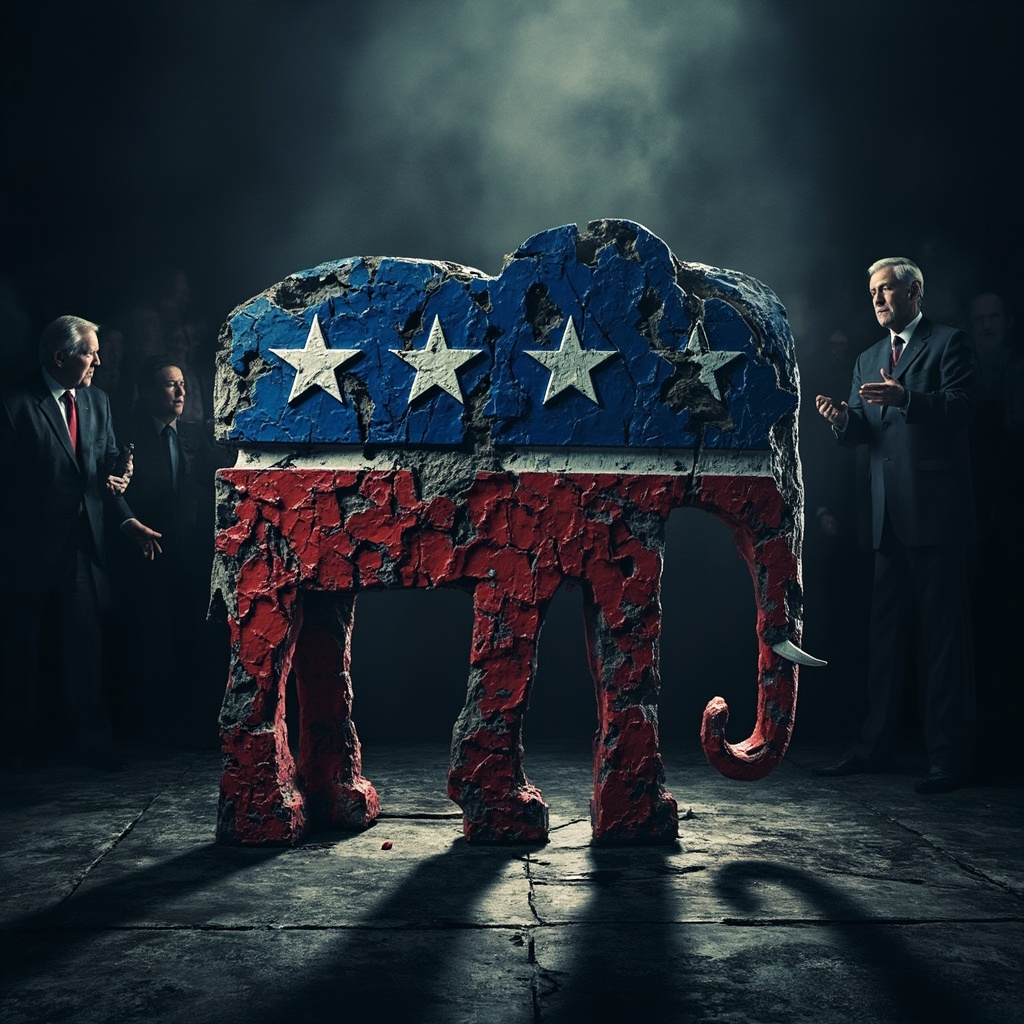
The 2026 midterm elections are still months away, but the Republican Party is already in crisis. Not a crisis of policy or ideology — a crisis of identity. As Trump’s approval ratings continue to slide and the political landscape shifts beneath their feet, GOP candidates across the country are doing something remarkable: they are running away from the very figure who, two years ago, seemed untouchable.
The signs have been visible for months. Poll after poll shows Trump underwater with independent voters. Fundraising numbers for Republican challengers tell the same story — donors are hedging, bundlers are nervous, and operatives are quietly rewriting their playbooks. The result is a midterm strategy that can only be described as political amnesia on an industrial scale.
The Great Un-Endorsement
Walk through any competitive congressional district and you will find Republican candidates doing something that would have been unthinkable in 2024: actively distancing themselves from the man they once called the greatest president in American history. They are not attacking Trump — that would be politically suicidal with the base — but they are conspicuously silent. No rallies. No endorsements. No mentions on the campaign trail.
This is not moderation. It is something far more cynical. These candidates are gambling that Trump’s brand has become a liability, that the voters who propelled him to victory in 2024 are now the voters most likely to stay home. They are betting that the path to victory runs through suburban moderates and independent swing voters — demographics that have soured on Trump sharply since the beginning of his second term.
The strategy carries enormous risk. Alienate the base, and turnout collapses. Embrace Trump too closely, and you lose everyone else. The GOP is trying to thread a needle that may not exist.
The Numbers Don’t Lie
Consider what the polling actually shows. Trump’s approval rating as of late April 2026 sits in the low 40s — a significant drop from where it was a year ago. More troubling for Republicans, his net approval among suburban voters, college-educated whites, and voters over 65 has turned sharply negative. These are the voters who handed the GOP its 2024 congressional majorities. If they sit out in November, the mathematics of the midterms become catastrophic.
The economy, long cited as Trump’s strongest suit, has become a complicated story. Tariffs imposed in early 2026 have begun filtering into consumer prices. Manufacturing indices have softened. The Federal Reserve, navigating its own political pressures, has signaled caution. None of this is catastrophically bad — but none of it is the triumphant economic narrative the White House was selling six months ago.
Meanwhile, the international landscape has grown more volatile. The ongoing Middle East conflict, the continued tension over Ukraine, and a trade relationship with China that remains unmanaged have created a foreign policy environment that does not lend itself to easy campaign ads. Voters are anxious. Anxious voters do not reward incumbents.
What Candidates Are Actually Doing
The Republican candidates most likely to succeed in 2026 are not running on Trump. They are running on local bread-and-butter issues — infrastructure, schools, property taxes, opioid response. They are staffing their campaigns with operatives known for geographic and demographic flexibility. They are holding events in venues that would never host a Trump rally: libraries, school gymnasiums, community centers.
One senior GOP strategist, speaking on background, described the emerging playbook bluntly: “You talk about the policies when they work. You do not mention the brand when it doesn’t. You run as a local representative who happens to share some views with the president, and you hope the national media does not make it a referendum.”
This is, at its core, an admission of failure. The party that ran on the cult of personality now must pretend it never did. The candidates who posed for photographs and quoted the talking points are now claiming independent minds. The entire ideological apparatus — the rallies, the social media amplification, the cable news defending every tweet — is being quietly dismantled as a campaign strategy.
The Base Is Not Fooled
Here is the fundamental problem with the GOP’s current predicament: the base is not stupid. Trump’s most loyal supporters understand exactly what is happening. They see the candidates who once wore red hats now giving anodyne answers about “local priorities.” They watch the cable networks that once broadcast every rally now carrying neutral coverage. They read the fundraising emails that mention Trump only in the smallest possible type.
The risk is not just that these voters feel betrayed — though many do. The risk is that they stay home. Midterm elections are decided by turnout, and no party can afford to demobilize its most reliable voters. If the Trump coalition, which turned out in historic numbers in 2024, decides that the political class has abandoned their leader, November could be a disaster for Republicans.
Some inside the GOP are beginning to whisper about the unthinkable: that Trump himself may need to be kept off the campaign trail. Not officially — you cannot un-Trump Trump — but practically. Fewer rallies. Fewer interviews. A strategic absence designed to give candidates the space to run their own races. Whether Trump himself would accept such an arrangement is another matter entirely.
The Democrats’ Opportunity — and Danger
It would be easy for Democrats to see all of this and conclude that November is already won. That would be a mistake. The same dynamics that are creating headaches for Republicans — economic anxiety, international instability, incumbent fatigue — do not automatically translate into Democratic gains. The party in power nationally has its own liabilities, and the coalition that would need to form to deliver a Democratic wave is complicated, diverse, and not always easy to motivate.
What is true is that the political environment is more favorable to Democrats than it was six months ago. What is also true is that favorable environments do not guarantee victories. The party needs a message, candidates who can run on local terms, and a turnout operation that can match what Republicans built in 2024. None of that is guaranteed.
The broader significance of the GOP’s dilemma is about more than one election cycle. It is a test of whether American political parties can recover from periods of intense personality-driven politics. History suggests it is possible — but not without pain. The Whigs did not survive their personality-driven crisis. The Federalists did not survive theirs. The Republican Party of 2026 is gambling that it can be the exception.
The Verdict
The Republican Party is attempting to do something politically extraordinary: to benefit from an outgoing president’s policies while surviving his declining political standing. The logic is sound in theory. In practice, it requires a coordination and discipline that political parties rarely possess, and it depends on voters being fooled — or at least willing to play along.
What we are watching in the spring of 2026 is not just a midterm strategy. It is a party in the early stages of an identity crisis — trying to figure out whether it is the party of Trump, the party of conservative ideology, or the party of competent governance. These are not the same thing. And the voters know it.
The candidates who will win in November will be the ones who figured this out first — and had the courage to act on it, even if it meant telling hard truths to the most powerful figure in their party. That kind of honesty is rare in American politics. If it emerges in sufficient quantity, it may prove to be the only thing that saves the Republican Party from itself.
Until then, we are watching an entire political infrastructure pretend that its most defining relationship of the past decade never happened. Call it strategy. Call it necessity. But do not call it conviction — because that is the one thing it demonstrably is not.