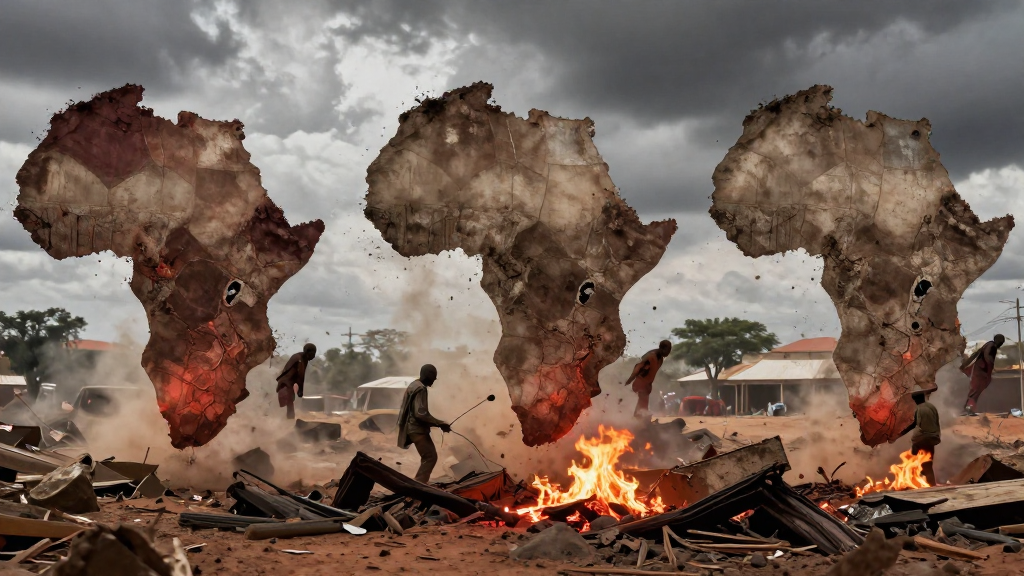
The African continent faced three compounding crises on Monday as a rapidly spreading Ebola outbreak crossed into a fourth province in the Democratic Republic of Congo, South Africa’s anti-immigrant ultimatum deadline expired with thousands fleeing the country, and Senegal pressed ahead with a contested constitutional referendum that has sparked mass protests in Dakar.
Ebola Outbreak Crosses Into Fourth Province as Cases Surge
The Ebola outbreak first confirmed in May in the DRC’s Equateur Province has spread into a fourth province, Africanews reported Monday, citing health officials. The Bundibugyo strain of the virus involved in the current outbreak has no approved vaccine or targeted treatment, making containment significantly more difficult than in prior outbreaks. The WHO confirmed last week that more than 300 positive cases remain unaccounted for in the DRC, raising fears that community transmission may be significantly underestimated. Uganda, which shares a porous border with the DRC, has also reported linked cases, prompting cross-border contact tracing operations involving Africa CDC and WHO teams. The outbreak is occurring in a region already burdened by conflict, displacement, and food insecurity — conditions that health experts warn will accelerate transmission and complicate the response for months to come.
“This is one of the most complex epidemiological situations we have faced in the region in years,” a senior Africa CDC official said in a press briefing Friday. “Without full access to all affected communities, we cannot get ahead of this outbreak.”
South Africa Anti-Immigrant Deadline Triggers Mass Flight
In South Africa, the unofficial June 30 deadline set by vigilante groups for undocumented migrants to leave the country passed on Monday, setting off a chaotic exodus of tens of thousands of foreigners and violent protests in several provinces. Africanews reported that 25,000 foreigners had fled South Africa as of Monday morning, many boarding emergency repatriation buses organised by their embassies. Videos shared on social media showed long queues outside border crossings with Mozambique and Zimbabwe, while police deployed in significant numbers to prevent confrontations between protesters and fleeing migrants. South Africa, which hosts the largest number of documented and undocumented migrants on the continent, has seen a surge in anti-immigrant sentiment linked to economic frustration and false social media claims about foreign nationals and crime.
“We came here to work, not to cause trouble,” said Precious Mkhize, a Zimbabwean street vendor who was among those queuing to leave Johannesburg. “Now it is not safe for us anymore.”
The African Union issued a statement calling on South African authorities to uphold their obligations under the Protocol to the African Charter on Human and Peoples’ Rights on the Specific Aspects of the Right to Nationality and the eradication of statelessness. The protocol guarantees free movement rights across the continent.
Senegal Presses Ahead with Constitutional Referendum Despite Mass Protests
In West Africa, Senegal’s National Assembly passed a constitutional reform package Sunday that curbs presidential powers, a day after the country’s opposition parties called for a national referendum on the changes that they say concentrate authority in the executive while weakening judicial independence. The reforms, championed by President Bassirou Diomaye Faye, would reduce the presidential term from five years to four, create a seven-member Constitutional Council, and give parliament greater oversight of security appointments. Critics, including former Prime Minister Mahammed Boun Abdallah Dionne, have raised concerns that the reforms bypass proper legislative scrutiny. Security forces deployed around key intersections in Dakar on Sunday as opposition groups attempted to march on the National Assembly. Human Rights Watch called for an independent investigation into reports that police used tear gas and baton charges against protesters.
“A constitution that cannot survive open public debate is a constitution built on sand,” said Mr. Dionne in a statement released Sunday evening.
The three simultaneous crises highlight the compounding pressures facing African governments as they balance public health emergencies, nationalist political movements, and constitutional governance challenges across multiple regions at once. Regional bodies including the African Union, ECOWAS, and Africa CDC are under pressure to respond to all three situations concurrently, raising questions about institutional capacity and resource allocation across the continent.