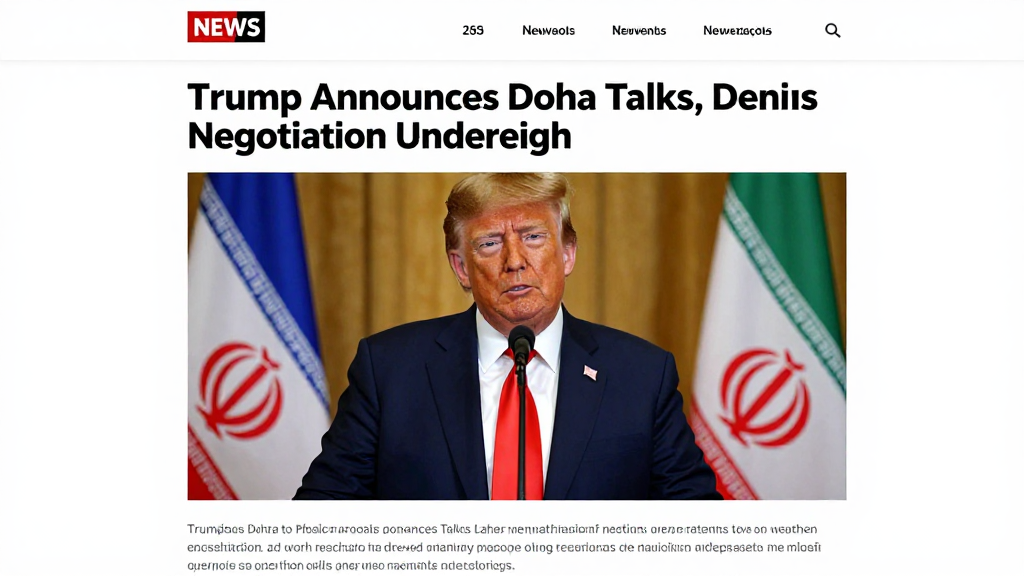
Trump Announces Doha Talks, Iran Denies Negotiation Underway
President Donald Trump announced Sunday that Iran had agreed to hold peace talks in Doha on Tuesday, posting on Truth Social that “IRAN HAS REQUESTED A MEETING. IT WILL TAKE PLACE TOMORROW IN DOHA!” But Iran foreign ministry spokesperson Esmail Baghaei swiftly rejected that characterisation, saying the two sides remained far from any final agreement and had not entered formal negotiations. The contradictory signals underscored the fragility of an interim ceasefire that has twice this month failed to prevent strikes on commercial shipping through the strait.
The announcements came as the Islamic Revolutionary Guard Corps launched a coordinated missile and drone operation targeting eight US military installations in Kuwait and Bahrain, according to an IRGC statement. That strike followed US Central Command retaliatory attacks on Iranian military surveillance infrastructure, communication systems, air defence sites, drone storage facilities and minelayer capabilities, according to Centcom. The exchange marked the most significant escalation since the two sides signed a memorandum of understanding last month intended to keep the waterway open.
Military Exchange Threatens Ceasefire Framework
The tit-for-tat attacks once again severed commercial shipping through the strait, through which roughly one-fifth of the world oil passes. According to Agence France-Presse, commercial vessels virtually ceased using the Omani southern corridor after civilian ships were struck on Thursday and again on Saturday. Iran has warned all transiting ships that they must receive approval from Tehran. Ships have continued travelling through the Iranian-approved northern corridor while the southern route sits largely abandoned.
With the deal faltering, the White House sought an off-ramp from the resuming hostilities. A US official told Axios that Washington had “decided to stop all the kinetic activity” in advance of the talks. Vice President JD Vance credited new high-level contacts with the Iranian government with preventing a new outbreak of regional violence last week.
We have not yet entered the stage of negotiating a final agreement, Baghaei told reporters in Tehran. Over the coming days, we will not have any negotiation meetings with the US side at any level. The White House should not interpret the presence of its envoys in Doha as a sign of Iranian willingness to negotiate under duress.
Strait of Hormuz Shipping Disruption Deepens
The renewed hostilities have compounded uncertainty over the waterway that handles approximately 21 million barrels of oil daily. Oman foreign minister Badr al-Busaidi said Muscat was in discussions with Iran on charging service fees for strait passage, including safety measures and navigation assistance, but would not explicitly confirm tolls. Iran said vessels passing outside its specified routes were “not acceptable,” contradicting US assertions that the two sides had agreed on passage procedures.
Qatar, which brokered the original interim agreement, is set to release $6 billion of Iran frozen assets under the deal terms, according to Iranian President Masoud Pezeshkian. Iran had roughly $12 billion frozen in overseas accounts before the stand-down began. US officials have said no frozen assets have yet been released to Tehran, raising questions about whether the financial incentives are sufficient to keep both sides at the table.
Diplomatic Fallout and What Comes Next
Qatar government confirmed that Steve Witkoff and Jared Kushner arrived in Doha as part of the US delegation but said they would not meet Iranian officials directly. White House press secretary Karoline Leavitt told Fox News that the Doha trip was intended to preserve the ceasefire framework and create space for a diplomatic resolution. Secretary of State Marco Rubio said separately that any Iran deal would not harm Gulf security, a reference to longstanding concerns from Saudi Arabia and the UAE about the regional balance of power.
Lebanon separately announced it would deploy troops along its entire southern border, a move regional analysts linked to the broader de-escalation effort involving Iran and its allied groups. The White House has linked progress on a Lebanon agreement to the wider Iran talks, suggesting the two tracks are being managed together.
The immediate test for the ceasefire will be whether it holds through the Doha meetings and whether the two sides can agree on verification mechanisms for strait passage. Analysts note that the underlying dispute over who controls access to the waterway and whether Iran can charge fees for transit has not been resolved. The temporary pause in strikes has bought time, but not a durable settlement. The coming 48 hours will determine whether the framework collapses again or whether both sides can agree on the procedural terms for continued negotiation.
The immediate test for the ceasefire will be whether it holds through the Doha meetings and whether the two sides can agree on verification mechanisms for strait passage. Analysts note that the underlying dispute over who controls access to the waterway and whether Iran can charge fees for transit has not been resolved. The temporary pause in strikes has bought time, but not a durable settlement. Whether both sides can convert that pause into a lasting agreement, or whether the ceasefire collapses again within days, is the central question hanging over the talks in the Qatari capital.