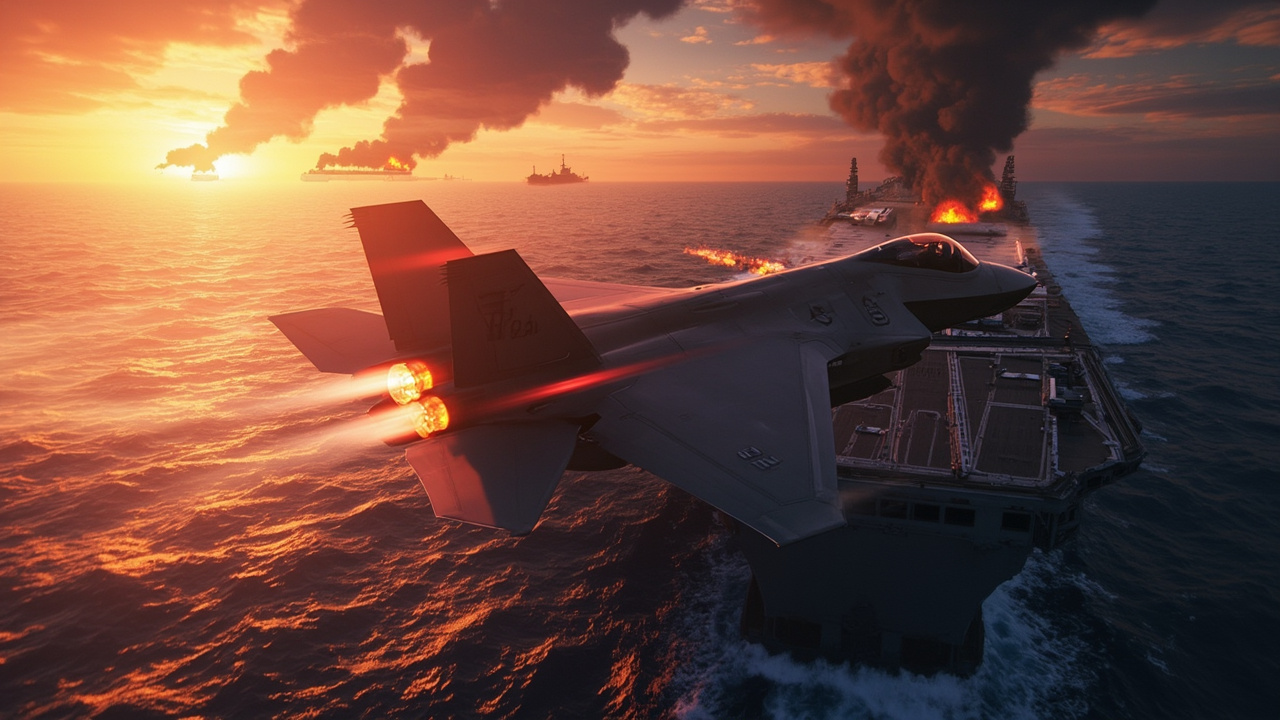
President Donald Trump warned Iran on Saturday it faces complete military annihilation if it continues to violate a fragile ceasefire in the Strait of Hormuz, after U.S. aircraft launched a second consecutive day of strikes against Iranian military targets. The escalation marks the most serious rupture in a peace agreement signed just weeks ago between Washington and Tehran, rattling global energy markets and putting allied Gulf nations on heightened alert.
The latest round of violence began early Saturday when Iranian forces struck the Panama-flagged oil tanker M/T Kiku with an attack drone near the Strait of Hormuz, according to U.S. Central Command. The vessel was carrying more than 2 million barrels of crude oil when it was hit around 4:30 a.m. ET. CENTCOM said Iran had been “given a chance to honor the ceasefire agreement” following U.S. retaliatory action a day earlier, but “elected not to” comply, prompting American forces to respond with strikes targeting surveillance infrastructure, communication systems, air defense sites, drone storage facilities and minelayer capabilities.
Trump’s Ultimatum and the Ceasefire Collapse
Trump issued his starkest warning yet from his Truth Social account. “There may come a point when we are no longer able to be reasonable and will be forced to militarily complete the job that we very successfully started,” he wrote. “If that happens, the Islamic Republic of Iran will no longer exist!” The statement marked a dramatic hardening of the administration’s tone after the president had weeks earlier signed a memorandum of understanding with Iranian President Masoud Pezeshkian aimed at developing a permanent peace deal.
The breakdown follows a series of Iranian attacks on merchant vessels that Washington says clearly breached the ceasefire. On Thursday, a one-way attack drone struck the Singapore-flagged cargo ship M/V Ever Lovely in the strait off Oman. Trump told reporters at the White House before the strikes were announced that Iran would face consequences. “You’ll find out,” the president said when asked whether the ceasefire would hold. Vice President JD Vance, traveling in Switzerland for talks with Iranian counterparts, reiterated that the United States had fully honored its commitments. “Violence will be met with violence,” Vance wrote on social media.
Iran’s Regional Retaliation and the Gulf Response
Iran’s Islamic Revolutionary Guard Corps said Saturday it had launched retaliatory missile and drone operations targeting U.S. military installations in Kuwait and Bahrain, following the American strikes. Bahrain’s government condemned what it described as a “blatant violation of its sovereignty” and a “flagrant threat to the security of citizens and residents.” The U.K. Maritime Trade Operations Centre reported that a commercial tanker was struck by an unidentified projectile Saturday, sustaining damage to its bridge though all crew were safe.
Iran’s parliament national security commission head, Ebrahim Azizi, accused the United States of undermining negotiations. “The U.S. attacked Iran in the middle of negotiations once again,” Azizi wrote. “This reckless violation of the ceasefire will, as always, lead to retreat and regret on their part.” The IRGC warned that any repeat U.S. attack would draw an even broader response. “If the aggression is repeated, our response will be broader than this,” the Guard Corps said.
Diplomatic Fallout and What Comes Next
The collapse of the ceasefire puts enormous pressure on the diplomatic channel that produced the memorandum of understanding. The U.S. and Iran had been engaged in indirect talks mediated by Swiss officials, with Vance serving as the primary American interlocutor. Those talks were intended to build toward a comprehensive agreement that would end hostilities and lift sanctions. The breakdown raises questions about whether that framework is salvageable, or whether the two sides are now locked in an escalatory cycle neither can control without appearing weak.
Regional allies are watching closely. Israel has coordinated closely with the United States throughout the conflict. Gulf Arab states, many of which host American military bases, have expressed alarm at the return of open hostilities in the strait. The Strait of Hormuz handles roughly one-fifth of the world’s daily oil consumption, making sustained escalation a critical concern for global energy markets.
The immediate test will be whether the ceasefire line can be restored before the next Iranian attack forces the U.S. hand again. If commercial vessels continue to be struck, pressure on Trump to authorize more expansive strikes — potentially targeting Iranian territory beyond the coastal military facilities struck so far — will grow substantially. The president has signaled he is prepared to go that far if necessary.