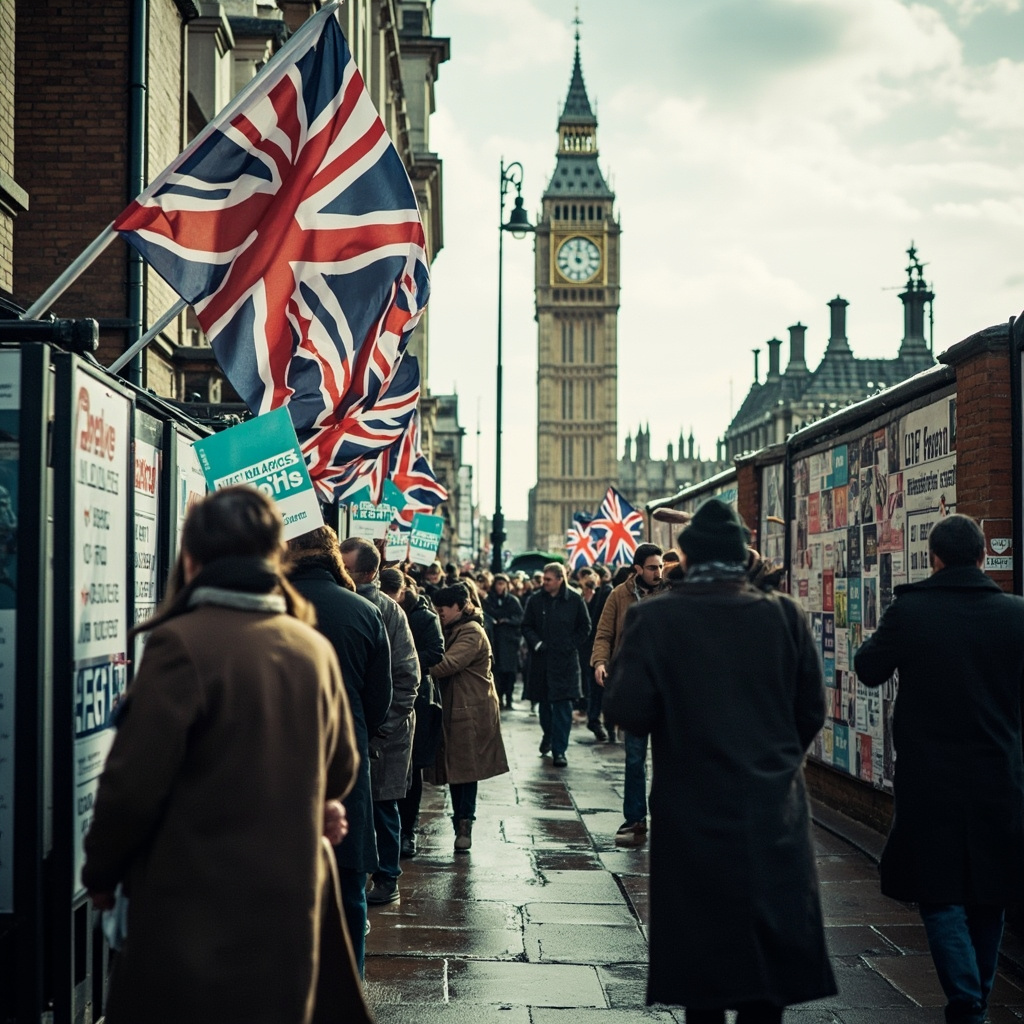
Voters across the United Kingdom headed to the polls on Thursday in what is being described as the most consequential set of elections in a decade, with all 129 seats in the Scottish Parliament, all 96 seats in the Senedd (Welsh Parliament), and more than 5,000 council seats across 136 English local authorities up for grabs.
Scotland: A Defining Moment for Independence
The Scottish Parliament election is being closely watched as a potential bellwether for the future of the independence movement. The Scottish National Party (SNP), which has governed Scotland for nearly two decades, faces a formidable challenge from Labour, which has surged in national polls under Keir Starmer’s leadership.
First Minister John Swinney is fighting to retain power amid growing discontent over public services, including the NHS, which is devolved to Holyrood. The SNP’s longstanding argument that only independence can protect Scotland from Westminster policies has been complicated by Labour’s resurgence and a public weary of constitutional battles.
Polling ahead of election day suggested that no single party is likely to secure the 65 seats needed for an outright majority. A coalition or confidence-and-supply arrangement appears almost certain, with the Scottish Greens and the Liberal Democrats emerging as potential kingmakers. Reform UK, fielding candidates across Scotland for the first time in a parliamentary election, could also play a spoiler role in key constituencies.
“This is the most unpredictable Scottish election in a generation,” said Professor Nicola McEwen of the University of Edinburgh. “The independence question is no longer the dominant issue — voters are focused on the cost of living, health waiting times, and education.”
Wales: The End of Labour Dominance?
In Wales, Labour has held power continuously since the Senedd was established in 1999 — 27 years of uninterrupted rule. But that streak may be about to end. Multiple Labour sources told BBC Wales that the party expects to lose its majority, with some predicting it could fall to second place behind Plaid Cymru or even the Conservatives.
First Minister Mark Drakeford’s successor, current Labour leader in Wales Eluned Morgan, has struggled to shake off the legacy of pandemic-era decisions and a healthcare system under immense strain. Waiting lists in Wales are the longest in the UK, and educational attainment levels have fallen relative to England.
Plaid Cymru, led by Rhun ap Iorwerth, has positioned itself as the party of competent governance, running on a platform of investment in the Welsh NHS, free school meals expansion, and a more assertive approach to securing funding from Westminster. The Welsh Conservatives, meanwhile, hope to capitalize on Labour’s weakness but face their own challenges from a resurgent Reform UK.
The Senedd election is the first under a new electoral system: Wales has been divided into 16 new constituencies, each electing six members using a proportional system. A party needs 49 seats for a majority.
England: Reform UK Shakes Up Local Politics
In England, early results from key wards showed a dramatic reshaping of the political landscape. According to polling expert Professor Sir John Curtice, Labour’s vote share in the first five key wards to declare had fallen by an average of 21 points, while Reform UK had captured 27 percent of the vote in those same wards.
Reform UK, led by Nigel Farage, has emerged as a serious electoral force, winning 35 council seats in the early counts — all of them gains. The party is eating into both Conservative and Labour support, particularly in former “Red Wall” seats in the Midlands and the North, as well as traditional Conservative strongholds in the South and East of England.
Labour, despite leading in national polls, appears to be losing ground at the local level. The party had won 32 seats in early counting but lost 32 — a net zero change that belies a more complex picture of losses to Reform in some areas and gains from the Conservatives in others.
The Liberal Democrats, meanwhile, have held their ground with 5 seats and 2 gains, while the Greens have won 4 seats with 3 gains, consolidating their position as a credible alternative in urban and suburban wards.
“The tectonic plates of British politics are shifting,” said Professor Curtice. “What we are seeing is not a simple swing from one party to another but a fragmentation of the two-party system that has dominated British politics since 1945.”
Six Mayoral Races and What They Mean
Beyond the council seats, six mayoral contests were held across England, including in the West Midlands, Greater Manchester, and Tees Valley. These races are seen as proxy battles for the next general election, with high-profile incumbents like Andy Burnham (Greater Manchester) and Ben Houchen (Tees Valley) seeking re-election.
Early indications suggest that while Labour may hold onto its metro mayor strongholds, the margins are narrowing. In Tees Valley, where Houchen has been a flagship Conservative mayor, Reform UK’s surge could split the right-wing vote and hand the seat to Labour — or, paradoxically, allow Houchen to win with a reduced majority if Reform voters back the incumbent as the “best available conservative option.”
What Happens Next
Counting in Scotland and Wales will begin on Friday morning, with full results expected over the weekend. In England, results from all 136 councils are expected by Saturday. The final picture will determine the political trajectory for the remainder of 2026 and set the stage for the next UK general election, which must be held by January 2029 but could come as early as 2027.
For Keir Starmer’s Labour, a poor showing in Wales and Scotland would raise serious questions about the party’s electoral strategy. For the Conservatives under Kemi Badenoch, the rise of Reform UK poses an existential threat: if the right-wing vote continues to split, the Tories could face a generation in opposition. And for Reform UK, the question is whether this surge is a protest vote or the beginning of a permanent realignment of British politics.
One thing is clear: the Britain that wakes up on Friday morning will look politically very different from the one that went to bed on Thursday.