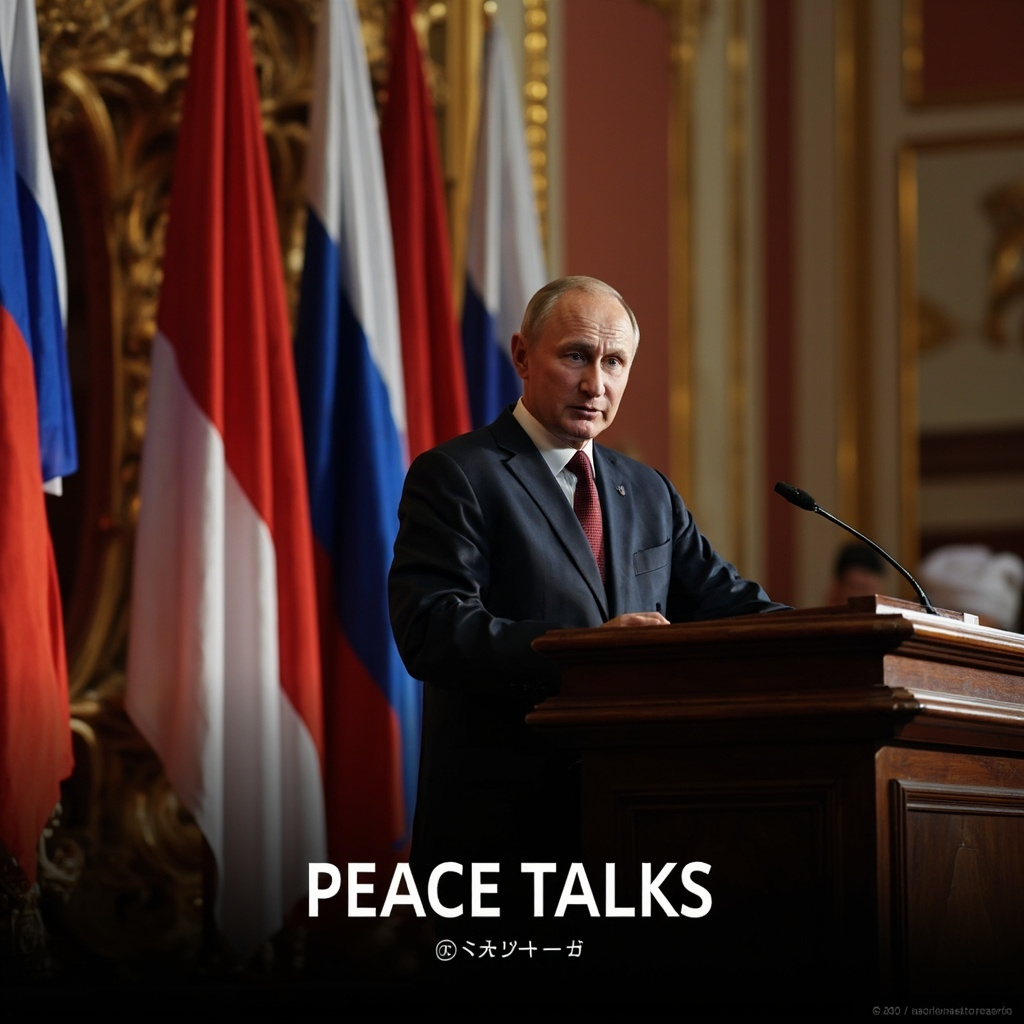
Russian President Vladimir Putin signalled for the first time that Moscow may be prepared to end its three-year war in Ukraine, telling reporters in Moscow on Monday that peace talks were now proceeding on a “serious political track” — the most direct indication yet that the Kremlin is moving toward a negotiated ceasefire after sustained diplomatic pressure from the United States and European mediators.
The development, confirmed by three independent diplomatic sources speaking to international wire services, marks a potential inflection point in the conflict that has killed an estimated 460,000 people and displaced millions since Russia’s full-scale invasion began in February 2022. The sources cautioned that significant gaps remain between the two sides on the territorial questions that have blocked previous ceasefire attempts.
What Putin Said — and What He Didn’t Say
Speaking at a joint news conference with visiting Hungarian Prime Minister Viktor Orban — whose government has maintained open channels with both Moscow and Kyiv — Putin described the current round of talks as the most substantive since negotiations collapsed in the spring of 2022. “We are now on a serious political track,” Putin said. “I cannot say we are close to a final agreement, but for the first time in a long period, I can say the dialogue is real.”
Ukrainian President Volodymyr Zelensky responded cautiously, saying in an evening address that Kyiv would study the Russian statement carefully but warning that “words and statements have not stopped rockets, drones, or glide bombs.” A readout from Zelensky’s office said Ukraine’s position remained anchored to President Trump’s May 2025 peace framework, which calls for an immediate ceasefire followed by a diplomatic process to determine the war’s final status.
“We are now on a serious political track. I cannot say we are close to a final agreement, but for the first time in a long period, I can say the dialogue is real.”
— Vladimir Putin, President of Russia, Moscow, May 12, 2026
The White House confirmed that U.S. special envoy Steve Witkoff had been in near-continuous contact with both parties over the preceding 72 hours. “The United States welcomes these signals and will continue to work with all sides to bring this conflict to a durable end,” National Security Council spokesman Brian Hughes said in a written statement.
The Ceasefire Framework on the Table
Sources familiar with the negotiating process described a framework under active discussion. The plan reportedly calls for an initial 30-day ceasefire along current front lines, followed by a six-month diplomatic window during which a final political settlement would be negotiated — covering the status of occupied territories in Donetsk, Luhansk, Zaporizhzhia, and Kherson oblasts.
| Phase | Duration | Key Actions |
|---|---|---|
| Phase 1 | 30 days | Immediate ceasefire along current front lines; prisoner exchange; humanitarian corridors opened |
| Phase 2 | Up to 6 months | Diplomatic talks on final territorial status; international monitoring; sanctions relief negotiations |
| Phase 3 | TBD | Final political agreement; reconstruction financing; EU/international investment framework |
Sticking Points That Could Derail Talks
Despite the cautious optimism, analysts and former negotiators warned that the gaps between Moscow and Kyiv remain enormous. The core dispute — who controls the four partially occupied oblasts — has blocked every previous ceasefire attempt. Russia has formally annexed all four regions, a claim rejected by Kyiv and the vast majority of the international community. Ukraine insists any ceasefire must include the complete withdrawal of Russian forces; Russia insists on keeping the territories it claims.
“The territorial question is not secondary. It is the war. Until both sides are willing to compromise on that, we are talking about a pause, not a peace.”
— Dr. Oleksandra Kwiatkowska, Senior Fellow, European Council on Foreign Relations
A second major sticking point is NATO membership. Ukraine’s constitution was amended in 2022 to embed Euro-Atlantic integration as a state goal. Moscow demands written security guarantees — mirroring those offered to Finland and Sweden before their NATO accession — that Kyiv will never join the alliance. Kyiv says its security is non-negotiable and has instead proposed bilateral security treaties with individual Western nations, a framework modelled on the security arrangements Israel holds with the United States.
Military analysts note that the battlefield situation as of May 2026 has shifted somewhat in Russia’s favour in the east, though Kyiv’s Kursk offensive — which captured several hundred square kilometres of Russian territory in mid-2025 — remains an important negotiating card for Ukraine. “Neither side controls enough to dictate terms,” said Michael Kofman, a senior fellow at the Carnegie Endowment. “That’s actually what makes this round of talks different. Both are exhausted enough to be serious.”
Europe and the U.S. React
European leaders responded with measured hope. French President Emmanuel Macron held separate calls with Putin and Zelensky on Monday and offered to host a follow-up peace summit in Paris “if and when both parties are ready.” German Chancellor Friedrich Merz said Berlin was prepared to begin laying the groundwork for a major European reconstruction programme for Ukraine “the moment a ceasefire holds.”
British Prime Minister Keir Starmer said the United Kingdom would maintain its current military support to Ukraine through any ceasefire and reiterated London’s position that no deal could be struck “over the heads of the Ukrainian people.” Polish Prime Minister Radoslaw Sikorski was blunter, telling reporters in Warsaw: “We will believe in peace when we see Russian soldiers going home, not when we read diplomatic communiqués.”
The Kremlin-watching analyst community was divided. Some saw Putin’s statement as a genuine shift, pointing to Russia’s increasingly parlous economic situation — squeezed by sustained sanctions, a declining oil revenue base, and a wartime labour shortage that has begun to bite in key industrial sectors. Others cautioned that Moscow has a history of negotiating in bad faith to buy time, noting that Russian forces launched a major assault in Kharkiv Oblast just weeks after previous ceasefire declarations.
Market and Economic Reaction
Financial markets registered an immediate positive reaction. European equity indices rallied sharply in afternoon trading, with the STOXX Europe 600 closing 2.3 percent higher. The euro gained 0.8 percent against the dollar. Ukrainian hryvnia bonds surged, with some sovereign debt instruments rising by their daily limit. Wheat futures fell 3.1 percent on expectations that a negotiated end to the war could open up Ukraine’s agricultural export corridors through the Black Sea — a vital artery for global food supplies that Russia has periodically disrupted since withdrawing from a UN-backed grain deal in 2023.
What Comes Next
A trilateral meeting involving representatives of Russia, Ukraine, and the United States is expected to take place in Istanbul later this week, according to a Turkish diplomatic source. The choice of venue carries symbolic weight: Istanbul hosted the initial Russia-Ukraine peace talks in March and April 2022, which collapsed just weeks before Moscow launched its full assault on the Donbas.
For now, diplomats are urging caution. “The distance between a diplomatic signal and a durable ceasefire is measured in weeks, months, and lives,” said a senior EU official who requested anonymity to discuss internal deliberations. “We want this to be real. But we have seen this moment before.”