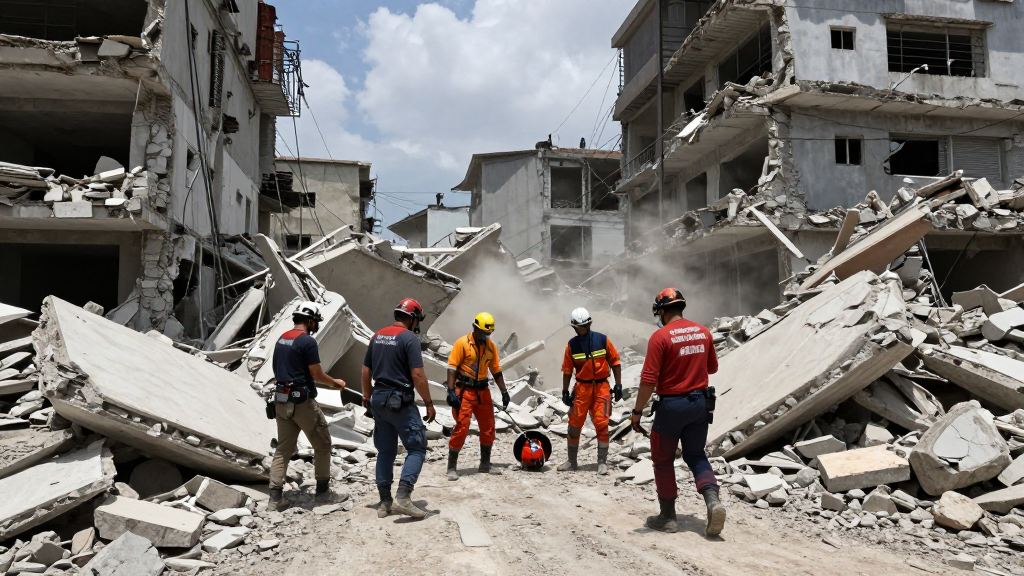
The international community launched one of Latin America’s largest disaster relief mobilizations in years on Thursday, as foreign rescue teams poured into Venezuela to assist in the search for survivors of the devastating twin earthquakes that have now killed more than 2,300 people and left tens of thousands unaccounted for.
44 International USAR Teams Deployed From 27 Countries
At the request of the Venezuelan government, 44 urban search-and-rescue teams — known as USAR — have deployed 2,245 specialists and 140 search-and-rescue dogs to extract survivors from collapsed structures, the United Nations Office for the Coordination of Humanitarian Affairs reported. The rescuers come from across the Americas and beyond: Argentina, Brazil, Canada, Chile, Colombia, Ecuador, El Salvador, Guatemala, Mexico, Panama, Peru and the Dominican Republic, alongside specialists from Germany, Czechia, Spain, the United States, France, Italy, Jordan, Lithuania, the Netherlands, Qatar, the United Kingdom, Serbia, Syria, Switzerland and Türkiye.
“We are racing against time,” said a rescue coordinator with the Mexican team who declined to be named. “Every hour that passes, the chances of finding someone alive diminish, but we will not stop.”
The twin earthquakes — magnitude 7.2 and 7.5 — struck within a minute of each other on June 24, devastating the coastal state of La Guaira, roughly 40 kilometers north of Caracas. The tremors were felt across six states and in the capital, toppling dozens of buildings and severely damaging the country’s main international airport.
A Nation in Mourning as Damage Estimated at $6.7 Billion
Venezuela’s interim president, Delcy Rodriguez, declared seven days of national mourning and announced the creation of a $200 million reconstruction fund to finance repairs to infrastructure, hospitals and housing. “The country’s soul is torn apart by the human losses,” Rodriguez said in a national address.
The United Nations Development Programme, using its RAPIDA satellite assessment tool, placed preliminary damage estimates at $6.7 billion — equivalent to roughly six percent of Venezuela’s gross domestic product. The range spans from $4.7 billion to $8.7 billion, and does not yet account for infrastructure disruption or long-term economic losses. Some 8.6 million people were exposed to moderate to severe shaking, including approximately 2.1 million who experienced the strongest tremors.
The US Geological Survey has gone further, estimating that the earthquakes could ultimately cause more than 10,000 deaths — a figure that would place the disaster among Latin America’s deadliest seismic events in the past century. As of Thursday, the National Assembly president, Jorge Rodriguez, confirmed 2,300 deaths, more than 11,000 injuries and nearly 13,000 people left homeless. The UN estimates that at least 50,000 people remain missing.
Satellite Imagery Reveals Scale of Destruction Across La Guaira
Satellite data analyzed by the UNDP also detected significant reductions in nighttime lighting across Carabobo, La Guaira, Caracas and Aragua — an indicator of widespread power outages compounding the humanitarian crisis. More than 1.7 million structures were located in the affected areas, many of them informal housing developments ill-equipped to withstand seismic forces of this magnitude.
Humanitarian agencies warn that the combination of infrastructure collapse, power disruption and the near-total loss of health facilities in La Guaira creates conditions ripe for a secondary health crisis. Water supplies have been interrupted across the state, and the UN Children’s Fund has estimated that at least 680,000 children in the affected zones are in need of emergency assistance.
The international relief operation is being coordinated through OCHA’s emergency response mechanisms, with UN agencies facilitating the arrival, logistics and deployment of incoming teams. Several Western nations, which do not maintain formal diplomatic relations with Venezuela, have routed their assistance through multilateral channels to navigate the political complications.
Venezuela will establish a $200 million reconstruction fund, with additional credit lines for those who lost businesses or jobs. Officials have also opened discussions with international financial institutions to secure longer-term reconstruction financing as the full scope of the disaster continues to emerge.