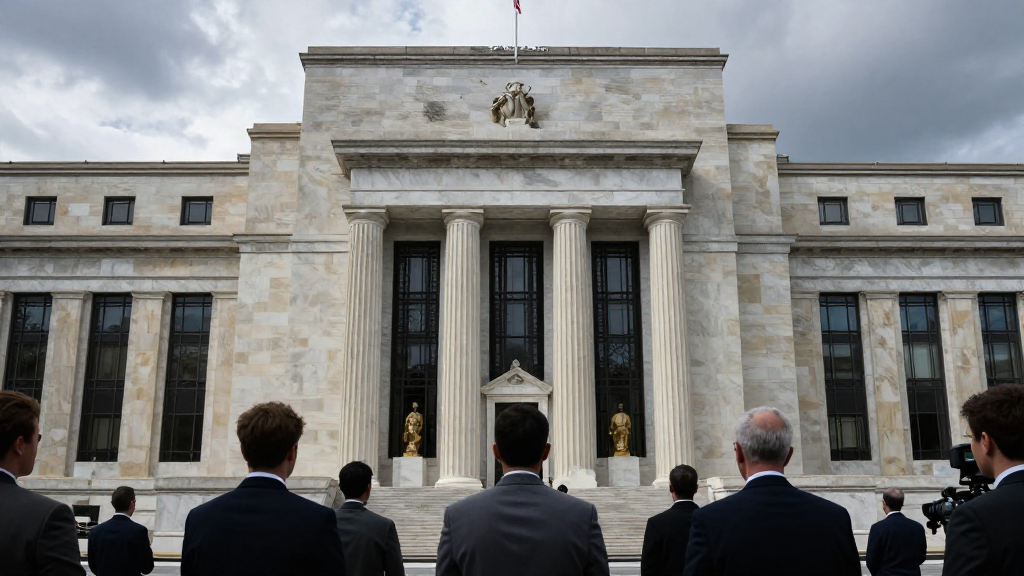
Warsh’s First Fed Hold Comes With a Hawkish Surprise as Nine Officials Favor Higher Rates
The Federal Reserve held its benchmark interest rate steady on Wednesday in Kevin Warsh’s first policy decision as chair, but the accompanying dot plot revealed something that rattled markets far more than the decision itself: nine of the Fed’s 19 officials now favor raising rates this year, a dramatic swing from the zero hikes projected just three months ago. The median projection now shows two quarter-point hikes by year’s end, a hawkish pivot that sent equities lower and the dollar higher within minutes of the announcement.
The FOMC voted 12-0 to hold rates in the 3.50 to 3.75 percent target range, maintaining the status quo while acknowledging that inflation has become an increasingly stubborn problem. Warsh, in his first press conference as Fed chair, struck a tone that differed markedly from his predecessor’s cautious easing bias. “This committee will deliver price stability,” Warsh said at the post-meeting briefing. “We have removed forward guidance because it no longer reflects where this committee actually stands. What you have in front of you is the statement stripped of ambiguity.” The Fed’s revised statement replaced its longstanding commitment to further rate cuts with language focused singularly on bringing inflation back to the 2 percent target.
Inflation has proven far more persistent than Fed officials anticipated when they cut rates late last year. Consumer prices climbed to 4.2 percent annually in May 2026, the highest reading in more than three years, according to the Bureau of Labor Statistics. The Iran conflict has driven energy prices sharply higher, creating supply-side inflationary pressures that monetary policy is poorly equipped to address through higher rates alone. Food prices have also surged, adding to the strain on household budgets at a time when wage growth, while still positive, has failed to keep pace with the cost of living.
The Dot Plot Rebellion: A Committee Divided on the Path Forward
The most striking element of Wednesday’s decision was not the hold itself but the divergence within the FOMC. Nine officials — nearly half the committee — indicated a preference for raising rates this year. Six of those nine support two quarter-point increases, reflecting deep concern that inflation has become entrenched in an economy still absorbing the shock of the Iran conflict. Only two officials favored cutting rates, a stark reversal from the March projections when the committee was broadly divided between holding and cutting.
“The committee is not of one mind, and that is actually healthy,” Warsh said when pressed on the divide. “What matters is that we are all committed to the same target.” The dot plot, historically a closely watched signal of future policy, has become a source of controversy under Warsh’s leadership. Three members submitted forecasts that fell well outside the central range, a level of dispersion not seen in recent memory. Markets initially interpreted the disagreement as weakness in Warsh’s grip on the committee, though Treasury yields stabilized by Thursday as investors digested the implications.
The divergence reflects a fundamental tension that Warsh inherited along with the chairmanship: an economy that remains structurally resilient in its labor markets and consumer spending, but is simultaneously exposed to supply shocks that higher borrowing costs cannot easily tame. Economists at Pantheon Macroeconomics noted in a research note that the Fed faces a dilemma with no clean exit. “Raising rates into a supply-shock environment risks choking off growth without necessarily taming inflation,” the note read. “But failing to act risks entrenching inflation expectations, which would be far more costly to correct later.”
Global Central Banks Are Moving in Opposite Directions, Deepening Market Volatility
The Fed’s hawkish pivot stands in sharp contrast to actions underway elsewhere. The European Central Bank raised rates for the first time since 2023 earlier this week, citing separate inflationary pressures rooted in European energy dependency and supply chain vulnerabilities. The Bank of Japan, meanwhile, has held rates steady near zero as it navigates a domestic economy struggling with demographic headwinds and sluggish productivity growth. This divergence has created sharp movements in currency markets, with the dollar index rising to its highest level in nearly two years against a basket of major trading partner currencies.
Emerging market central banks face the hardest calculus. Countries reliant on dollar-denominated debt find their borrowing costs rising just as export revenues come under pressure from slowing global trade. The Institute of International Finance reported outflows of $38 billion from emerging market funds in the week following the Fed’s announcement, the largest single-week exodus since the pandemic era of 2020. Countries like Brazil, India, and Indonesia have been forced to choose between defending their currencies with rate hikes or protecting growth by holding rates steady, a balance that is becoming increasingly difficult to maintain.
Warsh addressed the global dimension at his press conference, acknowledging that U.S. monetary policy carries spillover effects that cannot be ignored. “We are mindful of what our decisions mean for global financial conditions,” he said. “But our mandate is to serve the American people, and that means price stability first.” The remark signaled a continuation of the Fed’s traditional independence from considerations of global coordination, a stance that has drawn mixed reactions from international counterparts.
Looking ahead, all eyes are on the next two rounds of consumer price data and the July employment report. If inflation holds above 4 percent and job growth remains solid, the case for a September rate hike will solidify. Markets are currently pricing roughly a 60 percent probability of a hike at the September meeting, up from 35 percent before Wednesday’s statement. The next six weeks of data will settle the argument one way or the other.