OPEC and Allied Producers Agree to Extend Production Cuts Through End of 2026
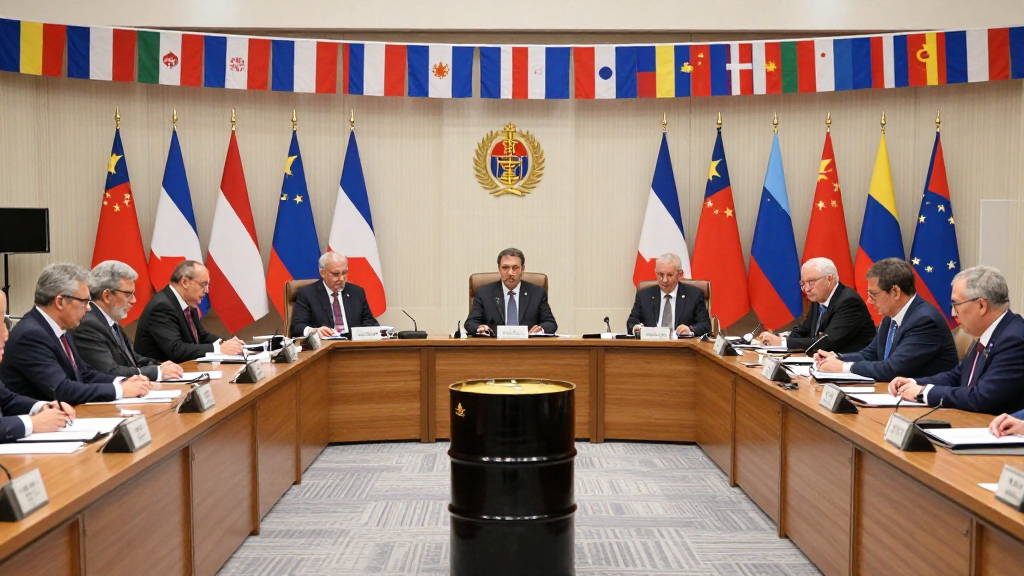
OPEC and its allied oil-producing nations agreed on Thursday to extend their collective production cuts of approximately 3.66 million barrels per day through the end of 2026, a decision that caught energy markets off guard and sent crude oil prices surging by more than 4% in immediate post-announcement trading. The agreement, reached at a ministerial meeting in Vienna, goes further than most analysts had anticipated, with Saudi Arabia shouldering a disproportionate share of the additional restraint. Saudi Arabia’s unilateral cut of 1 million barrels per day, first announced last year and extended multiple times, will now remain in place alongside the broader OPEC+ framework through December 2026, according to a statement from the Saudi Ministry of Energy.
The coordinated extension reflects deep concern among the Gulf monarchies that global oil demand growth is slowing as major economies wrestle with persistent inflation and rising interest rates, while new supply from non-OPEC producers including the United States, Brazil and Guyana continues to expand market share. “We have a very strong commitment to market stability,” Saudi Arabia’s Energy Minister Prince Abdulaziz bin Salman told reporters in Vienna. “These decisions are not taken lightly, and they reflect the resolve of our alliance to do what is necessary to support a balanced market.” The extension represents a strategic bet that controlled supply will be more valuable to producer budgets than increased volumes at lower prices.
Oil Prices Surge as Supply Deficit Deepens
Brent crude, the global benchmark, rose $3.84 to settle at $91.47 per barrel on Thursday, its highest closing price since October, while West Texas Intermediate climbed $3.61 to settle at $87.23. Energy analysts warned that the combination of extended OPEC+ cuts and rising seasonal demand during the Northern Hemisphere summer driving season could push Brent toward $95 per barrel within weeks. The American Automobile Association reported that the national average for regular gasoline reached $3.78 per gallon, its highest level since November, adding to cost-of-living pressures that have remained a political liability for governments across advanced economies.
The International Energy Agency had previously forecast a modest global supply surplus in the second half of 2026, but that projection is now being revised upward as the OPEC+ extension reshapes the supply-demand balance. The agency noted that inventories in OECD nations have fallen below the five-year average for the first time in 18 months, tightening the market’s structural cushion against future disruptions. “The extension of these cuts is a significant development that changes the near-term outlook quite materially,” said Vivek Dhar, a commodities analyst at Commonwealth Bank of Australia. “We are looking at a market that is going to be meaningfully tighter than we thought even a week ago.”
Inflationary Pressure Mounts as Energy Costs Rise
The jump in crude prices complicates the inflation calculus for central banks already struggling to bring price growth back to target, adding to concerns that energy-driven price spikes could reverse recent progress on headline inflation numbers. In the United States, where the Federal Reserve has been holding its benchmark interest rate steady, the recent rise in gasoline prices could add 15 to 20 basis points to the Consumer Price Index reading by August, according to estimates from Goldman Sachs economists. “Energy is often the first domino in the inflation sequence,” the firm’s research note stated. “Rising fuel costs feed into transportation, manufacturing and ultimately retail prices in ways that are difficult for central banks to offset without tighter monetary policy.”
European governments face a particularly delicate situation heading into autumn, with natural gas storage levels already below seasonal norms following an unusually cold spring and the prospect of further oil price escalation adding to industrial energy bills. The European Central Bank, which has held rates steady for four consecutive meetings, warned in its latest bulletin that energy prices represent the most significant upside risk to its inflation projections for the remainder of 2026. “The pass-through from energy to core inflation, while slower than in previous episodes, remains a channel we must monitor carefully,” the ECB stated.
Markets and Political Reactions
Energy equities rallied sharply on the OPEC+ news, with the S&P 500 Energy sector gaining 2.8%, led by major integrated producers ExxonMobil and Chevron, each up more than 3.5%. The jump in oil prices also supported the Canadian dollar and the Norwegian krone, both currencies closely correlated with energy export revenues. In producer nations, the news was broadly welcomed as a boost to fiscal revenues, though officials in countries like Nigeria and Angola, whose economies depend heavily on oil export volumes, expressed concern that prolonged output restraint could erode market share permanently to American and South American competitors.
In Washington, the Biden administration reiterated its commitment to releasing strategic petroleum reserves if prices spike to “unreasonable” levels, though analysts dismissed the threat as largely symbolic given the limited scope of reserves remaining after two years of repeated drawdowns. “We have tools and we will use them if necessary,” a White House spokesperson said. The OPEC+ extension is scheduled for formal review at the group’s next meeting in December, when officials will assess whether the supply deficit is producing the intended price stabilization effect or whether further adjustments are warranted.