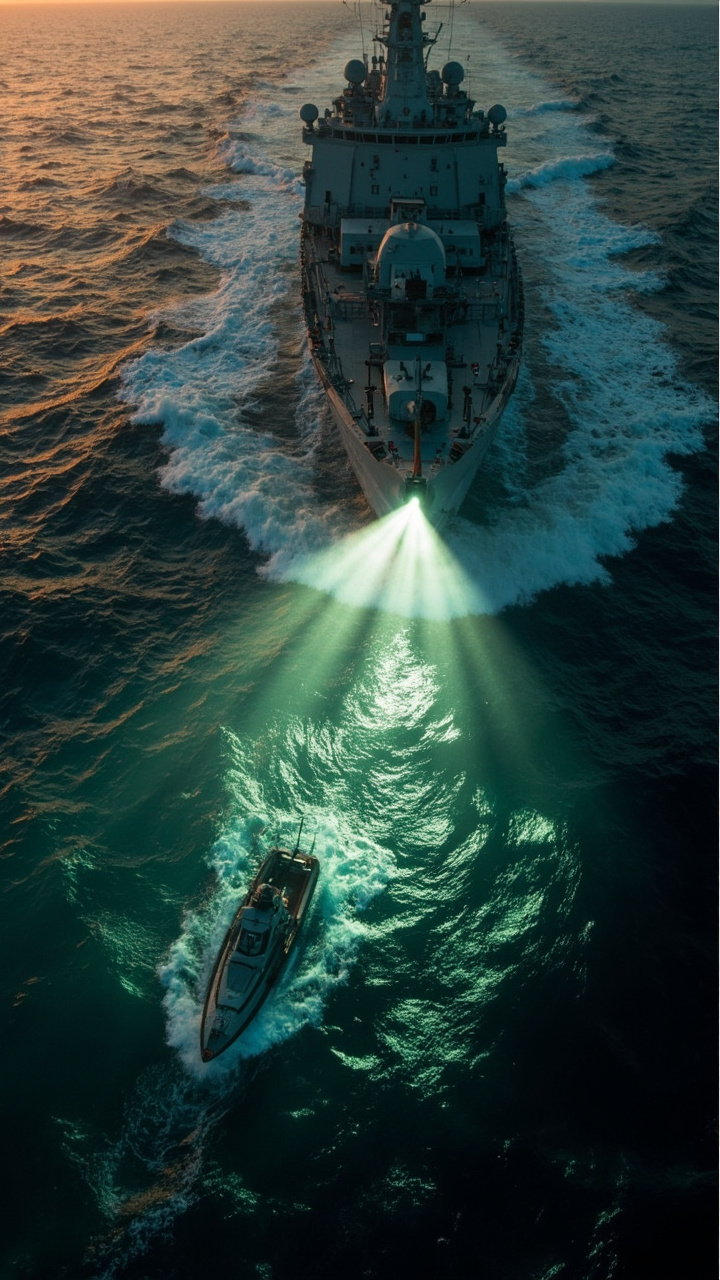
More than 20,000 merchant mariners from Bangladesh, the Philippines, India, Indonesia, and other Global South nations have been stranded aboard commercial vessels in and around the Persian Gulf for weeks — trapped by an American naval blockade, the threat of attack, and the complete breakdown of crew rotation and resupply chains since the U.S.-Iran conflict began in late February. The International Maritime Organization calls it the largest crew abandonment crisis in modern maritime history.
The International Maritime Organization, a United Nations agency headquartered in London, issued an extraordinary emergency appeal in late April calling on all belligerent parties to designate safe maritime corridors for the evacuation of non-combatant mariners. That appeal has gone unanswered, according to IMO Secretary-General Arsenio Fernandez, who told reporters the organization has received no formal response from Washington, Tehran, or any flag-state government whose vessels are caught in the Gulf.
“We have seafarers who have been at sea for 90 days, some for longer than 100 days. They signed contracts for weeks, not months. They have no wages, no fresh water in some cases, and no way to get home. This is a humanitarian crisis that is being overlooked because the cameras are pointed elsewhere.” — Arsenio Fernandez, Secretary-General, International Maritime Organization
The Hormuz Bottleneck: Why These Ships Cannot Move
The Persian Gulf and the approaches to the Strait of Hormuz represent one of the most strategically consequential maritime corridors in the world. Approximately 21 million barrels of oil per day flow through the Strait — roughly one-fifth of global daily oil consumption — making it the world’s most critical chokepoint. Before the current conflict, more than 1,500 merchant vessels transited the Strait each month, the vast majority crewed by sailors from Bangladesh, the Philippines, India, Indonesia, Myanmar, and East Africa.
Since American forces began enforcing what the Pentagon calls Operation Sentinel Shield — an expanded naval blockade of Iranian ports — the flow of commercial shipping through the Strait has effectively ceased. Insurance underwriters covering war risk have driven premiums so high that most vessel owners have pulled their ships from the region. For those that remained, the combination of hostilities, insurance withdrawal, and the closure of crew change ports in Oman, the UAE, and Bahrain has created a de facto stranding.
The Nautilus Institute for Survival and Sustainable Seas, a maritime security research organization based in Berkeley, California, estimates that between 340 and 410 commercial vessels carrying approximately 20,000 to 23,000 crew members are currently anchored or drifting in designated holding zones in the Gulf of Oman, the Red Sea approaches to the Suez Canal, and the Arabian Sea. Their crews cannot discharge cargo (there are no functioning ports that will accept Iranian-origin or Iranian-destined vessels), cannot rotate home (commercial airlines have suspended Gulf routes), and cannot be relieved by replacement crews (the ports are closed to non-military traffic).
“The crews are not prisoners, but they are effectively trapped. The ships cannot move without insurance. The ports will not accept them. The flag states — mostly Liberia, Panama, and the Bahamas — have beenabsent from the conversation. The owners are waiting for a resolution that isn’t coming, and the seafarers are paying the price.” — Dr. Priya Raghavan, Senior Analyst, Nautilus Institute for Survival and Sustainable Seas
The Human Cost: Living Conditions Aboard Stranded Vessels
The International Transport Workers’ Federation, a London-based union representing more than 600,000 seafarers worldwide, has documented cases of vessels that have been waiting in Gulf holding zones for more than 100 days without a full crew rotation. In at least 18 cases documented by the ITF, ships have exhausted their food stores and depend on sporadic supplies delivered by humanitarian organizations operating from Dubai and Muscat.
The ITF’s legal department, working with a network of maritime law firms, has filed crew abandonment claims on behalf of approximately 1,400 mariners under the Maritime Labour Convention, 2006, which obligates flag states and vessel owners to ensure seafarers are repatriated and paid within a defined period. Many of the stranded vessels are registered under flags of convenience — Liberian, Panamanian, and Bahamian registries that maintain minimal administrative presence in the Gulf.
Mental health is a growing concern. Dr. Fatima Al-Hassan, a psychiatrist with the seafarer welfare organization Stella Maris who has been conducting remote counseling sessions with stranded crews via satellite phone, described a pattern of acute anxiety, depression, and insomnia among the mariners she has contacted.
“These are men who left their families for what they were told would be an eight-week voyage. They left children, elderly parents, in some cases elderly parents who are ill. They cannot call home because the satellite phone credits run out. They cannot leave. The psychological toll is severe and is going to get worse the longer this goes on.” — Dr. Fatima Al-Hassan, Stella Maris International
The International Labour Organization, another UN agency, estimates that the average stranded seafarer in the Gulf has been unable to access wages totaling between $3,000 and $8,000 per person. For Bangladeshi mariners, whose monthly wages of $800 to $1,200 represent the primary income for extended family networks in rural villages, the loss of accumulated pay is not merely a financial inconvenience but an acute family crisis.
The Legal Vacuum: Who Is Responsible for the Stranded Mariners
The legal architecture governing the rights of stranded seafarers was not designed for a conflict this prolonged or this comprehensive. The Maritime Labour Convention, 2006, requires that seafarers be repatriated within eight months of the end of their contract — but that provision assumes functioning ports, functioning airlines, and functioning administrative systems. None of those conditions currently exist in the Gulf for vessels associated with Iranian-origin cargo.
Flag state responsibility is widely regarded as the primary legal avenue, but it has proven ineffective. The three largest flag states for vessels in the Gulf — Liberia, Panama, and the Bahamas — have each issued statements calling for the protection of seafarer rights, but have taken no enforcement action. The Liberian Registry, which licenses vessels through the world’s largest open registry, has a contractual relationship with vessel owners but no enforcement mechanism to compel repatriation in a conflict zone.
The vessel owners — shipping companies that in many cases are incorporated in jurisdictions with no operational presence in the Gulf — are legally liable under the MLC but practically unable to act. Several major shipping companies, including Frontline plc, Euronav NV, and Tsakos Energy Navigation, have confirmed to maritime industry publications that they have vessels in the Gulf but declined to provide crew-specific details citing operational security.
| Stranded Maritime Personnel — Country of Origin | Estimated Number Affected |
|---|---|
| Bangladesh | ~6,200 |
| Philippines | ~5,400 |
| India | ~3,800 |
| Indonesia | ~2,100 |
| Myanmar | ~900 |
| East Africa (Kenya, Tanzania, Mozambique) | ~700 |
| Other nations | ~1,000 |
| Total estimated | ~20,100 |
Humanitarian Operations and Diplomatic Stalemate
Three humanitarian organizations are currently attempting to deliver supplies to stranded vessels: the International Red Cross and Red Crescent Movement, which has secured limited access to the Gulf through Omani mediation; the Apostleship of the Sea, operating through its Stella Maris network from Dubai; and the Sailors’ Society, a Christian seafarer welfare organization based in the United Kingdom.
Each organization has described access as “severely limited” and “inconsistent.” The Red Cross confirmed in a statement that it has delivered food and medical supplies to 34 vessels in the past six weeks, reaching approximately 980 seafarers — a fraction of the total stranded population.
On the diplomatic front, the United Nations Security Council has discussed the maritime humanitarian situation in three closed sessions since March, according to diplomatic sources. No binding resolution has been proposed, reflecting deep divisions on the Council over the underlying conflict with Iran. The United States and United Kingdom have blocked procedural moves that would have put the issue formally on the Council’s agenda, diplomats told this publication on condition of anonymity because the sessions were not public.
The International Maritime Organization’s Fernandez has written directly to the permanent members of the Security Council as well as to Iran requesting a humanitarian corridor. He has received no substantive response from any party.
The Broader Risk: A Floating Environmental and Security Time Bomb
Beyond the immediate humanitarian crisis, maritime safety experts have raised alarms about the accumulated risk of dozens of large commercial vessels — many carrying petroleum products, chemicals, or raw materials — sitting unattended for extended periods in one of the world’s busiest and most geopolitically volatile maritime environments.
Professor James D. McGowan, Director of the Centre for Maritime Studies at the University of Greenwich, noted that the navigational risk of derelict or semi-derelict vessels in a active conflict zone is significant.
“These ships have crews that are exhausted, underfed, and in some cases not fully operational. If a vessel loses main power, if an anchor drags in heavy seas, if a fire starts in an engine room — you have a 300-meter supertanker with a full cargo in the approaches to the Strait of Hormuz. The environmental and safety consequences of an accident would dwarf the political fallout from any single military incident in this conflict.” — Professor James D. McGowan, Centre for Maritime Studies, University of Greenwich
The insurance industry has calculated the potential liability exposure from a major tanker accident in the Gulf at between $4 billion and $11 billion, excluding the environmental remediation costs. That figure, if realized, would be the largest maritime liability claim in history and would be largely uncollectable from vessels whose owners are effectively insolvent in the current environment.
For the 20,000-plus mariners stranded in the Gulf, the immediate question is simpler and more urgent than geopolitical calculations: when can they go home? Without a diplomatic agreement that explicitly addresses crew repatriation, without safe harbor access, and without functioning commercial aviation, there is no answer on the horizon.
“We are not part of this war,” said Mohammad Raza, a Bangladeshi third officer aboard a Liberian-flagged tanker anchored in the Gulf of Oman, in a voice message sent to his family in Chittagong that was shared with this publication. “We are workers. We signed contracts. We are not here by choice, and we cannot leave by choice. Please remember us.”
—
Sources: International Maritime Organization emergency appeal (April 2026); Nautilus Institute for Survival and Sustainable Seas, Berkeley, briefing paper (May 2026); International Transport Workers’ Federation crew abandonment database (May 2026); Stella Maris International remote counseling program documentation; Centre for Maritime Studies, University of Greenwich, risk assessment note (May 2026); Reuters maritime desk reporting; Lloyd’s List maritime insurance coverage.