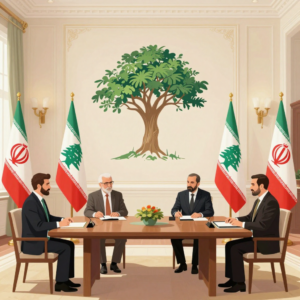
Burgenstock Talks Advance as US Waives Iran Sanctions and a Fragile Lebanon Ceasefire Holds
Switzerland confirmed on Monday that the United States and Iran reached agreement on a 60-day roadmap during second-day negotiations at the Burgenstock resort, producing what mediators called the most concrete progress in years of adversarial diplomacy between the two nations. The talks, which continued through the night into early Tuesday morning, produced a joint statement acknowledging the establishment of a High Level Committee, the waiving of certain United States sanctions on Iranian oil and petrochemical exports, and the opening of a deconfliction channel covering the Strait of Hormuz and Lebanese territory.
The State Department confirmed that Secretary of State Marco Rubio had authorized the partial sanctions waiver as a confidence-building measure tied to Iran’s commitment to halt uranium enrichment above five percent and to open its nuclear facilities to international inspectors. The waiver covers oil sales and port access but does not lift the broader sanctions architecture that has constrained Iran’s economy since 2018. A senior American official described the arrangement as reversible, contingent on Tehran complying with weekly monitoring benchmarks.
Lebanon Ceasefire First Real Test
Iran’s Foreign Minister Abbas Araghchi, speaking from the Burgenstock terrace after the joint statement was released, said the newly established deconfliction cell covering Lebanon would serve as the first genuine test of whether the broader framework could hold. His assessment carried an implicit warning: continued Israeli operations in southern Lebanon would be treated as a violation of the understanding reached in Switzerland.
“We have agreed that the cell will be operational within 72 hours,” Araghchi told reporters. “If fighting continues in Lebanon after that cell is standing, the entire architecture of this agreement collapses. That is not our position – that is the agreed position of both sides.” His statement marked one of the most direct public acknowledgments by an Iranian official that the outcome of the talks remained contingent on events beyond the conference room.
The Lebanon dimension proved the hardest to resolve. Even as delegations were meeting in Switzerland, Israeli forces carried out strikes in southern Lebanon for a second consecutive night. The attacks prompted a protest from the Iranian delegation, which submitted a formal complaint to the Qatari and Pakistani mediators. A Lebanese Armed Forces spokesperson said the army had received instructions to deploy to the border zone but had not yet done so, citing ongoing hostilities in certain sectors.
Hormuz Reopening Tied to Asset Releases
Perhaps the most commercially significant outcome of the talks was the agreement to reopen the Strait of Hormuz toll-free for at least 60 days, reversing the Islamic Revolutionary Guard Corps’ announcement on Saturday that the waterway would be sealed in response to Israeli strikes in Lebanon. The U.S. military publicly disputed Iran’s capacity to close the strait, and American naval vessels in the Gulf reported normal transit operations throughout the weekend.
The Hormuz agreement also included a provision for the release of a tranche of frozen Iranian sovereign assets held in European correspondent accounts, estimated by the International Monetary Fund at approximately eleven billion dollars. The funds will be accessible through a structured escrow mechanism overseen by Qatar and the United Arab Emirates. Iranian officials said the money would fund infrastructure repairs and humanitarian imports, while American and European officials insisted the escrow structure would prevent diversion to military purposes.
Vice President JD Vance, who had delayed his departure from Washington to resolve logistical complications, led the American delegation alongside Special Envoy Steve Witkoff and Jared Kushner, the president’s son-in-law who has maintained a discreet channel to Gulf state intelligence services. Vance told reporters before departing Geneva that the talks had produced more substantive agreement on the nuclear question than any previous engagement since the original Joint Comprehensive Plan of Action was signed in 2015.
What Comes Next
The High Level Committee is scheduled to convene again in Geneva in 30 days, with technical working groups on nuclear monitoring, sanctions architecture, and Lebanese deconfliction meeting at the working level in Doha beginning next week. The United Nations nuclear watchdog, the International Atomic Energy Agency, has been invited to station permanent inspectors at the Fordow and Natanz facilities under a revised monitoring protocol that Iran signed as an annex to the joint statement.
The framework remains contingent and reversible. Both sides have reserved the right to reinstate full sanctions if the monitoring benchmarks are not met, and the American official who briefed reporters acknowledged that enforcement would depend on intelligence sharing with regional partners. The biggest single risk, according to two European diplomats familiar with the negotiations, is not the nuclear file – where technical progress has been substantial – but the Lebanese track, where ground dynamics have repeatedly outpaced diplomatic agreements.