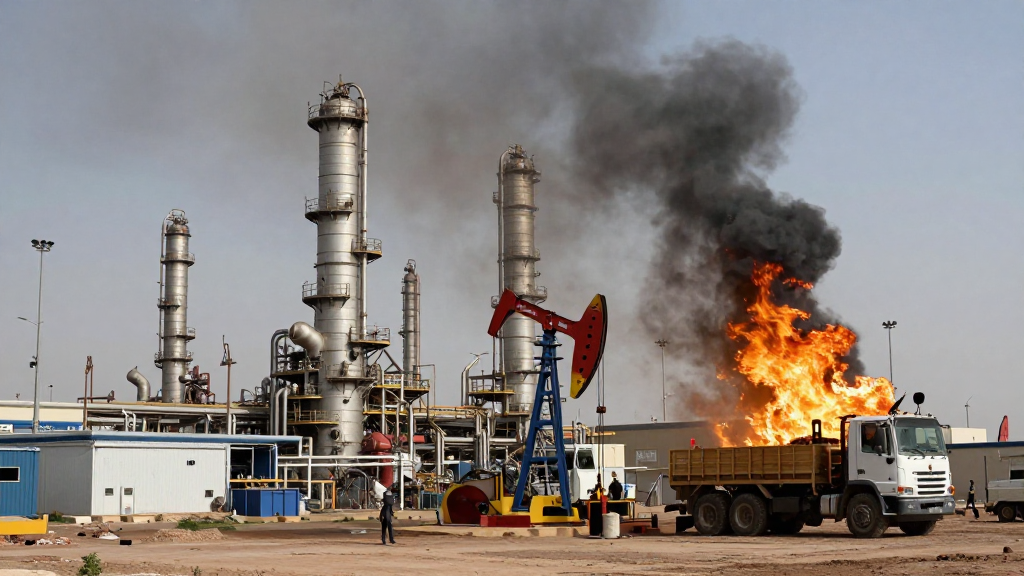
The conflict that erupted between Israel and Iran in mid-June 2026 has sent shockwaves through global energy markets at precisely the moment central banks on both sides of the Atlantic were navigating their most delicate policy pivots in years. Oil prices have climbed sharply since the opening salvos of the Iran-Israel exchange, pushing Brent crude above $94 per barrel and forcing governments in Europe to activate emergency energy consultations with Qatar, the United Arab Emirates, and Algeria. The timing could not be worse for central bankers who had been laying the groundwork for rate cuts after two years of aggressive tightening to bring inflation to heel.
The European Central Bank moved first, delivering a rate hike on June 11 — its first increase since 2023 — in direct response to the energy price shock triggered by the widening Middle East conflict. The ECB’s governing council cited a “material deterioration in the inflation outlook stemming from energy supply disruptions” as the primary driver of its decision to raise rates by 25 basis points, bringing its main refinancing rate to 4.25 percent. The move caught financial markets off guard, with traders who had been pricing in steady rate reductions now scrambling to reprice European borrowing costs. The ECB’s statement acknowledged that the geopolitical shock had complicated an otherwise encouraging disinflation trajectory, noting that energy-intensive sectors were already showing renewed pricing pressure.
The Federal Reserve Holds Its Ground
Just six days later, the Federal Reserve chose a different path. The Federal Open Market Committee voted unanimously to hold its benchmark rate at the 5.25-5.50 percent range, but the more consequential signal came from the updated dot plot — the quarterly summary of each Fed official’s interest rate projections. The median dot now shows just two rate cuts for 2026, down from three projections in March, reflecting the committee’s revised view on the persistence of inflation in the United States. The Fed’s updated Summary of Economic Projections also raised its core PCE inflation forecast to 2.8 percent for the year, up from 2.6 percent in the March round.
Federal Reserve Chair Jerome Powell, speaking at the post-meeting press conference, drew a clear distinction between a transitory energy shock and the kind of demand-side inflationary pressure that would warrant a policy response. “The U.S. economy has demonstrated considerable resilience,” Powell said. “We are monitoring the energy situation carefully, but our mandate is anchored in domestic conditions — employment and price stability — and the current data does not point to a domestically generated inflationary spiral.” The statement underscored the growing divergence between the Fed’s domestic-focused framework and the ECB’s more externally-sensitive approach to price stability.
The juxtaposition of the two central bank decisions — ECB tightening, Fed on hold — reflects fundamentally different starting points and threat assessments. The eurozone was already dealing with stagnant growth and persistent services inflation when the energy shock arrived, leaving the ECB with little room to absorb the blow without risking a resurgence of price-wage dynamics that proved so difficult to break in 2022 and 2023. The United States, by contrast, entered the shock from a position of relative strength: unemployment near 4 percent, consumption resilient, and headline inflation — if not yet at target — cooling consistently through the first half of the year.
Emerging Markets Caught in the Crossfire
For emerging market economies, the dual shock of higher energy prices and divergent developed-world monetary policy creates a toxic combination. Countries in Southeast Asia, Latin America, and sub-Saharan Africa that had been positioning themselves for capital inflows as the Fed cycle turned are now facing a more complicated calculus. If the Fed holds cuts longer than expected while the ECB hikes, the dollar-to-euro carry trade could strengthen the greenback against currencies already under pressure from higher import bills. This dynamic risks reigniting inflation in economies that had made progress bringing consumer prices down from post-pandemic peaks.
Analysts at the International Monetary Fund have flagged the confluence of geopolitical risk and monetary divergence as the central macro-financial challenge of the second half of 2026. In a research note published the week after the dual central bank decisions, the IMF’s research department warned that “the room for policy coordination across major central banks has narrowed precisely when the need for it has widened.” The report emphasized that commodity-importing emerging economies face the sharpest trade-offs, with fiscal positions in countries like Egypt, Pakistan, and Bangladesh particularly exposed to a sustained energy price elevation.
The energy market itself remains the pivotal variable. If the Iran-Israel conflict escalates further — with the potential for Straights of Hormuz disruption adding a shipping premium to an already tightening crude market — the ECB’s June hike could prove to be the first in a series of tightening moves, reversing the rate-cut trajectory that had been the consensus expectation for European markets entering 2026. Conversely, if diplomatic efforts contain the conflict and oil supplies remain uninterrupted, the ECB may have acted preemptively and could find itself navigating a growth recession with policy rates still elevated.
Fiscal Policy Becomes the Swing Variable
Beyond central bank calculus, the geopolitical shock is testing the limits of fiscal policy as a countervailing tool. European governments, still recovering from the debt sustainability challenges that followed the post-pandemic spending boom, have limited fiscal headroom to cushion households and businesses from higher energy prices without expanding deficits that could trigger market discipline in sovereign bond markets. Italy, Spain, and Greece — the eurozone’s most debt-sensitive members — face the tightest constraints, with bond spreads already widening modestly in the weeks following the ECB’s June hike.
In the United States, the fiscal picture is complicated by a separate dynamic: the Trump administration’s tariff regime, which has kept goods prices elevated and complicated the Fed’s path to 2 percent inflation even as consumption has remained buoyant. The combination of tariff-driven price pressure and energy-driven imported inflation leaves the Fed in a difficult position, needing to weigh financial stability risks from prolonged high rates against the political cost of admitting that inflation has re-accelerated on its watch. The dot plot’s shift from three cuts to two represents a modest recalibration, but market participants are watching for whether the next set of projections, due in September, will move further.
The divergence between the Federal Reserve and the European Central Bank is more than a technical monetary policy disagreement — it is a reflection of two economies navigating genuinely different inflationary realities from different starting points under the shadow of a geopolitical shock that neither central bank fully controls. The era of synchronized global rate cycles, which defined monetary policy for much of the 2010s and was dramatically repriced during the post-pandemic tightening wave, appears to be giving way to a new period of policy fragmentation. How that fragmentation interacts with a deepening Middle East conflict and its energy consequences will determine whether the global economy achieves a soft landing or stumbles into a period of sustained stagflation that tests the credibility of central banks on both sides of the Atlantic.