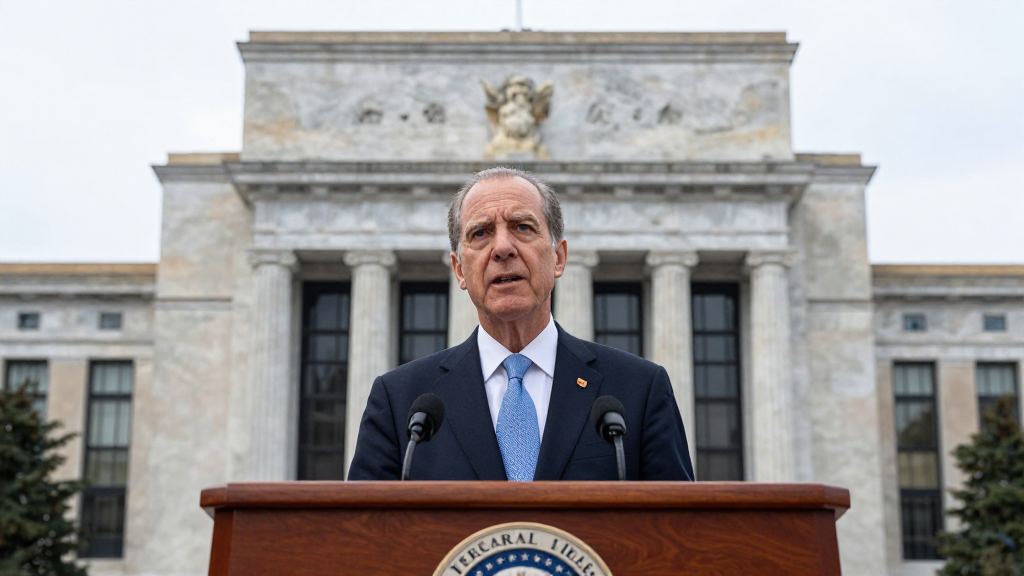
The Federal Reserve’s first policy decision under new Chair Kevin Warsh delivered exactly what markets anticipated but with an unmistakably hawkish tilt. The FOMC voted unanimously to maintain the federal funds rate at its target range of 3.5 to 3.75 percent, a move that carried a 99 percent probability according to CME FedWatch Tool pricing entering the meeting. What surprised observers was the accompanying statement and the quarterly Summary of Economic Projections, which showed policymakers penciling in one additional 25-basis-point rate increase before year-end. The median dot now points to 3.875 percent by December, a full quarter-point above the prior projection, signaling that Warsh’s chairmanship has shifted the committee’s priorities decisively toward inflation containment.
“The economic landscape has shifted materially since our last meeting,” Warsh acknowledged at the press conference following the decision, pointing to a resurgence in inflation pressures driven primarily by supply-side disruptions rather than demand overheating. Fresh consumer price index data released last week showed US inflation running at 4.2 percent annually, the highest reading in three years, with energy costs accounting for the bulk of that acceleration. May’s energy price index surged 23.5 percent month-over-month, a spike that policymakers attribute largely to the escalating US-Israel conflict with Iran and the associated disruption to shipments through the Strait of Hormuz.
The Geopolitical Inflation Shock
The conflict in the Middle East has reshaped the Fed’s inflation calculus in ways that go beyond the standard playbook. Crude oil prices have climbed sharply since hostilities intensified, pushing gasoline futures above $4.20 per gallon at the pump for the average American driver. Warsh noted that supply-side inflation shocks are inherently difficult for central banks to address through rate policy alone, but he stopped short of suggesting the Fed would look through the spike. “We are mindful that second-round effects tend to follow first-round shocks,” he said. “Our mandate is clear: price stability comes first.” The Fed’s updated projections now show the personal consumption expenditures price index, the central bank’s preferred inflation gauge, remaining above 3 percent through the end of 2026 before gradually declining toward the 2 percent target in 2027.
Beyond energy, broader price pressures are building across the global economy. The United Nations Food and Agriculture Organization’s food price index shows global food commodity prices at their highest sustained level since mid-2023, compounding the cost-of-living squeeze on households already stretched by higher transportation and utility bills. A senior economist at the International Monetary Fund, speaking on the condition of anonymity because the official forecast had not been released, told reporters that the combination of new tariff barriers and supply chain disruptions stemming from the Iran conflict could force a downward revision to global growth forecasts for the second half of 2026. The fund’s most recent World Economic Outlook, published in April, projected global growth of 3.1 percent for the year.
Market Reaction and the Dollar’s Surge
Financial markets absorbed the Fed’s message with notable turbulence. Two-year Treasury yields, which are most sensitive to near-term rate expectations, climbed roughly 15 basis points on the day to trade near 4.8 percent, reflecting the repricing of the expected rate path. The yield curve remained inverted, with the 10-year note yielding approximately 4.45 percent, a configuration that economists often interpret as a warning signal for recession risk over the next twelve to eighteen months. Equity markets declined in response, with the S&P 500 falling 0.8 percent and the technology-heavy Nasdaq Composite dropping 1.1 percent as higher discount rates weighed on valuations of future earnings. The dollar strengthened sharply against both the euro and the yen, with the euro falling below $1.04 for the first time since early 2025 and the yen weakening past 158 per dollar as the interest rate differential between the United States and other major economies widened in favor of dollar-denominated assets.
The conflict between the Fed’s hawkish pivot and the easier monetary conditions prevailing in much of the rest of the world is creating spillover effects that extend well beyond American borders. Marc Waterman, chief economist at Cambridge Alliance, warned that emerging market central banks are now trapped between competing imperatives. “If you are the central bank of Mexico, Brazil, or Indonesia, you face an impossible choice,” Waterman explained. “Follow the Fed and tighten to prevent capital outflows and currency depreciation, which crushes growth at exactly the wrong moment. Or ease to support your domestic economy and watch your currency collapse as the dollar rises. This is the dilemma that defined the 1980s Volcker era, and it is back with a vengeance.” Several emerging market currencies, including the Brazilian real and the Indonesian rupiah, have already come under pressure in early trading following the Fed’s decision.
A Fractured Global Policy Landscape
The Warsh Fed’s first decision underscores a deepening fracture in the global monetary policy consensus. While the Federal Reserve is pivoting further toward restriction, the European Central Bank is navigating its own precarious balance, with eurozone inflation still above its 2 percent target even as economic growth in the currency bloc has effectively flatlined. The Bank of Japan, which exited its negative interest rate policy only last year, now confronts a rapidly strengthening yen that threatens to derail a fragile export-led recovery. And in China, the People’s Bank of China is managing a prolonged property sector downturn while attempting to stimulate domestic consumption without further depreciating the yuan.
For global businesses and investors, the implications are profound. The era in which major central banks moved roughly in lockstep — tightening or easing together in coordinated fashion — appears to have ended decisively. Higher US rates mean a stronger dollar, which makes imports cheaper for American consumers but puts pressure on emerging market borrowers who hold dollar-denominated debt. It also complicates commodity pricing, since oil and most industrial metals are priced in dollars, meaning a stronger greenback effectively tightens global financial conditions even without any action from central banks outside the United States. The Federal Reserve may have held rates steady on Wednesday, but its influence on the global financial system was anything but neutral.