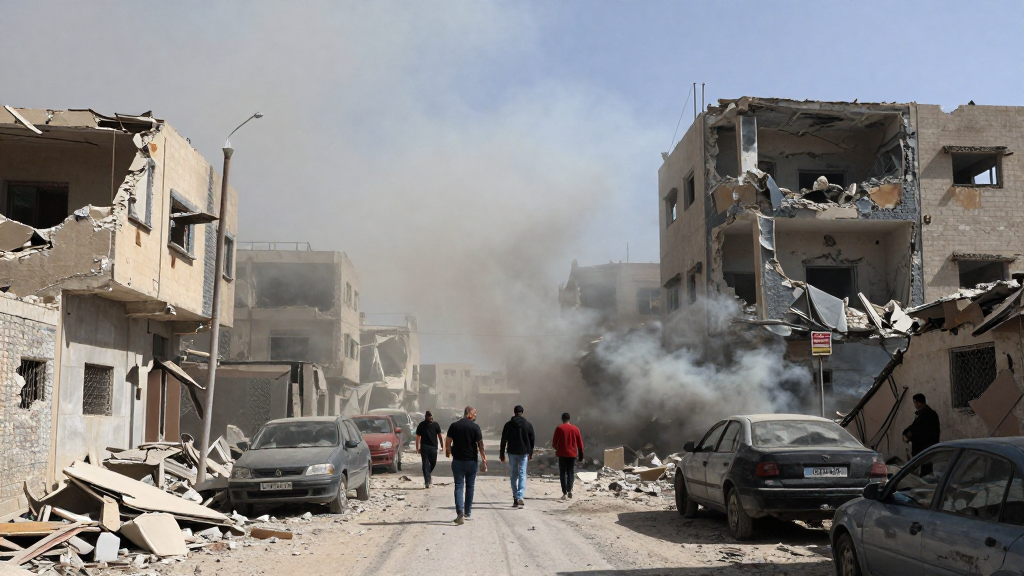
Negotiators working to halt the Israel-Hamas war in Gaza face a deepening crisis as the ceasefire framework agreed in Doha comes under severe strain following Israeli strikes in northern Gaza that killed at least 23 people, according to Palestinian health officials. The strikes, which Israel said targeted Hamas weapons storage sites adjacent to a residential area in Jabaliya, triggered immediate condemnation from Qatar and Egypt, the two mediating powers, and prompted the United Nations Special Envoy to warn that the entire diplomatic architecture was on the verge of collapse. Qatar announced it was reviewing its participation in the mediation process, a move analysts described as the most serious signal yet that the Gulf state may withdraw its diplomatic cover from the talks entirely.
The ceasefire framework, painstakingly assembled over six weeks of quiet diplomacy, had held for nine days before the strikes. Egypts Foreign Ministry issued a statement calling the strikes a blatant violation of international humanitarian law and urged the UN Security Council to intervene. The Palestinian Ministry of Health said the toll could rise as rescue workers continued to search collapsed structures. The IDF said it was reviewing the incident and that preliminary assessments indicated the structure housed a Hamas command centre. Israel has defended the strikes as necessary acts of self-defence under international humanitarian law.
Qatar Reviews Mediation Role as Ceasefire Frays
Qatars decision to review its participation marks a significant shift for a country that has invested considerable political capital in its role as a mediator between Israel and Hamas. Doha has hosted the Hamas political bureau since 2012 and has used that channel to facilitate multiple rounds of indirect talks through the years of the Gaza conflict. The move was driven by frustration with what one source described as a pattern of Israeli violations that the Biden administration declined to condemn forcefully. “We cannot continue to mediate in good faith when one party shows no willingness to honour the commitments it made at the table,” a senior Qatari official told the Financial Times. The same official warned that without a meaningful change in conduct, Qatar would have no choice but to step back from its mediating role.
The strikes in northern Gaza targeted what the Israel Defense Forces said were command-and-control facilities adjacent to a residential area. Footage circulating on Palestinian social media channels showed families carrying wounded civilians through streets littered with debris, a scene that mirrored the worst periods of the 14-month conflict. “This is exactly the kind of action that makes it impossible for us to keep our people at the table,” a Hamas political bureau member said in a statement issued from Doha. The ceasefire framework had included a phased arrangement in which Hamas would release the remaining hostages held in Gaza in exchange for a prolonged Israeli military withdrawal, increased humanitarian aid flows, and a political process aimed at eventual governance arrangements for the territory. International humanitarian organizations warned that any breakdown in the ceasefire would have immediate consequences for the 1.1 million civilians currently receiving food assistance through UNRWA and other agencies operating inside Gaza.
UN Envoy Warns of Full Diplomatic Collapse
The UN Special Envoy for the Middle East Peace Process told the Security Council in a closed briefing that the window to preserve the ceasefire was narrowing by the hour. According to diplomats in attendance, the envoy said the strikes had fundamentally altered the calculus inside Hamas and that militant commanders who had argued for continuing the diplomatic track were now facing pressure from within their own ranks to reverse course. The White House called for restraint from both sides but stopped short of directly criticizing Israel. The EUs foreign policy chief Kaja Kallas said the bloc stood ready to impose additional sanctions on actors undermining the ceasefire. “We are watching these violations with great concern and we will not hesitate to use every tool at our disposal,” Kallas told reporters in Brussels.
The breakdown comes at an already fragile moment for the region. Israel and Hezbollah have maintained an uneasy ceasefire along the Lebanon border since November, but both sides have reported violations in recent weeks, and the UN Interim Force in Lebanon said its peacekeepers had recorded a significant increase in overflights by Israeli drones along the Blue Line. In the West Bank, settler violence has escalated, and the Palestinian Authority has threatened to withdraw its administrative coordination with Israel, a move that would further complicate governance in occupied territory.
Regional analysts said the collapse of the Gaza ceasefire framework would have direct consequences for efforts to prevent the Israel-Lebanon border from escalating into a full-scale conflict. With Hamas and Hezbollah both drawing their legitimacy from armed resistance to Israel, a breakdown in one theatre inevitably affects the calculations of actors in the other. The convergence of crises has strained the diplomatic resources of the United States, European Union and Arab states simultaneously, leaving little room for a coordinated international response if the current ceasefire unravels entirely.
What Happens Next
Qatar is expected to announce its decision on continuing mediation by early next week. If Doha withdraws, the most likely alternative venue would be Cairo, though Egyptian officials have made clear they view the conditions for successful mediation as significantly degraded. The UN Security Council is scheduled to receive a full briefing on the Gaza situation early next week. Council members said a draft statement was being circulated but that agreement on language remained elusive, with the United States and Britain so far declining to endorse language that would amount to a direct condemnation of Israeli military action. Security Council action requires nine votes in favour and no vetoes from any of the five permanent members, a threshold that has historically proved difficult to reach on Middle East resolutions involving Israel.