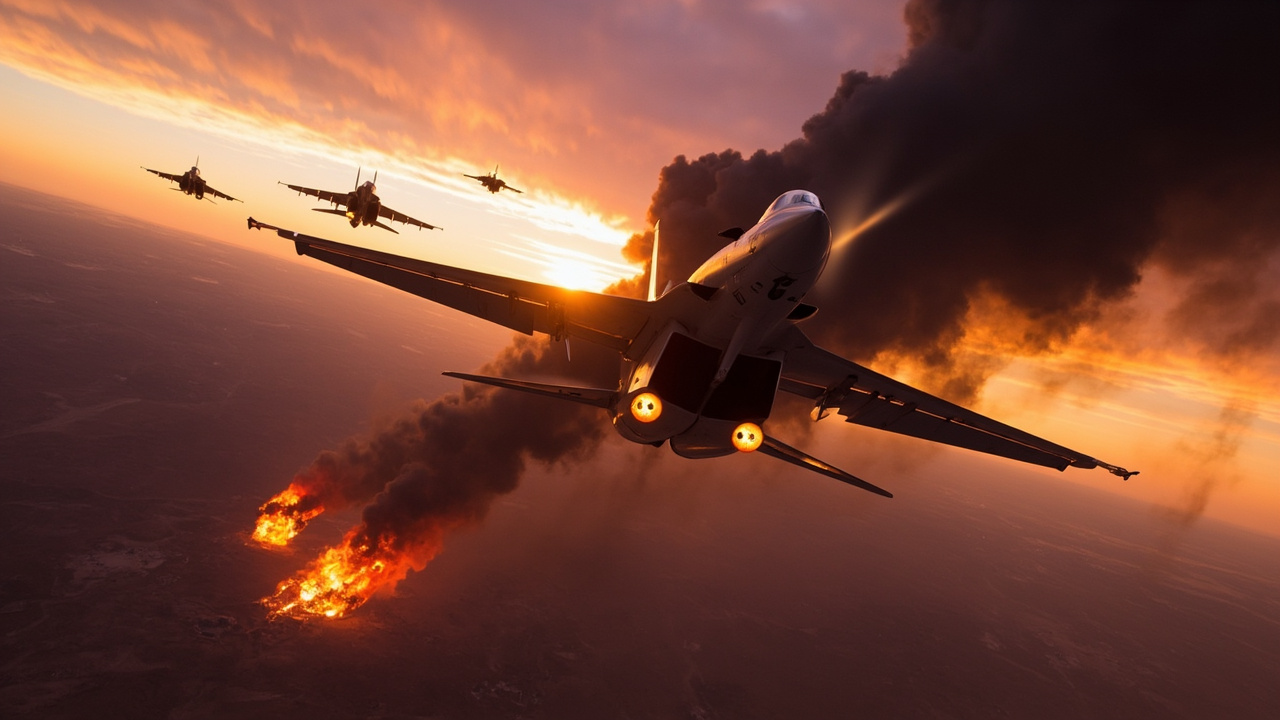
The United States and Israel launched coordinated military strikes against Iran on Saturday, officials confirmed, in the most significant escalation between Washington and Tehran in decades. The attacks, which targeted Iran’s nuclear infrastructure and Revolutionary Guard military facilities, came after weeks of failed diplomatic negotiations and followed a Iranian drone strike on a commercial vessel in the Strait of Hormuz that the White House described as an act of war.
President Donald Trump confirmed the strikes from the White House, saying the action was necessary to prevent Iran from acquiring a nuclear weapon. “We cannot allow a regime that sponsors terrorism to obtain a nuclear capability,” Trump said. “This was a targeted, proportional response to protect American lives and our allies in the region.” The President added that the strikes were designed to degrade Iran’s nuclear program without triggering a broader regional conflict.
Scope of the Military Operations
According to senior administration officials, the strikes were conducted jointly by United States and Israeli forces. American B-52 bombers flew from bases in the Gulf region while Israeli F-35 stealth fighters launched from Israeli territory. The combined operation targeted uranium enrichment facilities at Natanz and Fordow, missile production sites near Tehran, and command-and-control installations belonging to the Islamic Revolutionary Guard Corps.
Iran’s IRGC confirmed that several military sites had been struck but said its nuclear facilities remained “largely intact.” In a televised address, IRGC spokesman General Ali Fadavi warned of a “crushing and comprehensive response” and said Iran reserved the right to retaliate at a time and place of its choosing. The Pentagon acknowledged that some Iranian air defense systems had been neutralized in the opening hours of the operation, though officials cautioned that the campaign was still active.
The Israeli military said its forces had achieved all primary objectives and that no Israeli aircraft were lost during the strikes. Prime Minister Benjamin Netanyahu praised the coordination with Washington as “unprecedented” and warned that Israel would not hesitate to act again if provoked.
Diplomatic Repercussions
The strikes immediately triggered a global diplomatic crisis. The United Nations Security Council convened an emergency session at the request of Russia and China, though no formal resolution was expected given the United States’ veto power on the council. European Union foreign policy chief Kaja Kallas called the actions “extremely worrying” and urged all parties to return to negotiations immediately.
“Military force cannot be the solution to the Iranian nuclear question,” Kallas said in a statement from Brussels. “We are in direct contact with all parties and call for an immediate cessation of hostilities to prevent a full-scale war.” France, Germany, and the United Kingdom all issued similar statements, though British officials privately acknowledged that London had been briefed in advance by Washington.
Russia condemned the strikes as “unacceptable aggression against a sovereign state” and warned of consequences for regional stability. Russian Foreign Ministry spokesperson Maria Zakharova said Moscow held the United States and Israel “fully responsible” for the escalation. China’s foreign ministry called for “maximum restraint” from all parties and urged the international community to pursue dialogue rather than military solutions.
Regional Fallout
Lebanon’s Hezbollah movement, Iran’s most powerful proxy in the region, fired rockets into northern Israel within hours of the strikes beginning. The Israeli military said its Iron Dome defense system intercepted several projectiles and there were no reported casualties on the Israeli side. Hezbollah confirmed the launches, saying the strikes were a “first response” and that more would follow.
Oil markets surged on news of the strikes, with Brent crude rising more than 5 percent to surpass $95 per barrel. Analysts warned that sustained hostilities could push prices above $100 and strain global economic growth already facing pressures from inflation and supply chain disruptions. The Pentagon said it was monitoring energy markets closely but declined to discuss contingency planning for a potential oil supply shock.
Ukraine’s president welcomed the strikes as evidence that the United States was prepared to act decisively against adversaries, while the Taliban in Afghanistan issued a statement warning that the escalation could destabilize the entire region. Iraq’s government called an emergency cabinet meeting and said it would not allow its territory to be used as a launchpad for attacks on Iran.
Speaking from the Vatican, Secretary of State Marco Rubio called world leaders to rally behind American diplomacy and warned that the window for a negotiated settlement was narrowing rapidly. “The international community must now decide whether it stands with peace or with the sponsors of terrorism,” Rubio said, adding that the United States remained open to a diplomatic resolution if Iran agreed to permanently dismantle its enrichment program.