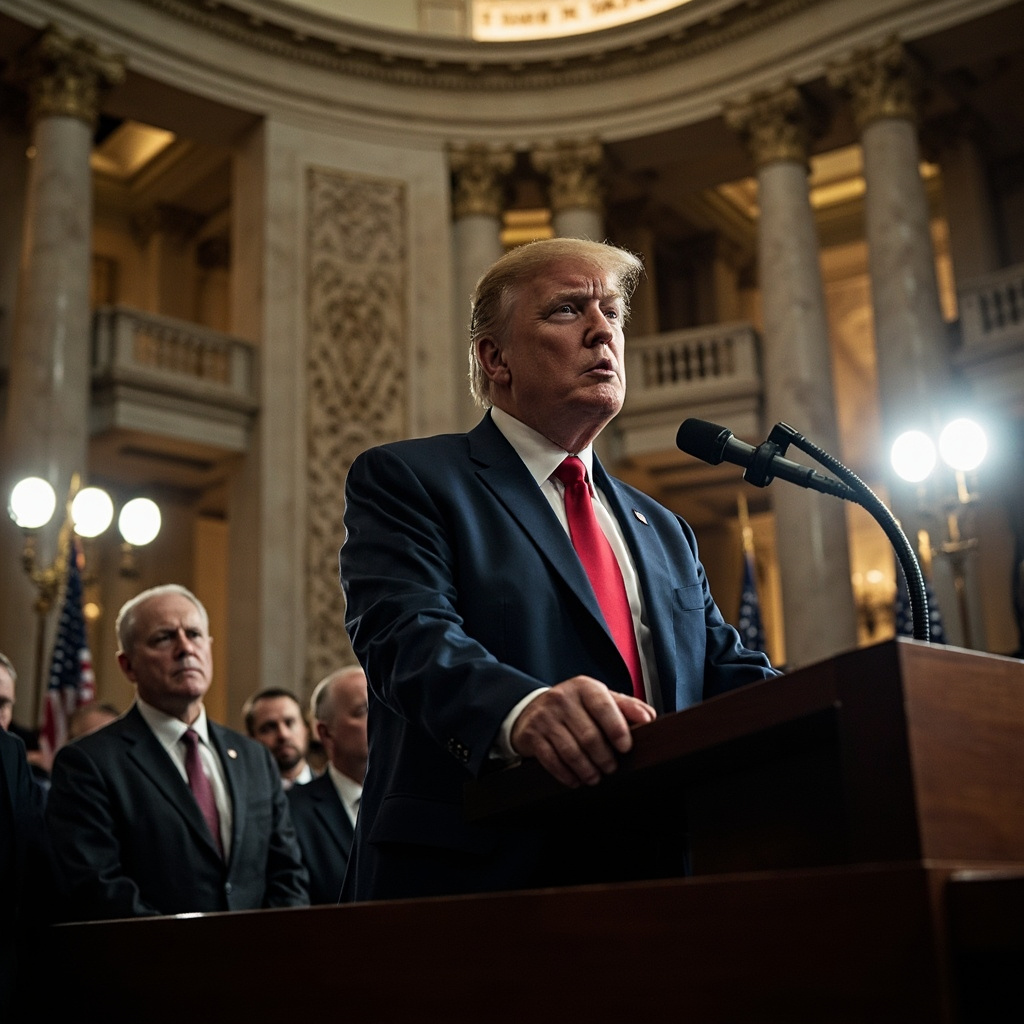
President Donald Trump abruptly canceled a planned signing ceremony for a landmark bipartisan housing affordability bill on Wednesday, stunning congressional leaders from both parties and throwing the measure into deep uncertainty just hours before it was set to become law. Trump announced the cancellation via Truth Social, saying he would not act on the housing legislation until Congress passed his controversial SAVE America Act, a sweeping voter identification measure that has stalled in the Senate. The reversal marked a chaotic day on Capitol Hill and deepened divisions within the Republican conference heading into the 2026 midterm elections.
House Speaker Mike Johnson, R-La., and Senate Majority Leader John Thune, R-S.D., had announced just days earlier that Trump would sign the housing package in Statuary Hall at noon on Wednesday, casting it as a rare bipartisan triumph. The measure, which cleared both chambers with overwhelming support, aimed to increase housing supply, cap the amount of single-family homes private equity firms can purchase, and expand mortgage financing options for first-time buyers. Members of both parties had eagerly positioned themselves to campaign on the legislation, which addresses one of the most persistent pocketbook complaints from voters across the political spectrum.
Trump’s Demand: Voter ID Before Housing
Trump’s cancellation caught even his own party’s leadership off guard. “Today’s Housing News Conference and Signing is hereby cancelled until such time as we pass the desperately needed SAVE AMERICA ACT, which I consider to be a National Emergency,” Trump wrote on Truth Social, less than 90 minutes before he was scheduled to appear at the Capitol. The SAVE America Act would impose nationwide voter identification requirements and further restrict noncitizen voting in U.S. elections, a practice that is already rare and illegal in federal contests. The House passed the measure in February, but it faces a steep climb in the Senate, where Republicans fall well short of the 60 votes needed to overcome a Democratic filibuster.
The president has 10 days to sign or veto a bill once it reaches his desk, a ticking clock that gives Congress almost no time to push through the SAVE America Act before the housing measure could face a potential veto. Senate Majority Leader Thune told reporters at the Capitol that he still hoped the housing bill would ultimately become law. “It’s a great piece of legislation that increases the supply of housing and the availability of credit to afford homes, so it’s an affordability issue, and eventually I hope he finds a way to sign it,” Thune said. House Speaker Johnson, speaking at a GOP news conference, suggested the SAVE America Act’s best hope lay in the Senate budget reconciliation process — though legal experts have questioned whether an election reform bill qualifies under reconciliation rules.
Tense Lunch: Cassidy Confronts the President
The housing bill cancellation was only the opening act of a volatile day on Capitol Hill. Trump traveled to the Senate side of the Capitol after canceling the signing ceremony to meet with Republican senators — a lunch convened at the invitation of Sen. Rick Scott, R-Fla., rather than through the usual channels managed by Thune and party leadership. The gathering quickly grew contentious. Sen. Bill Cassidy, R-La., who lost his Republican primary last month after Trump endorsed his primary opponent, directly confronted the president over the administration’s handling of the Iran situation, according to multiple people in the room.
“I’m not going to be bullied when I feel like I’m asking a question the American people need to know,” Cassidy told reporters after the meeting, describing an exchange that he said escalated from a pointed question into a personal confrontation. “And so at that point it began to escalate.” Sen. Ted Cruz, R-Texas, offered a more restrained characterization, calling the exchange a “spirited discussion.” Sen. Jim Justice, R-W.Va., said it was not “super combative, but very passionate.” Trump, for his part, was dismissive when asked about the confrontation upon leaving the Capitol. “I think we had a really great meeting,” he told reporters. “We like our leader. … I don’t like a few people, but that’s OK. I think you know who they are.”
What’s Next: A Bill in Limbo and a Party at Odds
The fate of the bipartisan housing package now rests entirely with the White House. Without presidential action, the bill will die by autograph veto — a scenario that neither party anticipated when it passed Congress. Republican strategists had counted on the legislation as a major electoral asset heading into November, a tangible achievement on the kitchen-table issue of housing costs that resonates across suburban and rural districts alike.
The SAVE America Act continues to face structural obstacles that Trump has so far been unable to overcome. Senate Republicans have discussed either eliminating the filibuster entirely or attaching the voter ID measure to a larger reconciliation bill, but both approaches carry significant political and procedural risks. Democrats are united in opposition, and outside groups are already mobilizing to make the fight over election rules a centerpiece of their 2026 messaging. With the midterm calendar tightening, Republican lawmakers face mounting pressure to deliver visible wins — and the whiplash of Wednesday’s canceled ceremony has left both chambers searching for a way to regroup.