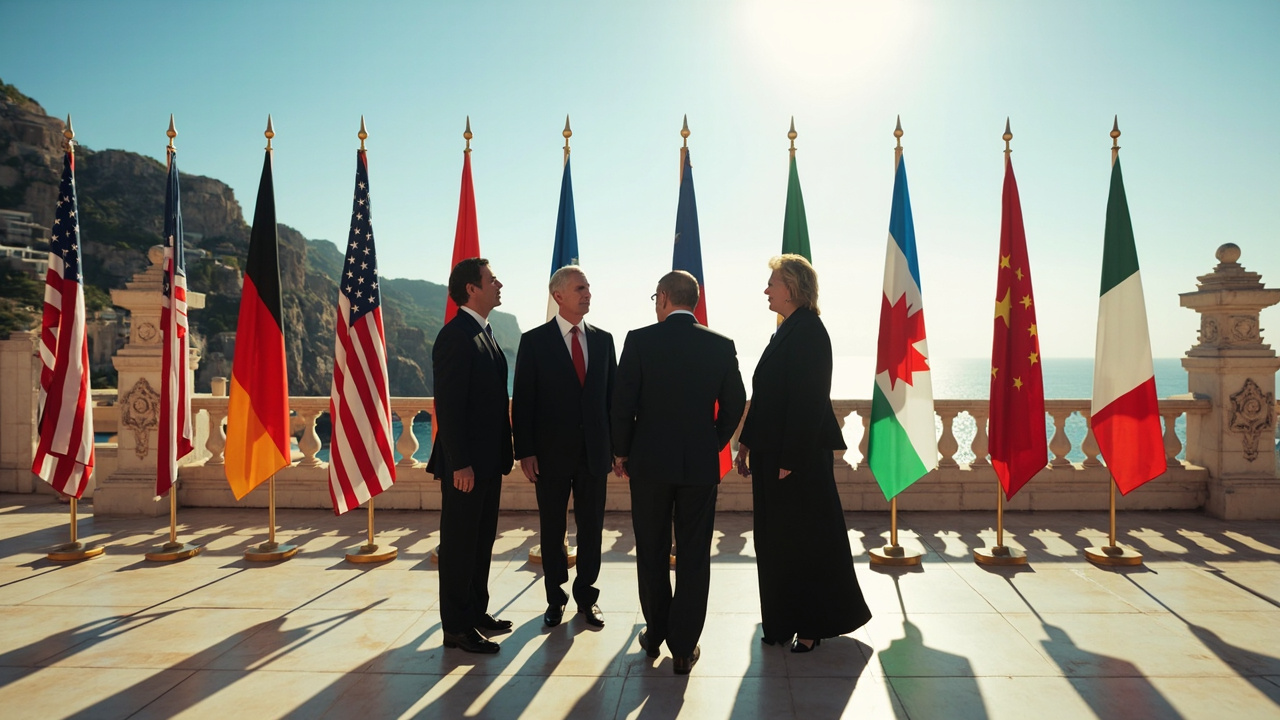
G7 leaders threw their collective weight behind President Donald Trump’s strategy to end the Iran war on Tuesday, issuing a joint statement at the close of their summit in Taormina, Sicily, that endorsed the fragile ceasefire framework agreed in Oman earlier this month. The declaration marked a rare moment of transatlantic unity on a conflict that has reshaped energy markets, strained alliances, and put hundreds of thousands of lives in the balance.
The United States launched coordinated strikes against Iranian nuclear facilities in March, retaliating for Tehran’s ballistic missile attacks on commercial shipping lanes in the Persian Gulf. A ceasefire brokered by Oman and the United Arab Emirates took effect in mid-May, but implementation has moved in fits and starts, with both sides accusing the other of violations along the contested frontier regions of Iraq and Syria.
The G7 statement called on Iran to grant International Atomic Energy Agency inspectors full access to its enrichment sites as a condition for maintaining sanctions relief. It also demanded that Tehran halt support for proxy forces across the region, a provision that diplomats acknowledged was the most contentious element of the communique.
Ceasefire Under Strain
Since the ceasefire took hold, instances of armed confrontation have diminished but not ceased. On the ground in Iraq, sporadic clashes between Iranian-backed militia units and Iraqi security forces have raised questions about how fully Tehran can control the armed groups it has cultivated over two decades. The United States has retained a contingent of forces in the region, and American officials have warned that the ceasefire will hold only as long as Iran demonstrates verifiable compliance.
French President Emmanuel Macron, speaking alongside the German and Italian heads of government at the summit’s closing press conference, said the G7 was prepared to reimpose coordinated sanctions within days if Iran violated the monitoring provisions. “The door to a permanent agreement remains open, but it will not remain open indefinitely,” Macron told reporters. The French president added that Paris was in active discussions with Tehran through the Omani channel and that a full nuclear accord would require Iran’s complete and audited dismantling of its intermediate enrichment infrastructure.
British Prime Minister Keir Starmer, who hosted a bilateral meeting with Japanese Prime Minister Shigeru Ishiba on the margins of the summit, said London was prepared to contribute naval patrol vessels to monitor the Strait of Hormuz, a critical artery for global oil shipments that Iran briefly threatened to blockade during the height of the conflict.
Regional Reactions and Diplomatic Channels
Israel’s government responded coolly to the G7 endorsement, with a spokesperson for the prime minister’s office saying that any ceasefire that left Iran’s enrichment capacity intact was “a temporary arrangement dressed as a lasting achievement.” Israel conducted a separate series of strikes against Hezbollah military installations in Lebanon in April and May, and officials in Jerusalem have reserved the right to act unilaterally if they determine that the ceasefire framework serves as a cover for Iran’s nuclear advancement.
Saudi Arabia and the United Arab Emirates, both of which attended the G7 summit as guest participants, welcomed the statement but urged the international community to establish a permanent monitoring mechanism for the strait. The two Gulf monarchies have recalibrated their own diplomatic postures since the ceasefire, seeking to avoid being drawn into a broader regional conflagration while positioning themselves as indispensable partners in any post-conflict reconstruction effort in Iraq and Syria.
Secretary of State Marco Rubio, who led the American delegation, met separately on the summit’s second day with the Vatican secretary of state, Cardinal Pietro Parolin, in a discussion that touched on the humanitarian situation in Gaza and the plight of Christian communities in northern Iraq. The State Department said Rubio also held informal talks with Russian Deputy Foreign Minister Sergei Ryabkov on the margins of the G7, though officials cautioned that Moscow’s role in enforcing the ceasefire remained ambiguous.
What Comes Next
Diplomats warned that the next sixty days would be decisive. The IAEA team is scheduled to resume inspections at the Fordow and Natanz facilities under a revised monitoring protocol agreed in Muscat. If Iran grants full access and the agency confirms no new construction activity, a second tranche of sanctions relief could follow, clearing the path for formal nuclear talks to begin in Geneva.
However, the political calculus inside Tehran remains opaque. Supreme Leader Ayatollah Ali Khamenei has publicly endorsed the ceasefire while simultaneously warning that Iran would not surrender its right to peaceful nuclear technology. Hardliners within the Islamic Revolutionary Guard Corps have expressed opposition to any arrangement that permits international inspectors on Iranian soil, and analysts say the internal debate could fracture along generational and institutional lines.
For now, the G7 communique provides the ceasefire with its strongest international endorsement since the Oman talks concluded. Whether it produces a durable resolution or merely pauses a conflict that has already cost thousands of lives will depend on events that diplomats say they cannot fully control. The next inspection report from Vienna will arrive before the end of July, and world capitals are already preparing contingency measures should it contain evidence of renewed enrichment activity.