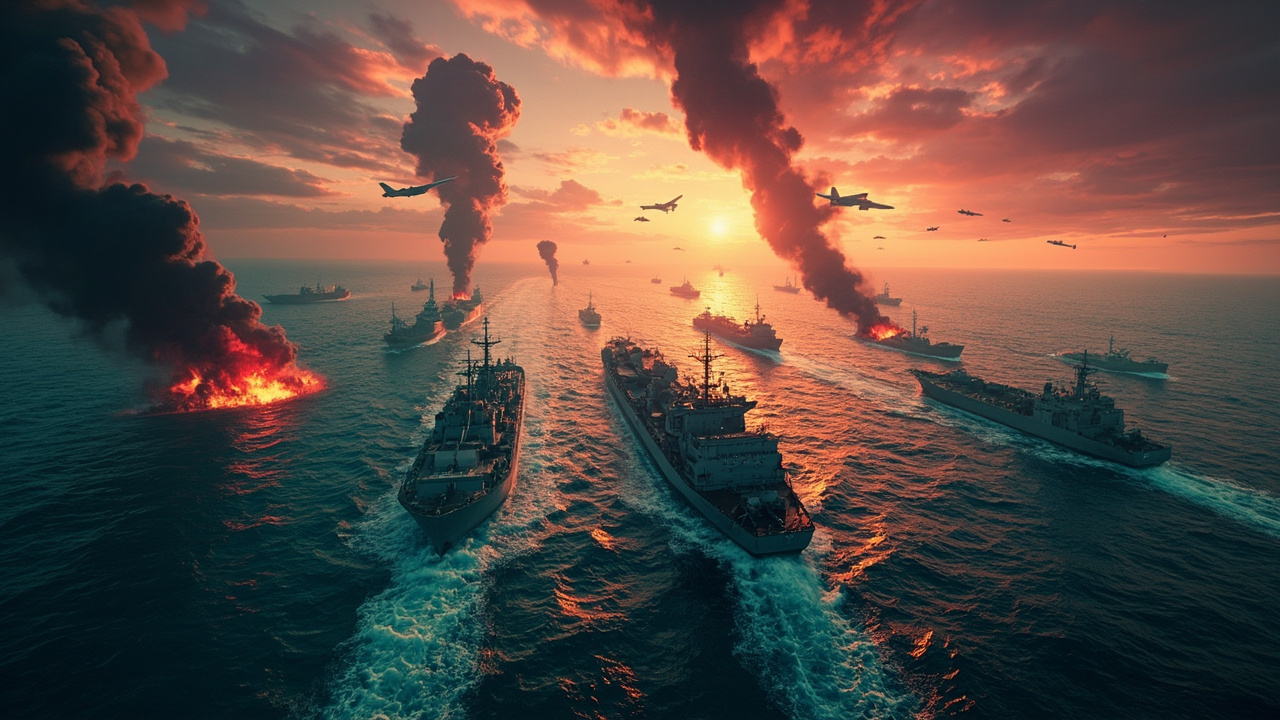
Iran launched drone and missile attacks targeting Bahrain and Kuwait on Sunday, officials in both Gulf states confirmed, responding to a wave of US airstrikes that hit Iranian nuclear and military facilities over the preceding days and bringing the Strait of Hormuz — through which roughly a fifth of the world’s oil and natural gas passes — into the center of an escalating regional confrontation.
Bahrain’s Interior Ministry said Iranian strikes damaged a residential building near the island’s international airport, though no casualties were reported. Kuwait’s military said air defenses intercepted two ballistic missiles and multiple drones Sunday morning. The attacks followed US F-15E and F/A-18 strikes on nine targets inside Iran, including an uranium enrichment facility near Natanz and a ballistic missile production site outside Isfahan, which the Pentagon said were retaliation for a drone attack that killed three American contractors aboard a commercial tanker transiting the Strait of Hormuz earlier in the week.
Iran Threatens to Halt Peace Talks
Iran’s foreign minister, Abbas Araghchi, speaking during a state visit to Baghdad, issued a stark warning that continued US military action would collapse the nascent ceasefire negotiations. “Any interference in this matter, any attempt to establish new or separate arrangements from those currently being carried out by the Islamic Republic of Iran, will only lead to further complications, delay the reopening of the Strait of Hormuz, and increase the level of tension,” Araghchi said during a press conference with his Iraqi counterpart. The statement came after a multinational maritime body operating under a UN mandate and overseen by the US Navy announced it was expanding a shipping route near Oman to bypass Iranian-controlled waters in the strait.
Secretary of State Marco Rubio, who met separately with Bahrain’s King Hamad bin Isa Al Khalifa on Thursday in Zallaq, Bahrain, said the United States remained committed to a diplomatic resolution but would not tolerate attacks on allies. “We have made clear that any escalation by Iran will be met with a full and overwhelming response,” Rubio said in a State Department statement issued Sunday. The 60-day memorandum of understanding signed by Washington and Tehran earlier this month, covering shipping arrangements through the strait, sanctions relief, and the disposition of Iran’s enriched uranium stockpile, is now in serious jeopardy.
Regional Fronts Widen as Gulf States Come Under Fire
The Kuwaiti military said it detected and intercepted two ballistic missiles and several drones with no injuries or significant damage reported. Kuwait hosts the Al Jaber Air Base, one of the largest US Army installations in the Middle East, and the Pentagon said the base was not struck. Bahrain, home to the US Fifth Fleet’s naval headquarters, raised its alert level to the highest classification and temporarily closed its airspace to non-military traffic following the strikes. The residential building struck near Bahrain’s international airport was largely destroyed, according to photos circulated by Bahrain’s state news agency, though officials said the site was unoccupied at the time.
Saudi Arabia issued a similar airspace advisory to commercial carriers, and the United Arab Emirates said it was coordinating with American and allied naval forces operating in the Gulf. Israel’s northern border also saw fresh violence Sunday when an Israeli soldier was killed by Hezbollah fire, threatening a separate but related ceasefire arrangement between Israel and the Lebanese armed group. The overlapping crises deepened concern in European capitals that the original US-Iran framework — already fragile — may not survive the current round of fighting.
Strait of Hormuz Becomes Ground Zero for Broader Conflict
The Strait of Hormuz has emerged as the flashpoint at the heart of the wider confrontation. A United Nations-brokered multinational maritime body began routing commercial traffic through Omani waters under US Navy protection, a move Iran described as a violation of its sovereignty over the strategic waterway. Iranian forces attacked vessels using the new Omani route on two occasions in recent days, according to maritime security officials who spoke to the AP on condition of anonymity because they were not authorized to discuss the matter publicly.
Brent crude oil prices climbed to $94.20 per barrel following the latest Iranian strikes, while Lloyd’s of London said it was treating the Persian Gulf as a high-risk zone for war risk insurance purposes. Lloyd’s warned that premiums for vessels transiting the area had reached levels not seen since the tanker wars of the 1980s. The UN Security Council held an emergency session Monday at the request of Russia and China, though diplomats said any binding resolution was unlikely given deep divisions among the permanent members.
What Comes Next
The Trump administration reimposed sweeping Iran sanctions last month and withdrew from indirect nuclear talks hosted by Oman, leaving few established channels for communication. Iranian officials have said repeatedly that they will not negotiate under military duress. The 60-day interim agreement — covering sanctions relief, a US blockade lift, and Iran’s enriched uranium stockpile — faces its most serious test as both sides appear to be hardening their positions. Regional oil markets are expected to remain volatile, and satellite imagery analyzed by the Center for Strategic and International Studies showed an increased concentration of Iranian naval vessels near the strait’s narrowest point, suggesting preparations for a potential interdiction of commercial traffic that does not route through Iranian-controlled channels.
The confrontation shows no immediate sign of de-escalation. Both Washington and Tehran have ruled out further negotiations under current conditions, and US defense officials have ordered the USS Truman carrier group to remain on station in the northern Arabian Sea indefinitely, leaving the strait and its vital shipping lanes at the center of the most serious US-Iran standoff since the early 1990s.
The confrontation shows no immediate sign of de-escalation. Both Washington and Tehran have ruled out further negotiations under current conditions, and US defense officials have ordered the USS Truman carrier group to remain on station in the northern Arabian Sea indefinitely, leaving the strait and its vital shipping lanes at the center of the most serious US-Iran standoff since the early 1990s.
The confrontation shows no immediate sign of de-escalation. Both Washington and Tehran have ruled out further negotiations under current conditions, and US defense officials have ordered the USS Truman carrier group to remain on station in the northern Arabian Sea indefinitely, leaving the strait and its vital shipping lanes at the center of the most serious US-Iran standoff since the early 1990s.