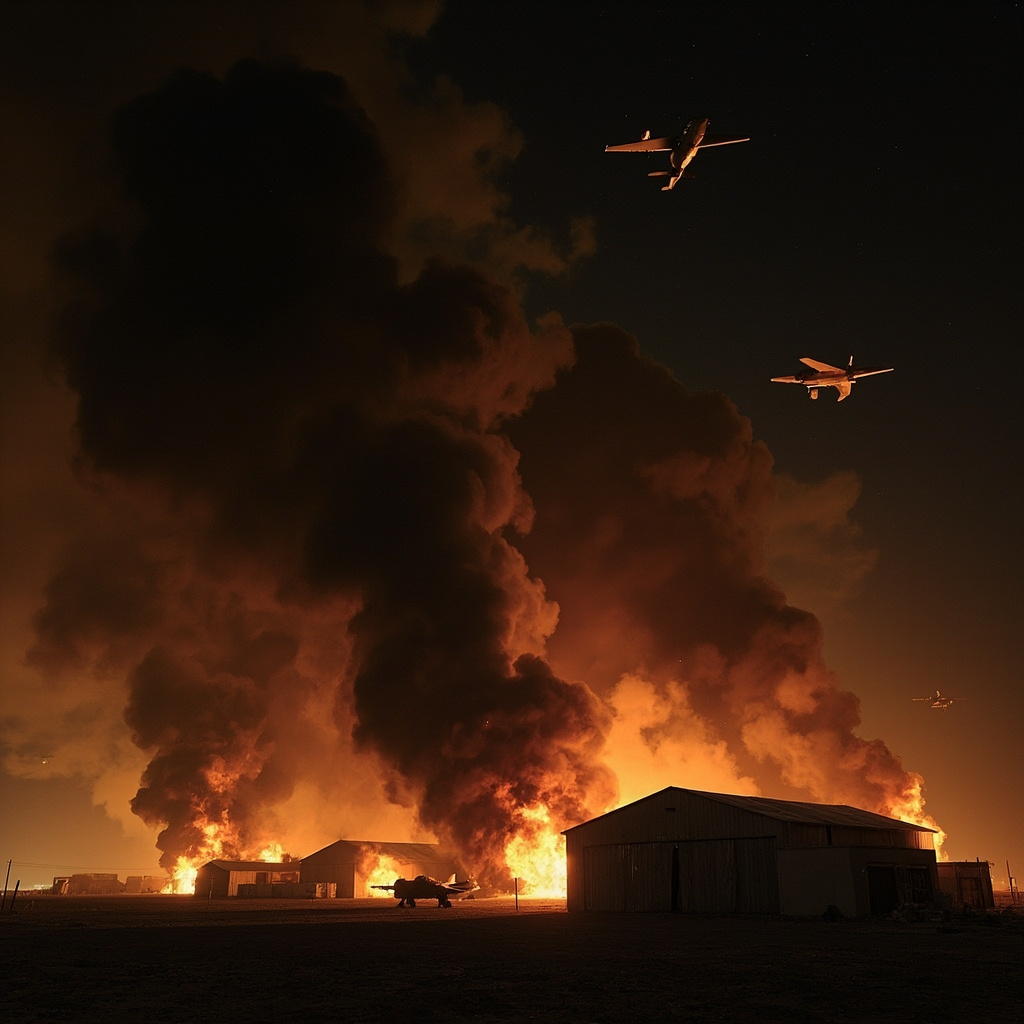
Iran launched attacks on U.S. military installations in Kuwait and Bahrain on Sunday, officials confirmed, marking a dramatic escalation that threatens to unravel a fragile ceasefire agreement signed just 11 days ago between Washington and Tehran. The Islamic Revolutionary Guard Corps said it fired ballistic missiles and drones at the U.S. Ali Al Salem airbase in Kuwait and the U.S. Fifth Naval Fleet at Port Salman in Bahrain, in what it described as a direct response to American strikes on Iranian soil.
The exchanges of fire represent the most serious breach yet of the Memorandum of Understanding negotiated between the United States and Iran earlier this month. That agreement, signed on June 17, extended a ceasefire in the broader U.S.-Israel war on Iran that began with strikes on February 28, granting both sides 60 days to negotiate a permanent resolution. Within days of the deal, access through the Strait of Hormuz — through which roughly 20 percent of the world oil passes — became a central point of contention.
Escalation and the Collapsing Truce
The latest spiral of violence began on Thursday, when an Iranian drone struck the Singapore-registered Ever Lovely container ship near the Strait of Hormuz. The U.S. military responded with strikes on Iranian monitoring and surveillance installations near Sirik and along the southern coast on Friday. On Saturday, the Pentagon ordered additional strikes on five Iranian targets at multiple locations near the Strait of Hormuz, including Sirik, Bandar-e Lengeh, and Qeshm Island. According to U.S. Central Command, those strikes killed at least 10 people. Iran Ministry of Foreign Affairs condemned the attacks as a “blatant violation” of the MoU and the United Nations Charter.
Bahrain Interior Ministry confirmed one of its residential buildings in Muharraq was hit by an Iranian drone. Manama condemned the attack as a violation of its sovereignty and said it “undermined opportunities for de-escalation and stability in the region.” Kuwait likewise branded the strikes a “flagrant violation of its sovereignty.” Qatar, Jordan, and the United Arab Emirates also issued statements condemning the attacks, with the UAE describing them as a “blatant violation” of international law.
Trump Warns of Total Destruction
President Donald Trump issued his starkest warning yet on Saturday, posting on social media that Tehran had violated the ceasefire agreement and that the United States might be forced to militarily complete the job. “There may come a point when we are no longer able to be reasonable, and will be forced to militarily complete the job that we very successfully started,” he wrote. “If that happens, the Islamic Republic of Iran will no longer exist!”
U.S. Ambassador to the United Nations Mike Waltz reinforced that message on Sunday, telling Fox News that President Trump patience “is not going to last forever.”
“If the Iranian regime thinks for a second that President Trump is going to sit by, stand by, while Iran continues to attack international shipping without a response, or our bases without a response, they are sadly mistaken,” Waltz said. He added that the U.S. would continue to militarily, if needed, take down infrastructure that Iran tries to use to illegally control an international waterway.
Iranian Foreign Minister Abbas Araghchi, speaking in Iraq, warned that the Strait of Hormuz would remain under the total oversight and management of Iran throughout the remaining 30 days of the ceasefire. He called on all parties to honor their obligations under the MoU, adding that new developments would result in exacerbating the situation and could derail negotiations entirely.
What Comes Next
Wolfgang Pusztai, a defense analyst tracking the conflict, told Al Jazeera that while neither Washington nor Tehran has an interest in a broader war, the risk of unintended escalation remains dangerously high.
“If there are some hits in residential areas, if a larger number of civilians are getting killed in the Arab Gulf states, if an American base is hit severely so that American soldiers are killed, this might easily get out of control,” he said.
The ceasefire agreement gave both sides 60 days to negotiate a permanent end to hostilities. The latest strikes have left that timeline in serious doubt. Diplomatic channels remain technically open, but the exchange of ultimatums from both sides suggests the window is narrowing rapidly. The world is watching whether the two most powerful adversaries can pull back from the brink, or whether a miscalculation will transform a regional conflict into something far wider.