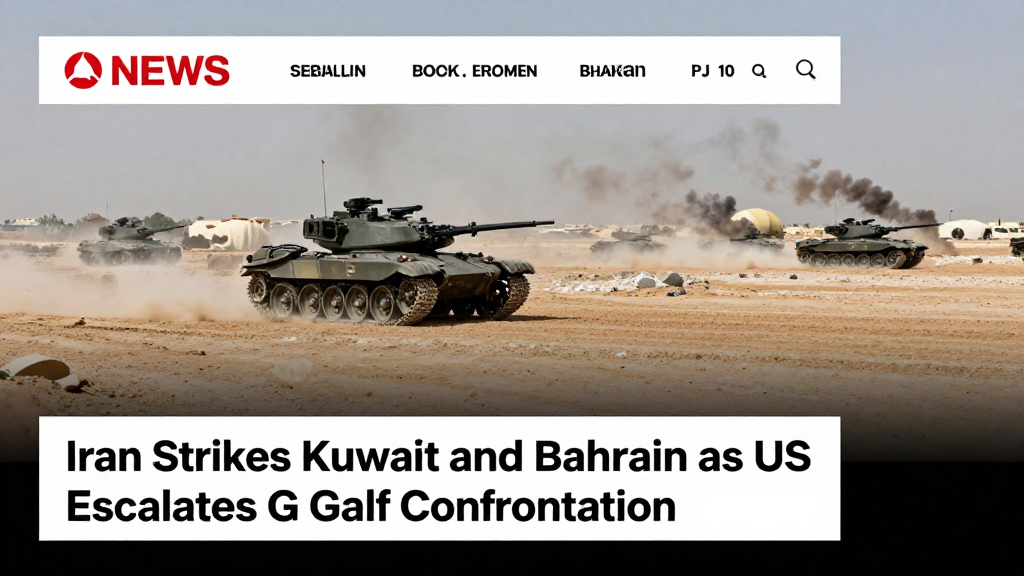
Iran launched drone and missile strikes against Kuwait and Bahrain in the early hours of Sunday, officials in both Gulf states confirmed, hours after the United States launched its own wave of attacks on Iranian military installations near the Strait of Hormuz. The twin assaults marked a dramatic widening of the five-week-old conflict and threatened to unravel a fragile 60-day ceasefire that both Washington and Tehran have accused each other of violating.
President Donald Trump issued his starkest warning yet, writing on Truth Social that the United States may be forced to “militarily complete the job that we very successfully started.” He added: “If that happens, the Islamic Republic of Iran will no longer exist.” The post followed U.S. Central Command’s announcement that American fighter jets had struck 10 Iranian military targets in and near the Strait of Hormuz on Saturday, targeting drone storage facilities, coastal radar sites, air defense positions and communication systems. The strikes were ordered in retaliation for an Iranian drone attack on the Panamanian-flagged oil tanker M/T Kiku as it transited the strait carrying more than two million barrels of crude oil.
Ceasefire Collapses Amid Mutual Recriminations
The escalation pushes both sides deeper into a cycle of retaliation that has defied multiple attempts at de-escalation. The United States and Iran had been holding talks under a 60-day ceasefire brokered with the expectation of reaching a permanent peace agreement. Both governments signed a memorandum of understanding more than a week ago aimed at ending their war. Within days, however, the accord began fraying. The U.S. military struck Iranian targets on Friday after Trump accused Tehran of a “foolish violation” of the ceasefire by launching drone attacks on commercial vessels in the strait. Iran on Thursday struck the Singapore-flagged cargo ship Ever Lovely off the coast of Oman.
“There may come a point where we are no longer able to be reasonable, and will be forced to militarily complete the job that we very successfully started,” Trump wrote Sunday. He has repeatedly threatened to send Iran back to the “stone age,” raising in a previous post the specter of nuclear war and warning that “a whole civilization will die tonight.”
Gulf Allies Under Direct Attack
Iran’s Ministry of Defense confirmed Sunday that its armed forces had struck U.S. military installations inside Kuwait and Bahrain in what it described as a “reciprocal response” to American attacks on its coastal infrastructure. Kuwait’s army said its air defenses were “confronting hostile missile and drone attacks.” The strikes represented a significant escalation because they directly targeted two countries that host U.S. military personnel and assets. Bahrain is home to the U.S. Navy’s Fifth Fleet headquarters.
Bahrain’s Ministry of Foreign Affairs issued a sharp condemnation, saying: “What Tehran is doing is not a passing act, nor an isolated incident, but rather a deliberate approach and a systematic pattern of repeated aggression.” The statement described the attacks as “a dangerous escalation that violates international law and the sovereignty of the Kingdom of Bahrain.”
Regional reaction was swift. The United Arab Emirates and Qatar, both of which have been repeatedly struck by Iranian projectiles in recent weeks, condemned the attacks on Bahrain and Kuwait as violations of sovereignty and international law. Saudi Arabia also denounced Iran, citing both the strikes on its neighbors and “the security and freedom of navigation in the Strait of Hormuz,” according to a statement carried by the official Saudi Press Agency.
Oil Markets React as Vital Shipping Lane Remains Under Threat
Despite the attacks, U.S. Central Command said commercial vessel transits through the Strait of Hormuz continue. Oil prices, however, extended declines on Friday as more tankers chose to reroute away from the critical waterway, easing near-term supply concerns. International benchmark Brent crude futures for August settled down 4.34 percent at $71.99 per barrel, while U.S. West Texas Intermediate futures for August declined 3.74 percent to close at $69.23 per barrel. The last time WTI futures closed below $70 was on February 27, the day before the start of the Iran war.
The conflict has disrupted one of the world’s most vital energy chokepoints. Roughly 20 percent of global oil supply passes through the Strait of Hormuz, and insurers have imposed sweeping war-risk premiums on vessels transiting the area. Several major shipping companies have rerouted vessels around the Cape of Good Hope, adding roughly two weeks to journey times and increasing costs significantly.
Diplomatic Channels Still Open, Officials Say
Despite the escalating violence, American officials insisted Sunday that diplomatic channels with Tehran have not been fully severed. The State Department said talks are continuing through intermediaries in Oman, which has served as the principal mediator since the conflict began. “We remain at the table,” a senior official told reporters, speaking on condition of anonymity because of the sensitivity of the discussions. “But Iran must cease its attacks on shipping and its neighbors, or there will be no deal.”
Iran’s foreign minister, Abbas Araghchi, said Saturday that Tehran was prepared to return to the negotiating table but blamed Washington for the breakdown in the ceasefire. “The United States has violated every provision of the memorandum of understanding,” he said in a statement carried by Iranian state media. “Until Washington demonstrates genuine good faith, Iran will respond to every aggression with proportional and decisive force.”
What comes next remains deeply uncertain. Kuwait and Bahrain have requested emergency defensive assistance from the United States, and the Pentagon said it was moving additional air defense systems to the region. Israel, which has conducted its own strikes inside Iran throughout the conflict, has so far remained on the sidelines of the latest exchange but has warned it will act if Tehran crosses what it describes as irreplaceable red lines. The UN Secretary-General called on all parties to halt operations and return to the ceasefire framework, saying the risk of a broader regional war is “real and growing.”