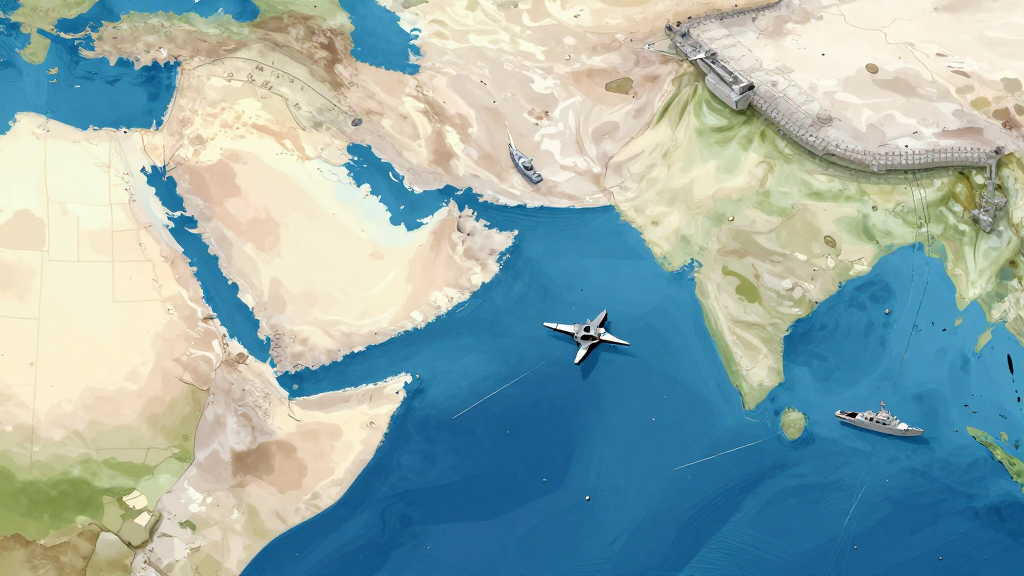
Iran’s Revolutionary Guard Corps said Saturday that a coastal defense battery intercepted an unidentified drone flying near the Strait of Hormuz, the second such incident in the Persian Gulf in less than a week, according to a statement carried by the official IRNA news agency. The encounter, which took place roughly 45 kilometers east of the Iranian island of Qeshm, triggered temporary restrictions on commercial shipping through one of the world’s busiest oil corridors before authorities lifted them within hours.
The Bahrain-based U.S. Naval Forces Central Command confirmed in a brief statement that one of its unmanned aerial vehicles had been conducting routine surveillance in international airspace when it lost contact with its ground control station. The command said it was investigating the cause of the loss and that no U.S. personnel were harmed. The incident comes as diplomatic efforts to revive the 2015 Iran nuclear deal remain stalled, with European mediators warning this month that the window for a negotiated solution is narrowing.
Bahrain’s Foreign Ministry summoned Iran’s charge d’affaires in Manama to protest what it called a “dangerous escalation” after debris from the drone was recovered in Bahraini territorial waters. The ministry said the object that crashed was a medium-altitude long-endurance unmanned system consistent with the U.S. Navy’s Scan Eagle platform. “Such reckless acts threaten regional stability and freedom of navigation,” the statement read.
Escalating Drone Incidents in Gulf Waters
The incident marks the latest in a series of encounters between U.S. and Iranian forces in the Persian Gulf and Gulf of Oman that have raised concerns among allied navies operating in the region. In March, a U.S. Navy destroyer fired warning shots at an Iranian fast attack craft that approached within 150 yards of the vessel in the Gulf of Oman. Last month, a separate Iranian drone flew within 1,000 feet of a U.S. Air Force aircraft over the same body of water, prompting a formal protest through Swiss intermediaries who handle U.S.-Iran diplomatic communications.
General Michael Kurilla, commander of U.S. Central Command, told reporters at a security forum in Bahrain that the accumulated incidents amount to a “deliberate campaign of harassment.” He said the United States would continue to operate in international airspace and waters and would respond “proportionally and decisively” to any threat to U.S. or allied personnel. The statement was unusually direct for a sitting commander, reflecting the frustration inside the Pentagon over what officials describe as Iran’s strategy of testing thresholds without crossing a clear red line.
Iran’s Defense Minister, Brigadier General Aziz Nasimzadeh, rejected the U.S. characterization, saying in a televised address that foreign military drones near Iranian shores constitute a violation of national sovereignty. “Our armed forces will confront any unauthorized foreign aircraft or vessel that enters our territorial waters or approaches our military installations,” he said. The Defense Ministry also submitted a formal complaint to the United Nations, arguing that U.S. surveillance flights near the Strait of Hormuz violate the 1982 UN Convention on the Law of the Sea.
Diplomatic Channels and Regional Reactions
The United Nations Special Envoy for the Gulf region urged both governments to exercise maximum restraint and warned that miscalculation could unravel recent progress on confidence-building measures negotiated in Oman earlier this year. A statement from his office said the envoy had spoken separately with senior officials in Washington and Tehran within 48 hours of the incident and that both sides expressed a desire to avoid escalation “for now.”
Saudi Arabia’s Foreign Ministry issued a cautious statement calling for “all parties to respect international law and the sovereignty of Gulf states” without directly naming either country. The measured tone reflected Riyadh’s careful balancing act as it pursues its own tentative rapprochement with Tehran, a process begun under Chinese mediation in 2023. Qatari officials, who host the forward headquarters of U.S. Central Command, declined to comment on the specific incident but reaffirmed Doha’s commitment to freedom of navigation in the Persian Gulf.
Britain’s Ministry of Defence confirmed that a Royal Navy Type 45 destroyer operating in the Gulf of Oman had detected the drone incident on its radar and had been in contact with U.S. naval command throughout. A ministry spokesperson said the UK was “monitoring the situation closely” and emphasized that allied navies would continue to exercise their right of innocent passage. France and Germany, through the European External Action Service, issued a joint statement calling for an independent investigation under the UN framework established following the 2019 tanker incidents in the Gulf of Oman.
Stalled Nuclear Talks Add to Tensions
The drone incident occurs against a backdrop of renewed nuclear tensions that have complicated efforts to revive the Joint Comprehensive Plan of Action, the 2015 agreement that limited Iran’s uranium enrichment in exchange for sanctions relief. Negotiations in Vienna collapsed in late 2024 after Iran demanded the removal of its Revolutionary Guard Corps from the U.S. foreign terrorist organization list as a precondition for returning to full compliance. The Biden administration has maintained that delisting the IRGC is a non-starter, several current and former officials told the Associated Press.
International Atomic Energy Agency Director General Rafael Grossi told the agency’s board of governors in a report circulated this month that Iran’s uranium enrichment levels have continued to climb, with samples at the Fordow facility now measuring up to 84 percent purity — a level that is a technical step away from weapons-grade but which Iran insists is for civilian research purposes only. The report, described to the AP by two diplomats who had seen its contents, said Iran had also expanded its centrifuge inventory at the Natanz facility by approximately 30 percent since the Vienna talks ended.
“We are at a particularly dangerous juncture,” said Ali Valadnezhad, a former Iranian nuclear negotiator now at the Sharif University of Technology in Tehran. “The combination of increased enrichment, increased incidents at sea, and the absence of any diplomatic channel creates a situation where a small incident could produce a large response.” European officials have privately warned that a further Iranian enrichment advance could trigger a “snap-back” of United Nations sanctions, a prospect that Tehran has described as a red line that would end negotiations permanently.
What Comes Next
U.S. and Iranian officials confirmed through separate channels that a virtual meeting between lower-level diplomats had been scheduled for next week under Omani mediation, though both sides cautioned that progress was unlikely without a gesture on either the nuclear or maritime front. The UN Special Envoy is expected to brief the Security Council in closed session on Thursday on the broader regional security situation, according to a spokesperson for the Secretary-General.
Naval traffic through the Strait of Hormuz returned to normal levels by Saturday evening, according to maritime tracking data reviewed by Reuters. The U.S. Navy said its operations in the region were continuing as scheduled and had not been altered following the incident. Analysts at the Center for Strategic and International Studies in Washington noted that the incident, while serious, was unlikely to alter the U.S. strategic posture in the Gulf but could complicate behind-the-scenes diplomacy. “The question is not whether they will talk, but whether either side can afford to be seen making concessions before their domestic audiences,” said one senior research fellow who tracks Iranian military capabilities.
Diplomatic observers say the next meaningful checkpoint will come during the scheduled IAEA Board of Governors meeting in Vienna next month, where Iran’s nuclear compliance will be formally reviewed. Separately, the Gulf Cooperation Council is expected to convene an emergency session in Riyadh to debate a joint maritime surveillance framework — a proposal that has languished for months but gained new urgency after the back-to-back drone incidents near Hormuz. Whether those talks produce binding commitments or another round of nonbinding statements will depend largely on whether the incoming signals from Tehran are interpreted as tactical posturing or a genuine shift in posture, analysts say.