IMF Slashes Global Growth Forecast Amid Escalating Trade and Geopolitical Tensions
The International Monetary Fund delivered a stark downgrade to the global economic outlook on June 18, 2026, cutting its projection for world growth to 2.4 percent for the year — the weakest reading since the post-pandemic recovery of 2021. The downward revision, which follows a similar warning from the World Bank issued just one week prior, reflects a convergence of headwinds that policymakers describe as the most complex environment since the 2008 financial crisis. Trade fragmentation has accelerated sharply as major economies impose sweeping tariff regimes, while supply chain disruptions tied to ongoing Middle East hostilities continue to push shipping costs to multi-year highs. The fund chief economist cautioned that without coordinated international action, the world risks sliding into a sustained period of low growth and elevated inflation — a combination that disproportionately harms low-income households and developing nations.
“The risks are heavily tilted to the downside,” said the IMF economic counselor during a press briefing in Washington. “We are seeing the beginning of a sustained deceleration that could become entrenched if fiscal and monetary policies fail to adapt.” The fund cited United States tariff policies implemented in the first quarter as a primary catalyst, noting that the United States-China trade war has entered a new phase characterized by technology export restrictions and third-country secondary tariffs. These measures have rippled through global value chains, disrupting semiconductor supplies, inflating consumer electronics prices, and forcing manufacturers from Berlin to Bangkok to reconsider investment decisions. The IMF estimated that the current tariff architecture could subtract as much as 0.8 percentage points from global growth over a two-year horizon if sustained.
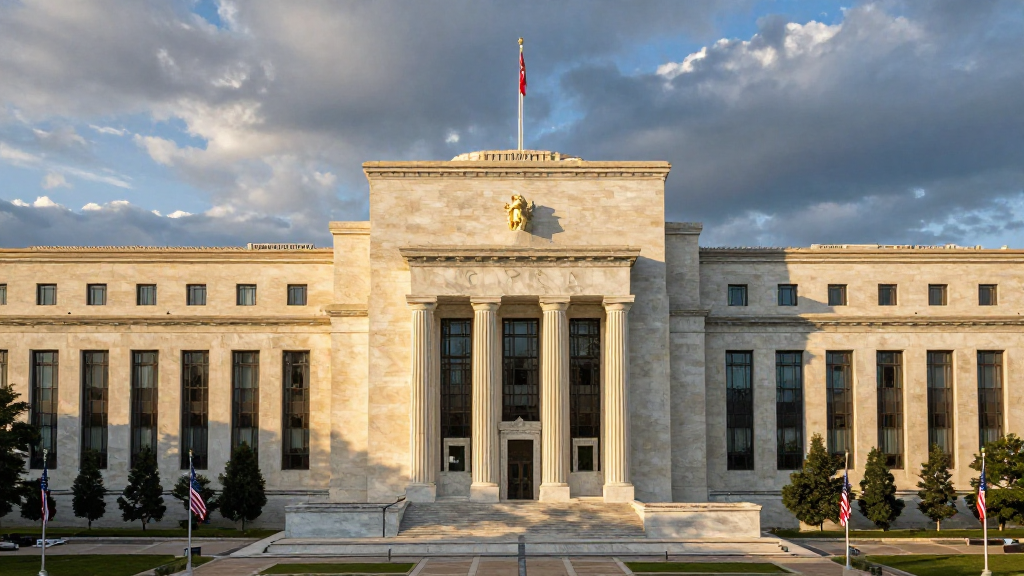
Federal Reserve Faces Divided Committee as Inflation Proves Stickier Than Forecast
At the Federal Reserve June 17-18 policy meeting, officials held the benchmark interest rate in the 3.50 to 3.75 percent range for the seventh consecutive meeting, but the dot plot projections revealed deep internal divisions about the appropriate path forward. Three committee members broke ranks to advocate for an immediate rate reduction, citing softening labor market data and signs that credit conditions are tightening in a manner that historically precedes economic contraction. Four members signaled support for additional rate increases if inflation does not show meaningful deceleration in the coming quarter. The median dot plot now indicates only one quarter-point cut before the end of 2026, a significant retreat from the three cuts projected at the March meeting.
Financial markets interpreted the Fed caution as a signal that monetary policy may remain restrictive longer than anticipated. The two-year Treasury yield climbed to 4.73 percent in the immediate aftermath, its highest level since November 2023. “The Fed is essentially telling you that they cannot cut because inflation is too high, but also that the economy is weakening — that is the impossible situation they are in,” said Diane Swonk, chief economist at KPMG in Chicago. Equity indices posted modest declines as investors recalibrated expectations for corporate earnings, while the yield curve narrowed to its flattest level since early 2024.
European Central Bank Diverges From Fed as Eurozone Inflation Falls Below Target
While the Federal Reserve maintained its cautious hold, the European Central Bank delivered a more dovish signal by cutting its three key interest rates by 25 basis points at its June 18 meeting, citing a sustained decline in eurozone inflation that has brought the annual rate to 1.8 percent — below the ECB 2 percent target for the first time since 2021. The decision, widely anticipated by markets following weaker-than-expected economic data from Germany, France, and Italy, marks the second consecutive rate reduction in the ECB current easing cycle. ECB President Christine Lagarde stressed that the council remains vigilant and prepared to adjust the pace of cuts based on incoming data, particularly wage growth figures and services inflation at 3.2 percent annually. The euro fell 0.4 percent against the dollar following the decision, as the policy divergence between the Fed and ECB widened to levels not seen since the 2018 rate cycle.
The contrasting trajectories of the Federal Reserve and the European Central Bank reflect fundamentally different inflationary experiences over the past three years. The United States economy experienced inflation that peaked at 9.1 percent in June 2022 and has proven resistant to standard monetary tightening due to persistent shelter costs and a resilient labor market. Europe faced an energy price shock from Russian supply cutoffs that triggered a severe recession in industrial Germany. “This is not a soft landing — it is a managed slowdown that has yet to prove it can avoid recession,” warned Clemens Fuest, president of the Ifo Institute for Economic Research in Munich.
Emerging Markets Bear the Brunt as Dollar Strengthens and Capital Flows Reverse
The combined effect of slower global growth, elevated interest rates in the United States, and heightened geopolitical risk has triggered a significant reversal in capital flows to emerging market economies. The Institute of International Finance reported that emerging market funds experienced net outflows of $47 billion in the second quarter of 2026, the largest quarterly redemption since the pandemic onset. Countries with large external financing needs — including Egypt, Pakistan, and several sub-Saharan African nations — face acute pressure as dollar-denominated debt becomes more expensive to service and sovereign borrowing costs rise sharply. The Egyptian pound has lost 18 percent of its value against the dollar this year, forcing the Central Bank of Egypt to deplete foreign reserve buffers to defend the currency.
“The era of cheap global capital is definitively over for emerging markets,” said Ratna Sahay, former deputy director of the IMF Monetary and Capital Markets Department. “Countries that built reserves and reformed their fiscal positions will weather this better, but many others are entering a very difficult period.” India growth outlook has been revised downward by the IMF to 6.2 percent, reflecting both external headwinds and a domestic slowdown in manufacturing output, while Brazil has held its benchmark SELIC rate at 14.75 percent — one of the highest real interest rates in the world — to defend the real and contain inflation fueled by currency depreciation.