Japan and South Korea Forge Boldest Defense Pact in Decades as Regional Alliances Reshape
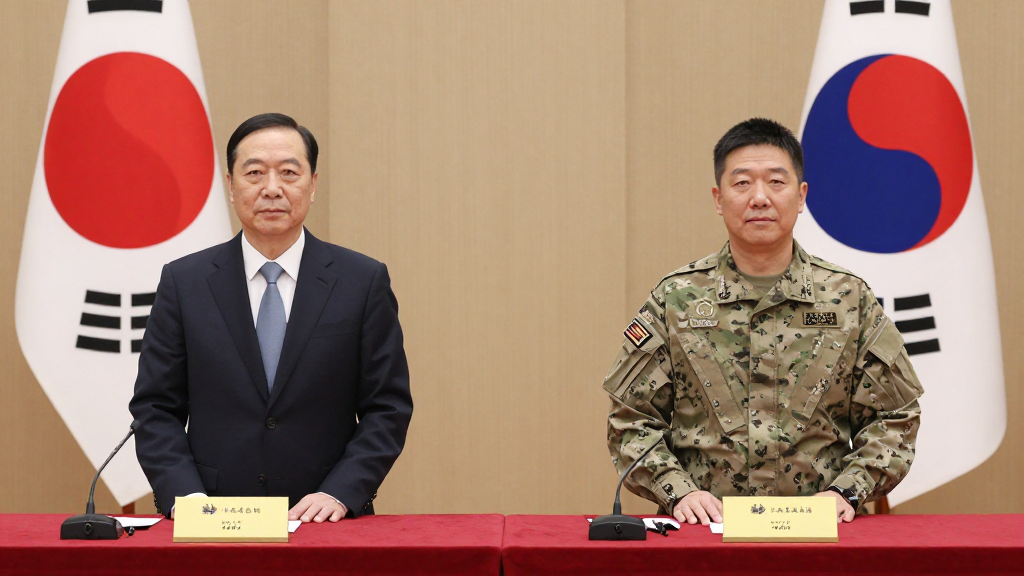
SEOUL — Japan and South Korea signed their most sweeping bilateral defense agreement in decades on Sunday, ending a nine-year lapse in joint maritime exercises and committing to restore regular shuttle diplomacy between their defense authorities — a milestone that analysts say reshapes the Indo-Pacific security architecture.
Japanese Defense Minister Shinjiro Koizumi and his South Korean counterpart, Ahn Gyu-Back, met in Seoul on June 27–28 for the first bilateral defense talks primarily focused on bilateral ties since 2015. The two ministers issued a joint statement reaffirming their commitment to the complete denuclearization of the Korean Peninsula and agreeing that cooperation must continue to preserve regional peace and stability amid what they called an increasingly difficult security environment.
Shuttle Diplomacy Returns After Nine Years
The agreement restores what both sides described as “shuttle diplomacy” between defense authorities — a mechanism that allows regular, formalized visits and meetings between senior defense officials. Koizumi paid respects at Seoul National Cemetery and visited South Korea’s Black Eagles aerobatic team at Wonju Air Base, while Ahn is expected to travel to Tokyo in coming months, completing the reciprocal reset.
Koizumi and Ahn also welcomed the resumption of a bilateral maritime search and rescue exercise — the first such drill in approximately nine years. Both defense ministries said the exercise would be developed further to prepare for a wider range of maritime emergencies across the seas separating the two countries.
“The two ministers reaffirmed their commitment to establishing lasting peace on the Korean Peninsula and agreed that cooperation should continue to preserve regional peace and stability,” the joint statement said.
AI, Aerospace and Trilateral Architecture
Beyond traditional defense domains, the two countries agreed to deepen cooperation in artificial intelligence and advanced science and technology fields, with defense officials tasked to continue discussions on AI applications for maritime domain awareness. South Korea’s Black Eagles aerobatic team and Japan’s Blue Impulse team also agreed to expand exchanges, following the Black Eagles’ refueling stop at Naha Air Base in Okinawa in January — the first time Japan’s Air Self-Defense Force supported a South Korean military aircraft.
The revival of the acquisition and cross-servicing agreement — which would allow the two militaries to share fuel, food and ammunition — was not formally placed on the agenda, though officials said informal discussions remained possible. South Korean President Lee Jae Myung has acknowledged the potential need for such an agreement while citing unresolved historical issues as a limiting factor. Lee’s approval rating stood at 46.5 percent in a Realmeter poll released this week, with disapproval at 49.5 percent.
The bilateral talks are embedded in a broader trilateral security architecture involving the United States. Both ministers restated their commitment to trilateral coordination with Washington, which has been expanding its web of allied partnerships across the first and second island chains as a counterweight to Beijings’s growing maritime footprint.
Regional Context: Taiwan, China’s Economy and Pacific Alliances
The Koizumi-Ahn agreement arrives against a backdrop of intensifying regional activity. Taiwan is currently running military exercises as China’s Fujian aircraft carrier completed a transit of the Taiwan Strait — the third such carrier passage this year. Beijing has refused to renounce the use of force to achieve reunification and has increased naval and aerial incursion operations around the island.
China’s domestic economic pressures are adding complexity to the regional picture. China’s total debt burden has topped 300 percent of gross domestic product as property-sector liabilities and household defaults deepen financial risks across the economy — a development that could either embolden or caution Beijing’s foreign policy adventurism, analysts say.
In the Pacific, Australia and Vanuatu signed the Nakamal Agreement in May, blocking foreign military bases in Vanuatu and providing a template for Canberra’s broader engagement across the region. Australia’s 2026 National Defense Strategy formally named China the primary driver of Indo-Pacific instability, while Japan and the Philippines finalized an intelligence-sharing agreement on submarine cables and maritime domain awareness.
The convergence of these developments — bilateral defense normalization between Seoul and Tokyo, Pacific island states choosing Western security partnerships, and Beijings’s economic headwinds — is producing the most significant realignment of Indo-Pacific alliances in years.