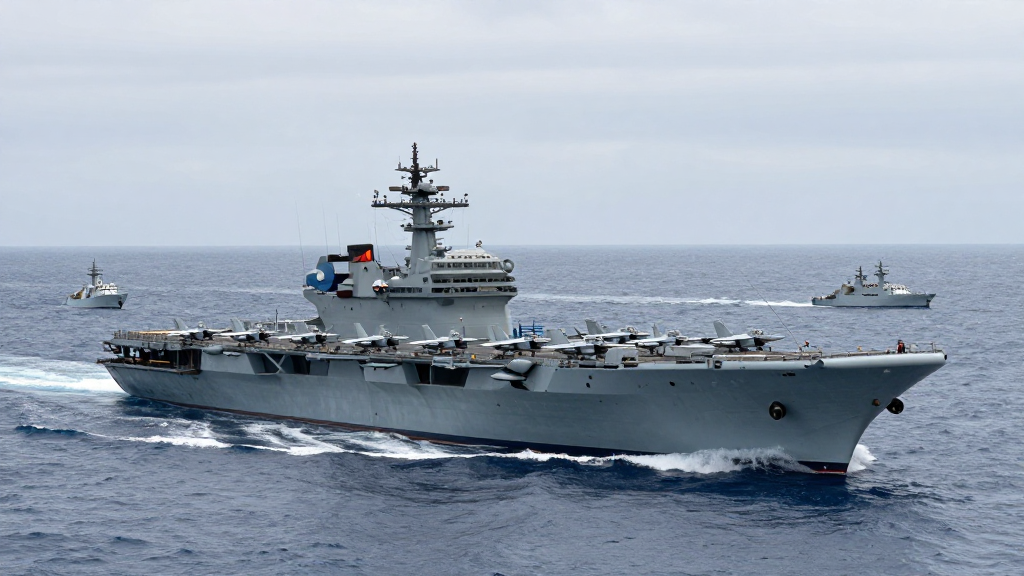
China has deployed its most advanced aircraft carrier through the Taiwan Strait for the first time, according to Taiwan’s Defense Ministry, in a transit that comes as Japan and South Korea rebuild their defense relationship after nearly a decade of dormancy. The move signals a further tightening of the strategic landscape in a waterway that has become one of the world’s most consequential and contested passages.
The Fujian, China’s third and newest carrier, passed through the Taiwan Strait on Monday as Taiwan’s military simultaneously conducted its five-day Immediate Combat Readiness Exercise, a drill designed to test forces under live-fire conditions. The timing underscored the heightened volatility in the waterway, with both parties operating in close proximity under elevated alert postures.
Taiwan Conducts Emergency Readiness Drill
Taiwan’s Defense Minister Wellington Koo said the exercise was triggered by the sudden change in the operational environment rather than any single provocation. “The shift in the strait’s operational picture demanded an immediate response,” Koo told reporters in Taipei. The five-day drill involved naval, air and missile units and was designed to evaluate how quickly commanders could transition forces to combat posture. It was the first such emergency drill conducted in direct response to a live carrier transit rather than a scheduled annual exercise.
The United States and its regional allies watched the transit closely. American forces were already engaged in the Valiant Shield exercise in the Philippine Sea when the Fujian crossed the median line, adding another layer of complexity to an already crowded operational environment.
Japan and South Korea Restore Defense Channel
In Seoul, Japanese Defense Minister Shinjiro Koizumi and South Korean Defense Minister Ahn Gyu-Back met for the first time in nine years to restore a direct bilateral defense dialogue. The two ministers agreed to regularize reciprocal visits, resume a maritime search-and-rescue exercise, and explore cooperation in artificial intelligence, a three-track expansion of a relationship that had atrophied since 2015.
“We agreed that cooperation should continue to preserve regional peace and stability amid an increasingly difficult security environment,” the two sides said in a joint statement. They also reaffirmed their shared commitment to the complete denuclearization of the Korean Peninsula, a pledge that takes on new weight as North Korea’s weapons programs accelerate.
The meeting was the first visit by a Japanese defense minister primarily for bilateral talks since 2015. Koizumi toured South Korea’s Black Eagles aerobatic team at Wonju Air Base, a gesture that drew a sharp response from Pyongyang, which called the outreach a “provocative return to Cold War-era militarism.”
US and Allied Exercises Run in Parallel
The Fujian’s transit occurred as three major US-led exercises ran simultaneously across the Pacific, Valiant Shield, the Rim of the Pacific exercise off Hawaii, and the Japan-US-Resolute Dragon drills. The convergence of so many live-force events in a single week reflects the intensity of the strategic competition unfolding across the region.
Australia announced it would station a permanent defense attache in Vanuatu as part of the Nakamal Security Agreement signed in Port Vila, an arrangement that explicitly bars foreign military bases on Vanuatu’s soil. China called the pact “a transparent attempt to box out Beijing from Pacific island diplomacy.” The agreement is the most concrete expression yet of Australia’s Pacific step-up policy, which has sought since 2023 to rebuild influence across the island chain.
Meanwhile, Vietnam separated its South China Sea operational command into five distinct geographic zones, each with its own rules of engagement and patrol rotation, in what analysts described as the most significant structural change to Hanoi’s maritime posture in a decade. The move reflects growing confidence in Vietnam’s ability to manage its claims as China increases its coast guard and naval presence around the Paracel and Spratly archipelagos.
The overlapping exercises, diplomatic resets and structural military changes point to a region that is actively reshaping its security architecture in real time. The Taiwan Strait remains the most volatile flashpoint, but the wider Indo-Pacific is witnessing the most comprehensive realignment of alliances and military postures since the Cold War, a transformation that is unfolding at speed.