South Korea and Japan Restart Joint Naval Drills After Nine Years as Regional Alliances Sharpen
SEOUL — South Korea and Japan resumed joint maritime search-and-rescue drills on Sunday for the first time in nine years, ending a prolonged military chill driven by overlapping historical disputes and a series of confrontational incidents between the two nations’ armed forces that had paralysed defence cooperation since 2017.
The exercise, known as SAREX, took place in international waters southeast of Jeju Island on June 7. South Korea deployed the 4,900-ton landing ship ROKS Cheon Ja Bong, while Japan contributed the 7,250-ton Aegis-equipped destroyer JS Kongo and a maritime patrol helicopter. The training included the rescue of a distressed vessel, shipboard firefighting, emergency medical treatment, and helicopter operations, according to the South Korean navy’s announcement and photos released after the drill.
From Radar Incident to Resume: A Decade of Fracture
The biennial exercise began in 1999 to improve coordination between the neighbouring countries during at-sea incidents near the Korean Peninsula. The drills were suspended after 2017 as relations deteriorated sharply over historical grievances and a series of military confrontations that brought the two allies of the United States to the edge of open acrimony.
In 2018, Japan withdrew from an international fleet review hosted by South Korea after refusing to display its Rising Sun flag, which many South Koreans regard as a symbol of Japanese militarism and colonial rule from 1910 to 1945. That same year, Japan accused a South Korean destroyer of locking fire-control radar onto a Japanese patrol aircraft near Japan’s Noto Peninsula, calling the incident a “hazardous act.” South Korea denied the allegation and said the destroyer was conducting a search-and-rescue operation, while Seoul accused the Japanese aircraft of making a dangerous low-altitude pass over the vessel.
The most damaging rupture came in 2019, when Seoul moved to end the GSOMIA intelligence-sharing pact after Tokyo restricted exports of semiconductor materials and removed South Korea from its preferential trade list — measures taken over lingering grievances rooted in Japan’s colonial occupation of the Korean peninsula.
Denuclearization Pledge and Logistics Pact Advance
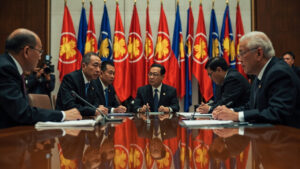
South Korean Defence Minister Ahn Gyu-back and his Japanese counterpart Shinjiro Koizumi met at the Defence Ministry in Seoul on Sunday, where they signed a joint declaration reaffirming their commitment to the denuclearization of the Korean Peninsula and agreeing to institutionalise direct logistical cooperation between their armed forces for the first time.
“Both ministers shared the view to continue cooperation for maintaining regional peace and stability amid a grave security environment,” South Korea’s defence ministry said in a statement describing the outcome of the sixth round of bilateral defence talks between the neighbouring countries. The declaration stopped well short of the deeper mutual defence commitments the United States has pressed both governments to consider, but it marked a measurable thaw after years of deep freeze.
Koizumi and Ahn also discussed a military-logistics support agreement — covering fuel, food, and ammunition — that would for the first time create a standing framework for direct cooperation between the two countries’ armed forces. Both ministers committed to working with Washington against North Korea’s accelerating nuclear program and Pyongyang’s deepening military ties with Russia, which have included cooperation on artificial intelligence and unmanned systems.
Broader Indo-Pacific Realignment Accelerates
The Seoul meeting comes as the Indo-Pacific security architecture undergoes rapid restructuring. Australia announced a 7.3 percent increase in its defence budget this month, lifting spending to 2.4 percent of GDP, with new funding directed at nuclear-powered submarine capabilities under AUKUS and expanded joint exercises with Japan, the Philippines, and South Korea.
Japan’s own defence spending has accelerated sharply under Prime Minister Sanae Takaichi’s government. The 2026 budget allocated a record 8.2 trillion yen to defence — a 17 percent increase over 2025 — focused on strike capabilities, missile defence, and logistics infrastructure designed to support expanded allied operations throughout the region.
Australia and Vanuatu signed the Nakamal Security Agreement in Port Vila, explicitly barring foreign military bases from Vanuatu’s territory. Australia’s Defence Minister Richard Marles described the accord as “the most significant step forward in our Pacific security partnership in a generation.” The Philippines and Vietnam elevated their own strategic partnership in Manila, where President Ferdinand Marcos Jr. and Vietnamese President To Lam agreed to coordinate maritime domain awareness in the South China Sea and renewed a 2010 defence cooperation pact.
The resumption of joint drills between Seoul and Tokyo sends a coordinated signal at a moment when North Korea’s nuclear arsenal is expanding, Chinese naval activity in the East and South China Seas is intensifying, and the web of US-allied security arrangements across the Indo-Pacific is tightening around both threats in parallel. For the first time in nearly a decade, two of America’s most important regional allies are operating from a shared strategic premise rather than at cross-purposes.