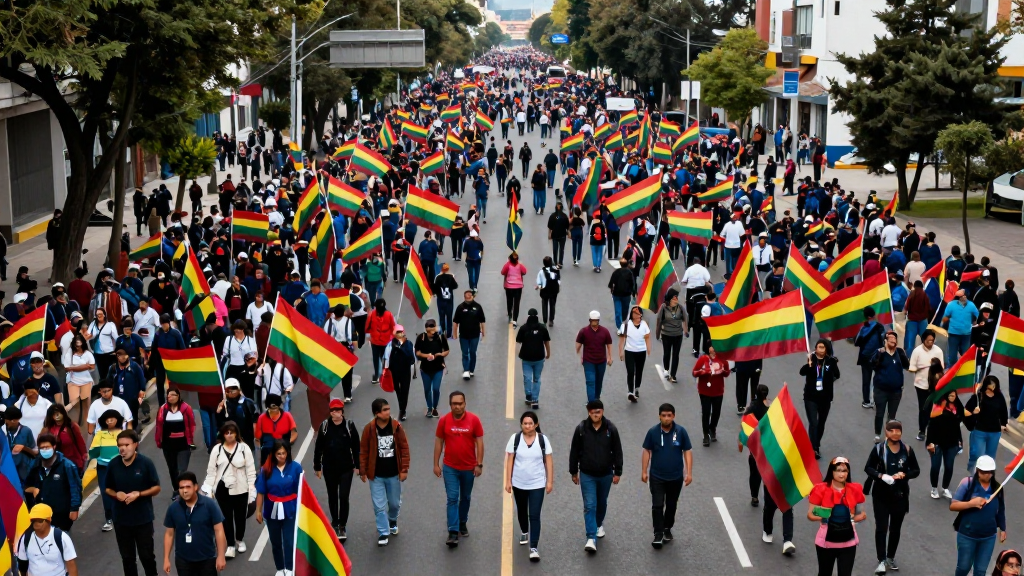
La Paz, Bolivia — Bolivia has declared a state of emergency following 50 consecutive days of mass protests that have paralyzed the country, killed at least six people in a military aircraft crash, and exposed a deep rift between the右-wing government of President Rodrigo Paz and the indigenous, labor, and farmer movements that once dominated Bolivian politics.
The declaration on June 20th grants the military broad powers to clear roadblocks, restrict movement, and detain protesters without standard judicial oversight. It marks the most severe domestic crisis since the political upheavals of 2019 and 2020, and comes after weeks of failed negotiations between Paz’s cabinet and the country’s most powerful union confederation.
From Ballot Box to State of Emergency
Just eight months ago, Paz won a runoff election on a platform pledged to bring “capitalism for all” to Bolivia, positioning himself as a moderate alternative to his more openly reactionary opponent. His first actions in office, however, quickly alarmed the coalition of unions and indigenous movements that have historically wielded veto power over Bolivian governments.
In his first weeks, Paz abolished the country’s tax on large fortunes, a move that sparked immediate condemnation from labor unions. Then came the cancellation of fuel subsidies that had been in place for more than two decades. The result was an immediate 86 percent spike in gasoline prices and a 162 percent increase in diesel costs overnight.
“I have never seen anything like this,” said Maria Fernanda Condori, a bus driver in El Alto who participated in the blockades. “They took everything from us in one night and called it reform.”
Law 1720 and the Spark That Lit the Fuse
The immediate trigger for the current wave of unrest was Law 1720, passed in April, which sought to consolidate small farms into larger landholding operations. The law struck at a raw nerve in Bolivia, where land distribution has long been among the most contentious issues in national politics. Nearly 67 percent of the country’s agricultural land is held by just 0.63 percent of landowners, and the proposed reforms threatened to make that inequality permanent.
On May Day, the Bolivian Workers’ Center, known by its Spanish acronym COB, called an indefinite nationwide strike. Within days, blockades went up across 67 highways. Marches swelled in La Paz, bringing thousands of farmers, miners, teachers, and indigenous Bolivians into the streets. The Tupac Katari campesino federation, one of the most powerful grassroots organizations in the country, threw its weight behind the movement.
Even after Paz reversed course on Law 1720, reshuffled his cabinet, and cut his own salary and those of his ministers in half, the protests only intensified. On May 26th, the national legislature passed a law authorizing the military to contain the unrest. A second law, passed on June 7th, went further: it granted security forces legal immunity for actions taken against protesters, effectively making the military’s use of force presumed lawful.
Six Killed as Military Aircraft Crashes During Relief Mission
The crisis took a tragic turn on June 21st, when a Bolivian Air Force Cessna jet crashed in a remote area of the Cochabamba department while on an assistance mission, killing all four civilians and two crew members aboard. Defense Ministry officials said the aircraft had in recent weeks been used to transport children suffering from cancer to treatment centers in Cochabamba after blockades cut off road access to hospitals. The cause of the crash remains under investigation.
The accident overshadowed what had briefly appeared to be a turning point. Earlier that same day, lawmakers had overwhelmingly approved Paz’s state of emergency decree, and negotiators had achieved their first real breakthrough: a series of agreements to lift critical roadblocks, including a key blockade in the town of San Julian in Santa Cruz department.
Despite the partial progress, the COB and allied protest groups have refused to stand down. Their demands include a rollback of the fuel price increases, the reinstatement of fuel subsidies, wage increases to offset the jump in transportation and food costs, and Paz’s resignation. The president, for his part, has dug in, describing the protests as an attempt by “foreign-backed destabilization forces” to overthrow a legitimately elected government.
The crisis has also accelerated a dramatic foreign policy realignment. Paz has moved Bolivia toward closer alignment with the United States, inviting the DEA back into the country after it was expelled in 2008, re-establishing diplomatic relations with Israel, and joining the Trump administration’s “Shield of the Americas” military coalition. Those moves have only deepened the opposition’s conviction that Paz has betrayed the country’s sovereign, anti-imperialist traditions.
As Bolivia’s highways remain pockmarked with blockade debris and the government’s emergency decree enters its second week, there is no clear end in sight to one of the most volatile political crises in the country’s recent history.