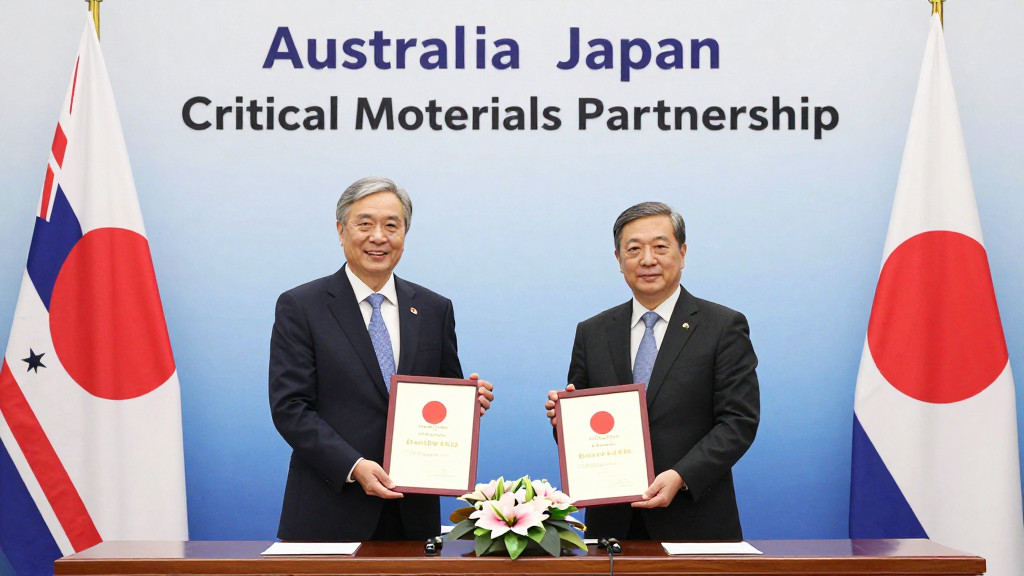
CANBERRA — Australia and Japan elevated their critical minerals partnership to a core pillar of their economic and national security relationship on Monday, with the Australian government committing up to $1.3 billion in financing support for strategic projects that will supply Tokyo with gallium, nickel, graphite, rare earths, and fluorite — materials Beijing has weaponised as leverage in its own trade disputes with Japan.
Prime Minister Anthony Albanese of Australia and Prime Minister Sanae Takaichi of Japan met in Canberra and issued a Joint Statement on Critical Minerals Cooperation, building on the existing Australia-Japan Critical Minerals Partnership launched in 2022. The accord makes coordinated investment in processing and refining capacity a shared strategic priority for both governments.
$1.3 Billion to Rewire the Supply Chain
The Australian government, acting through the Critical Minerals Facility and Export Finance Australia, extended up to $1.3 billion in non-binding Letters of Support to critical mineral projects with Japanese involvement. The financing is designed to accelerate onshore processing and refining in Australia, stripping out China’s stranglehold on the intermediate stages of rare earth and gallium supply chains that Tokyo depends on for semiconductor manufacturing, defence electronics, and electric vehicle production.
“Japan has been a long-standing partner in the development of Australia’s critical minerals sector,” Prime Minister Albanese said in a joint statement. “By working closely with Japan, we can attract greater investment in our critical minerals sector and further develop the sector, creating jobs and capability in Australia.”
The deal also reflects Canberra’s own strategic calculation. Australia holds the world’s largest known reserves of gallium and sits among the top producers of nickel and rare earths, yet most of that value has historically been exported as unprocessed ore to China. The new partnership is designed to change that calculus by tying Australian production directly to Japanese industrial demand, creating commercial linkages that bypass Chinese processing facilities entirely.
Japan’s Strategic Dependency and China’s Trade Leverage
For Tokyo, the urgency of the partnership is directly tied to a series of trade disputes with Beijing that have exposed Japan’s vulnerability in critical mineral supply. China halted exports of gallium and germanium to Japan in 2023 after Tokyo imposed export controls on semiconductor manufacturing materials to align with U.S. technology restrictions — a move that underscored how completely Japanese industries depend on Chinese raw material processing that no alternative supplier had yet replicated at scale.
“Our cooperation with Japan is all about building more resilient and stable supply chains over the long term,” said Foreign Minister Penny Wong, who participated in the Canberra talks alongside Trade Minister Don Farrell and Resources Minister Madeleine King. “We both see the tremendous potential in working more closely together to support reliable access to critical minerals.”
Trade Minister Don Farrell framed the arrangement as integral to Australia’s own Future Made in Australia agenda, which seeks to anchor advanced manufacturing on Australian soil rather than leaving it exposed to geopolitical disruption. “We are committed to working with Japan to develop Australia’s critical minerals sector and support resilient supply chains between our countries and in our region,” he said. “Developing our critical minerals is a key national priority under our Future Made in Australia agenda, and we can achieve this by working closely with Japan, a trusted and longstanding partner.”
A New Era for the Indo-Pacific Minerals Order
Minister for Resources Madeleine King was blunt about what the partnership represents for the region’s strategic alignment. “Sustained, trusted, constant investment from Japan is a cornerstone of the global powerhouse that is the resources sector of Australia,” she said. “Working together with Japan we are building a new era for our resources sector that will support both our economies and our shared security for generations to come.”
The Canberra statement lands as the United States and its allies are racing to construct alternative supply chains for the 14 critical minerals the Commerce Department has designated as essential to semiconductor, battery, and defence manufacturing. The U.S.-Japan Critical Minerals Agreement signed in 2023 already eliminated tariffs on critical minerals trade between Washington and Tokyo, and the new Australian pillar extends that architecture by securing the upstream raw material base that neither Japan nor the United States can yet produce domestically at scale.
The Quadrilateral Security Dialogue — grouping Australia, India, Japan, and the United States — has separately identified critical mineral security as a shared strategic objective, with particular focus on reducing collective dependence on Chinese processing capacity for gallium, graphite, and rare earth elements. Australia’s Critical Minerals Facility, which now has $4 billion in total capital, is the principal instrument Canberra is using to redirect its mineral wealth away from a single export market and toward a network of trusted Indo-Pacific partners.