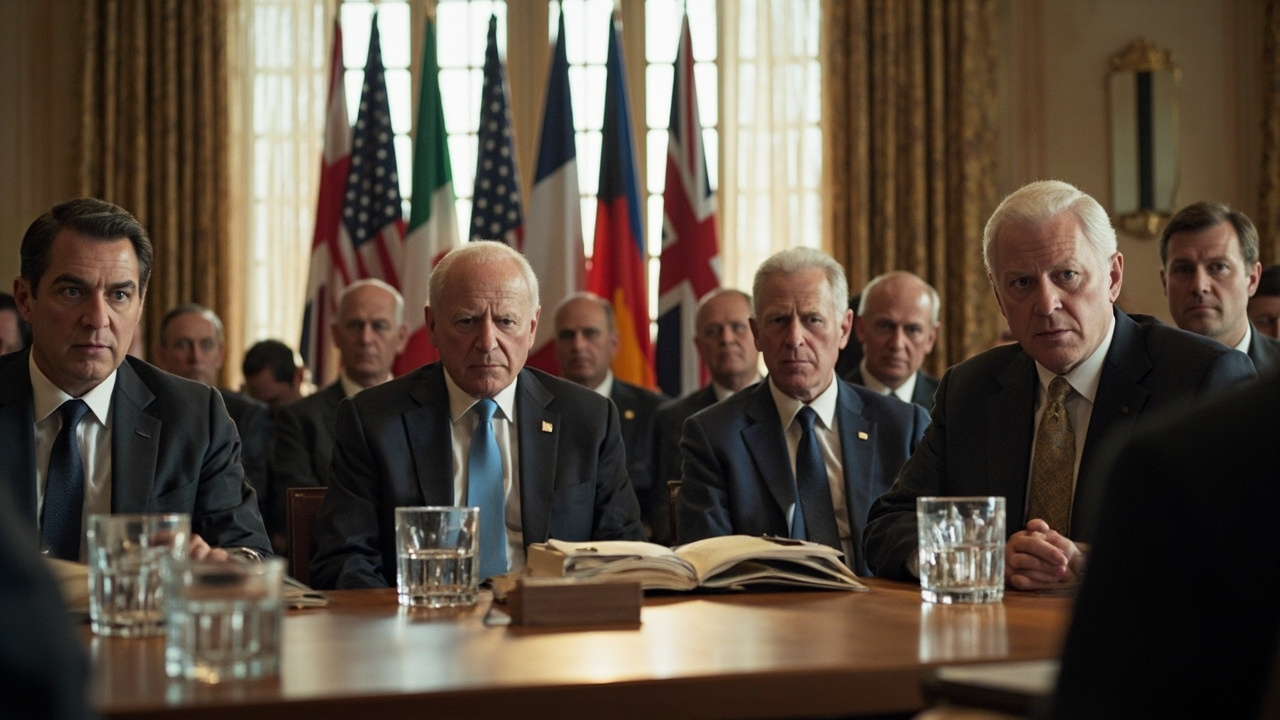
G7 leaders wrapped a three-day summit in Évian, France on Wednesday with a joint declaration endorsing the landmark US-Iran peace agreement, committing to diversified critical mineral supply chains, and calling for a coordinated international response to a re-emerging Ebola outbreak in Central Africa. The gathering in the lakeside resort brought together leaders from France, Germany, Italy, Japan, the United Kingdom, Canada, and the United States for what several delegations described as one of the most consequential summits in the group’s recent history.
G7 Leaders Endorse US-Iran Framework Deal
The leaders of the seven major industrialized democracies issued a joint statement welcoming the US-Iran peace framework signed digitally on June 15 by President Donald Trump and Iranian Parliament Speaker Mohammad Bagher Ghalibaf. The agreement ended a three-month conflict that claimed the lives of 13 US service members and disrupted global oil shipments through the Strait of Hormuz, through which roughly 20 percent of the world’s oil passes. The deal was brokered with help from Qatar and Oman, whose foreign ministers participated in the final hours of negotiations.
The deal provides for the reopening of the Strait of Hormuz, the lifting of the US naval blockade on Iranian ports, and a 60-day ceasefire during which both sides will negotiate a permanent settlement covering Iran’s enriched uranium stockpile, sanctions relief, and regional security arrangements. The US has agreed to freeze sanctions on Iran’s oil and shipping sectors pending the outcome of the talks, while Iran has agreed to suspend uranium enrichment above 3.67 percent and allow international inspectors expanded access to its nuclear sites.
“The deal has already boosted market sentiment, with expectations of increased oil flows and reduced geopolitical risk across the Middle East,” an IFM Investors economic update noted ahead of the summit’s final day. Brent crude fell more than 4 percent in the week following the announcement, as traders anticipated the Strait of Hormuz returning to full operational capacity.
A signing ceremony for the full agreement is scheduled for June 19 in Geneva, Switzerland. G7 leaders expressed support for a multinational maritime initiative to ensure safe passage through the Strait of Hormuz once normal traffic resumes. Several European nations have already indicated willingness to contribute naval vessels to a joint monitoring operation coordinated under the International Maritime Organization.
Israel’s Opposition and Regional Tensions
Israeli Prime Minister Benjamin Netanyahu addressed the summit, underscoring Israel’s longstanding objections to the nuclear provisions in any long-term arrangement with Tehran. He told reporters that he and President Trump “do not always see eye to eye” on the agreement, reflecting deep skepticism within the Israeli government about Iran’s nuclear ambitions under any framework. The Israeli leader reiterated his country’s position that Iran must not be permitted to possess nuclear weapons capability under any circumstances.
The G7 statement acknowledged Israeli security concerns while affirming that the nuclear issue must be resolved through diplomacy. The leaders stopped short of endorsing any specific enforcement mechanism for the enriched uranium provisions, deferring that question to the ongoing 60-day negotiating period. European diplomats noted that the language was deliberately calibrated to avoid alienating either Israel or Iran during the fragile ceasefire window.
Israeli officials have demanded a permanent ceasefire and full verification of Iran’s nuclear program before considering any normalization of relations. Iran has insisted on the complete lifting of all nuclear-related sanctions as part of any final agreement. The gap between those positions remains substantial, and negotiators in Geneva face an October deadline to bridge it.
Critical Minerals and Supply Chain Declarations
Beyond the Middle East, G7 leaders issued a separate declaration on securing supply chains for critical minerals, identifying their strategic importance for economic prosperity, digital transformation, and energy security. The declaration expressed “grave concern over non-market policies, economic coercion, and arbitrary export restrictions” that threaten supply chain resilience, language that analysts said was aimed at China, which dominates global processing of rare earth elements and permanent magnets used in electric vehicles, wind turbines, and defense systems.
Leaders committed to reducing dependency on single suppliers outside the G7 for rare earths and permanent magnets to under 60 percent by 2030, with an ambition to reach 50 percent. The declaration welcomed 195 projects announced since early 2026, representing 64 billion euros in new investments across member states, including lithium processing facilities in Portugal, rare earth recycling plants in Germany, and cobalt refining operations in Canada.
The leaders also agreed on a set of digital safety principles for minors online, adopted separately by G7 digital and tech ministers on May 29, calling for safety-by-design risk management, robust age assurance solutions, and enhanced privacy settings for accounts used by minors. The principles are non-binding but are expected to shape national legislation in member states over the next two years.
Global Health and Ebola Response
The G7 leaders issued a separate call for a coordinated global response to the Bundibugyo Ebola outbreak in the Democratic Republic of the Congo and Uganda. The outbreak is centered in an isolated, conflict-affected area near the border between the two countries, complicating containment efforts. Existing vaccines and treatments remain effective against the Bundibugyo strain, but border crossings and population movement in the region have accelerated transmission rates in recent weeks.
The World Health Organization has requested 500,000 additional vaccine doses from the global stockpile. G7 leaders pledged financial support and logistical assistance to reinforce local health systems and support contact-tracing operations across affected areas. Canada and the United Kingdom have already deployed public health experts to the region, while France has committed to airlifting protective equipment to distribution hubs in Goma and Kasese.
The Évian summit marked the first G7 gathering since the European heatwave emergency that killed more than 1,400 people across the continent in late June. Leaders acknowledged that the extreme weather event underscored the urgency of the climate and resilience commitments discussed throughout the meetings, though no new binding emissions targets were added to the final declaration. The discussion instead focused on adaptation finance and disaster response coordination, areas where G7 nations have existing frameworks they are expanding.