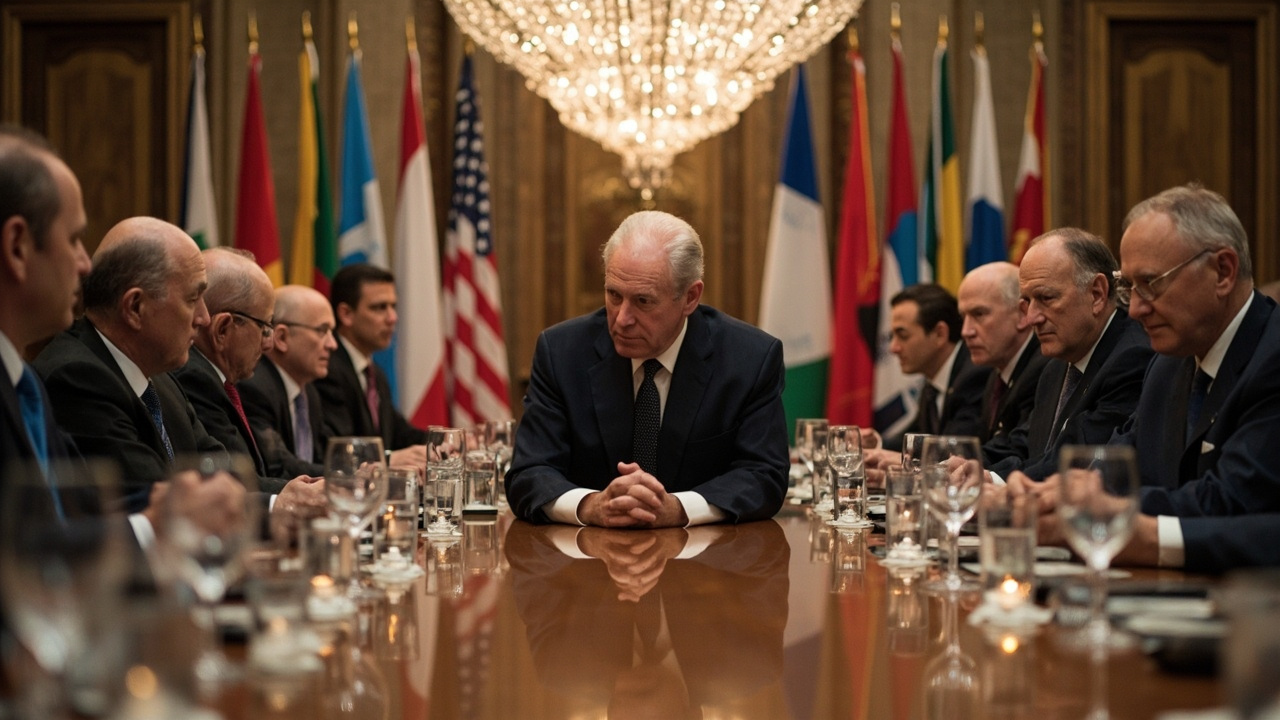
World leaders at the G7 summit in Evian, France, adopted a joint declaration on Wednesday addressing the wars in Ukraine and West Asia, while Indian Prime Minister Narendra Modi told assembled presidents and prime ministers that the greatest global challenge is eroding trust between nations. The three-day gathering of the world’s seven largest democracies produced agreements on critical minerals supply chains, targeted sanctions on actors fueling the Ukraine conflict, and a framework for regulating artificial intelligence in financial markets, according to a final communiqué issued after the summit closed.
President Donald Trump, attending his second G7 summit, held a bilateral meeting with President Emmanuel Macron focused on the interim US-Iran agreement that has halted strikes between the two countries for 90 days. The two leaders also discussed a proposed joint statement on ending the Ukraine war, though final language on territorial questions remained under negotiation as the summit closed. Trump told reporters aboard Air Force One that the summit had produced more progress than skeptics expected.
Modi Warns of Global Trust Deficit
Indian Prime Minister Narendra Modi delivered one of the summit’s most striking interventions when he told fellow leaders that the international system is suffering from a shortage of trust, not resources. Speaking at the opening session alongside Trump, Modi outlined a vision of global cooperation built on equal partnerships rather than traditional donor-recipient frameworks.
“The world suffers from a shortage of trust, not resources,” Modi said, drawing a rare moment of silence from the typically contentious plenary hall. The Indian leader’s remarks reflected mounting frustration among emerging economies with what many see as a rules-based order that has failed to deliver equitable outcomes for nations outside the original post-war architecture.
Modi also raised the human cost of the West Asia conflict, telling leaders that several Indian civilians have died as a direct result of the fighting. He called for guaranteed safe passage for merchant vessels through the Strait of Hormuz, a chokepoint through which roughly one-fifth of the world’s oil shipments pass. Disruptions to maritime trade caused by exchanges between Iran and Israel have pushed global shipping insurance rates to their highest levels since the 1980s Iran-Iraq war, according to industry data cited at the summit.
Ukraine Crisis Dominates Closed Sessions
Senior officials from the United States, European Union and Ukraine held three rounds of closed discussions at the summit on a proposed ceasefire framework. According to a senior European official who spoke on condition of anonymity because the sessions were private, the most contentious issue remains the status of territories currently under Russian administration. Kyiv insists on full restoration of its internationally recognized borders, while Moscow has demanded legal recognition of its annexation of four Ukrainian oblasts.
“The gap between the two positions remains substantial, and no amount of diplomatic language can paper over that fact,” the official said. “We are trying to find wording that allows both sides to claim they have not surrendered their core positions, but the legal questions are genuinely hard.” G7 leaders agreed to expand sanctions on actors that facilitate Russia’s military supply chains, with new measures targeting third-country intermediaries that have allowed sanctions circumvention.
The group also announced a joint initiative to trace and seize Russian sovereign assets held in G7 jurisdictions, with proceeds directed to a reconstruction fund for Ukraine. Legal questions over the long-term custody of these assets remain unresolved, with Germany and France favoring a multilateral escrow arrangement and the United States preferring direct transfer to Kyiv.
Critical Minerals and AI Governance Frameworks
Finance ministers from G7 nations reached a separate tentative agreement at the summit’s sidelines on a coordinated framework for regulating artificial intelligence systems deployed in financial markets. The proposed regime would require large AI model providers to register with national regulators before deploying general-purpose AI systems to trading, credit scoring or insurance underwriting. Member states would share surveillance data on model performance and algorithmic failures under an information-sharing compact that France proposed.
The critical minerals initiative seeks to reduce dependence on Chinese processing of rare earth elements essential for clean energy technology and defense manufacturing. G7 leaders committed to co-investing in extraction projects in Canada, Australia and three African nations, with processing facilities to be built on G7 territory. The initiative represents the most concrete structural response to supply chain vulnerabilities exposed during the 2024-2025 period when export controls on semiconductor materials triggered production halts at European EV battery plants.
The summit’s final déclaration acknowledged significant disagreements remain on trade policy, with the United States maintaining higher tariffs on steel and aluminum than its allies. G7 leaders agreed to reconvene in a virtual format within 90 days to assess progress on implementation of the declaration’s commitments before the United Nations General Assembly session in September, according to the Élysée Palace, which holds the rotating G7 presidency through the end of 2026.