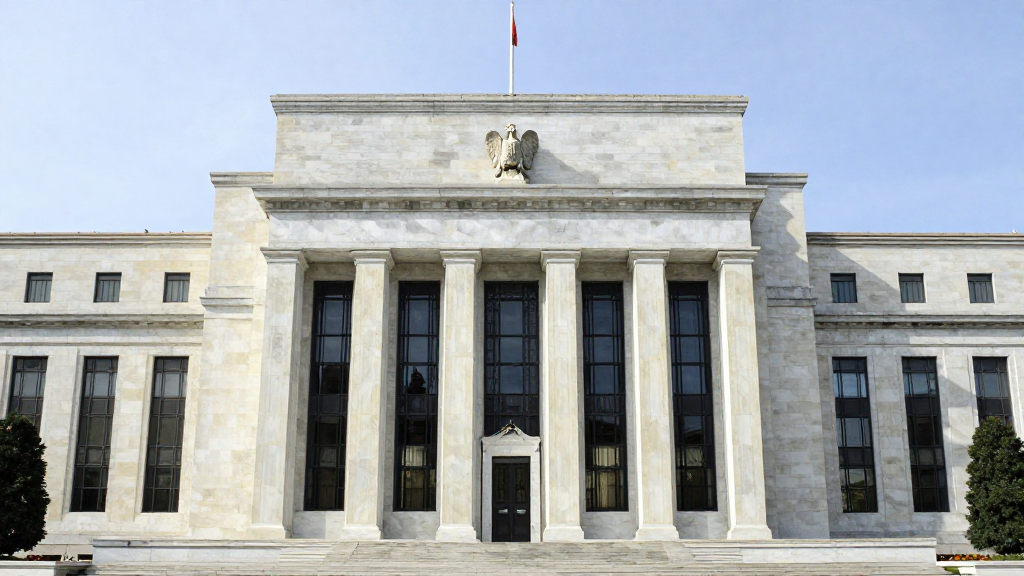
Warsh’s First Fed Meeting Ends With Hawkish Signal
In Kevin Warsh’s first meeting as Federal Reserve chairman, the central bank held interest rates steady but delivered a notably more hawkish message to markets. The Federal Open Market Committee voted unanimously on June 17, 2026 to keep the benchmark overnight borrowing rate in a range of 3.5% to 3.75%, where it has remained since the Fed cut rates by three-quarters of a percentage point in late 2025. However, it was the dramatic rewording of the FOMC statement and Warsh’s refusal to submit his own rate forecast that sent a clear signal: the new chairman is in no hurry to ease monetary policy further, and may be inclined to tighten if inflation does not cool.
The most striking change was the deletion of language indicating a bias toward future rate cuts. The previous statement had carried language suggesting the committee would remain attentive to deflationary risks and stood ready to cut rates if economic conditions deteriorated. That passage was absent from the June statement entirely. Market participants interpreted the silence as a green light for rates to remain elevated for longer, and possibly move higher if the inflation picture fails to improve. The two-year Treasury yield, which moves closely with expectations for Fed policy, rose sharply in the hours following the decision, reflecting the market’s reassessment of the rate trajectory.
Perhaps the most closely watched aspect of any Fed meeting is the “dot plot,” the grid of individual rate forecasts submitted by FOMC members. In a surprise that rattled bond markets, Warsh declined to submit his own dot. “I did not submit a dot for me,” he said at his post-meeting press conference. “It’s not helpful in the conduct of policy.” The omission was particularly notable because prior to his appointment as chairman, Warsh had been among the most vocal critics of the Fed’s reliance on forward guidance and dot plot forecasts as policy instruments. His refusal to participate in the first meeting of his chairmanship underscored his intent to fundamentally reshape how the committee communicates its intentions to the public.
Task Forces and Communication Overhaul
Beyond the rate decision itself, Warsh used his inaugural press conference to outline a broader agenda for reform. He announced the formation of several task forces charged with overhauling major Fed operations, including the communication framework, the structure of press conferences, the role of the dot plot, and the content of meeting transcripts and minutes. The move reflects a philosophical view that the Fed’s existing communication architecture has contributed to confusion and market volatility, rather than providing the clarity investors need to make informed decisions.
“I suspect by year-end there will be a review about communication broadly, press conferences, dots, meetings, and the like, transcripts, minutes,” Warsh told reporters. “This will be part of that. I don’t want to prejudge the outcomes there.” The statement was carefully worded to avoid signaling any specific policy direction, but it signaled clearly that Warsh intends to be methodical and deliberate in reshaping the Fed’s public-facing framework. Financial markets, which have grown accustomed to using Fed statements and dot plots as GPS navigation for asset pricing, will need to recalibrate their models in the months ahead.
The absence of Warsh’s own forecast created an unusual information vacuum at the center of the policy process. Prior to the meeting, investors had attempted to divine the new chairman’s likely rate path from his public speeches and writings during his tenure as a board governor. Those signals pointed toward a hawkish orientation, but the lack of a formal dot left traders without a quantitative anchor. Federal Reserve watchers noted that without Warsh’s dot, the committee’s collective projection for the end of 2026 is effectively incomplete, which could introduce additional uncertainty into market pricing of rate expectations.
What This Means for Markets and Borrowing Costs
For American consumers and businesses, the implications of Warsh’s hawkish debut are straightforward: borrowing costs are unlikely to decline meaningfully in the near term. Mortgage rates, which track the 10-year Treasury yield closely, have already risen in anticipation of a more restrictive Fed stance. Credit card rates, home equity lines of credit, and small business loans all carry variable rates tied to the federal funds rate or short-term rate benchmarks. The unchanged policy rate means those costs will remain elevated, squeezing household budgets and raising financing expenses for companies that rely on short-term credit markets.
The equity market’s reaction reflected the ambiguity at the heart of Warsh’s communication. Stock indices initially fell on the hawkish statement language but partially recovered as investors absorbed the message that the Fed remains data-dependent and is not pre-committed to any specific rate path. The S&P 500 ended the session slightly lower, with rate-sensitive sectors such as utilities and real estate investment trusts bearing the brunt of the selling pressure. Technology stocks, which have benefited from the expectation of a prolonged low-rate environment, also faced headwinds as the market repriced the likelihood of future rate cuts downward.
The dollar strengthened against most major currencies following the decision, reflecting the relative attractiveness of higher U.S. interest rates compared to the ultra-loose policies still in place in Europe and Japan. That dollar strength has implications for multinational corporations, as earnings denominated in foreign currencies translate into fewer dollars when repatriated. For emerging market economies, a stronger dollar typically creates additional stress, as it increases the cost of servicing dollar-denominated debt and can trigger capital outflows from local currency assets.
Looking ahead, the next major data point that could shift the Fed’s calculus will be the June consumer price index report, scheduled for release in July. If inflation continues to run above the Fed’s 2% target, the hawkish tilt signaled at this meeting could harden into actual rate increases before yearend. Conversely, a meaningful cooling in the jobs market or a sharp decline in consumer spending could give Warsh and his colleagues cover to pivot back toward easier policy. For now, markets are left with a chairman who has shown his hand: he prefers discipline over accommodation, and he is willing to break with convention to prove it.