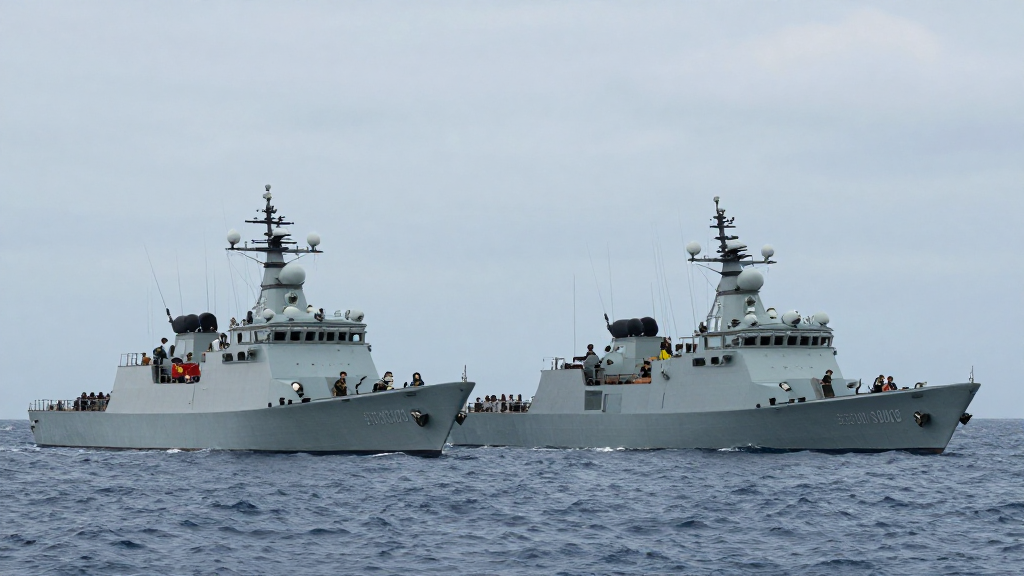
China’s most advanced coast guard ships surrounded and dispersed Philippine fishing vessels near Scarborough Shoal on Tuesday in the most serious confrontation in the South China Sea in months, according to Philippine coast guard reports and satellite imagery analyzed by independent monitors. The incident, which took place as the Philippines conducted a routine maritime patrol in its exclusive economic zone, prompted urgent consultations between Manila and Washington and reignited debate in Tokyo over whether Japan should take a more direct role in monitoring the disputed waterway.
Philippine coast guard spokesman Jay Tarriela said three Chinese coast guard vessels intercepted the Filipino fleet at close range, crossing within 100 meters of the bow of the BRP Teresa Magbanua as it conducted a patrol near the contested shoal that both nations claim. The Chinese ships then formed a barrier formation, forcing the smaller Philippine vessels to retreat. No injuries were reported, but the confrontation was described by Philippine officials as the closest encounter since 2024.
Manila Responds as Washington Watches Closely
The Philippine coast guard released footage of the confrontation, showing Chinese vessels making sharp turns in close proximity to the Filipino ships. Tarriela said the maneuver was a deliberate attempt to intimidate the patrol and discourage Filipino fishermen from operating in the area.
“The China Coast Guard vessels were operating unlawfully in these waters, aggressively obstructing our navigation route by speeding up and dangerously crossing close to our vessel in an attempt to intimidate and harass our personnel,” Tarriela said. He called the actions “part of a recurring pattern of coercion” that Manila has documented and protested through diplomatic channels on at least fourteen occasions this year alone.
The United States, which is bound by a mutual defense treaty with the Philippines, said it was monitoring the situation but stopped short of invoking the treaty’s provisions. A State Department spokesperson said the confrontations “underscore the importance of the rules-based international order in the South China Sea” and reaffirmed that an attack on Philippine vessels would trigger obligations under the treaty.
Tokyo Reconsiders Its Role in the Western Pacific
The confrontation has had immediate fallout beyond Manila. Japanese Prime Minister Fumio Kishida convened an emergency session of his National Security Council after receiving a briefing on the incident, according to a government spokesperson. Japan does not claim territory in the South China Sea but has growing economic and strategic interests in the waterway, through which roughly $3 trillion in trade passes annually.
Japan has deepened its security cooperation with the Philippines over the past two years, signing a reciprocal access agreement in 2024 that allows each country’s military forces to deploy on the other’s territory. Japanese officials have been debating whether to begin joint coast guard patrols with the Philippines in the South China Sea, a step that would mark a significant departure from Tokyo’s postwar security posture.
“Japan has a direct interest in the freedom of navigation in these waters,” said one Japanese defense official who asked not to be identified because the discussions are ongoing. “We are not a claimant, but we cannot be indifferent when the rules-based order that protects our trade is being challenged daily.”
China’s Foreign Ministry rejected the Philippine account of the confrontation, saying the coast guard vessels acted professionally and lawfully to protect Chinese territorial claims. A ministry spokesperson accused Manila of “deliberately provoking” the incident to rally international support and warned that Beijing would “take all necessary measures to defend its sovereign rights.”
Regional Actors Reassess Their Positions
The Scarborough Shoal confrontation comes as several other Southeast Asian nations have reported increased Chinese maritime activity near their own coasts. Vietnam has filed formal complaints with Beijing after Chinese coast guard ships operated near Vietnamese fishing grounds in the central part of the sea on three separate occasions over the past six weeks. Malaysia has summoned the Chinese ambassador to protest the deployment of a Chinese survey vessel in its exclusive economic zone without authorization.
Regional security analysts say the pattern reflects a deliberate Chinese strategy to test the limits of American commitments to its allies while avoiding direct confrontation that might trigger the mutual defense clause in the U.S.-Philippines treaty.
“Beijing is trying to establish facts on the water without crossing the threshold that would force Washington to respond militarily,” said one regional analyst who tracks Chinese maritime operations. “The goal is to make Philippine operations in the South China Sea progressively more costly and risky, without giving the United States a casus belli.”
For now, the immediate dispute is being handled through diplomatic channels. The Philippines has filed a protest with the Chinese embassy and requested a meeting under the bilateral maritime consultation mechanism established in 2017. Whether that channel produces results remains uncertain. Both sides have used it before without resolving the underlying tensions that make the South China Sea one of the world’s most volatile maritime flashpoints.