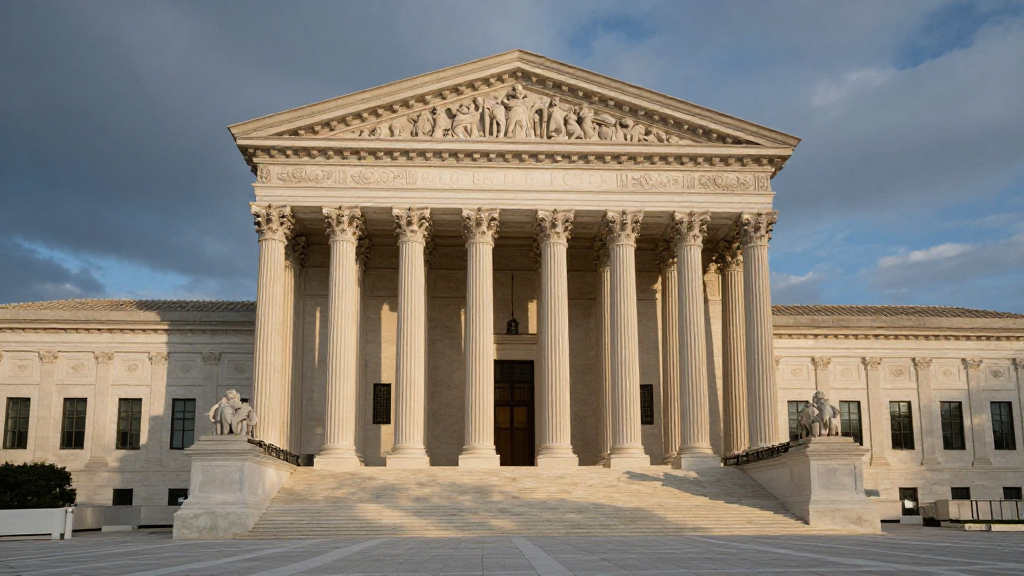
The Supreme Court delivered a landmark rebuke to President Donald Trump on Tuesday, upholding birthright citizenship in a 6-3 decision that exposed deep rifts among the court’s conservative justices while simultaneously emboldening the president’s allies to push for a legislative workaround. Chief Justice John Roberts wrote for the majority in Trump v. Barbara, declaring that children born on American soil to undocumented or temporarily present parents are citizens at birth under the 14th Amendment, rejecting the administration’s argument that “primary allegiance” or “domicile” should govern who receives citizenship.
“Children born in the United States to parents unlawfully or temporarily present are ‘subject to the jurisdiction’ of the United States and are citizens at birth under the Fourteenth Amendment’s Citizenship Clause,” Roberts wrote. The ruling invalidated Trump’s January 20 executive order that sought to end automatic citizenship for babies born to non-citizens on U.S. soil.
Three Conservative Justices Break With the Majority
The decision was notable not only for its substance but for the depth of disagreement it exposed on the right. While Roberts was joined by Amy Coney Barrett alongside the court’s three liberal justices, three other conservatives wrote separate dissenting opinions. Justice Samuel Alito called the ruling “one of the most important decisions in the history of the Court” and “a serious mistake,” arguing the 14th Amendment was designed to secure rights for formerly enslaved Black Americans, not to extend citizenship broadly to the children of those who entered the country illegally. “American citizenship is not the birthright of the world,” Alito wrote. “It belongs only and solely to Americans. No provision of the Constitution can be read to require our national self-obliteration.”
Clarence Thomas penned a lengthy dissent joined by Neil Gorsuch, calling the majority’s historical analysis “not accurate” and accusing the court of misusing the Reconstruction-era amendment. Gorsuch also wrote separately, suggesting that while the challengers had framed the case too broadly, the question of whether the children of undocumented immigrants truly “domiciled” in the U.S. are citizens remains unsettled. Brett Kavanaugh agreed with the outcome but not the reasoning, arguing Trump’s order violated a federal statute rather than the Constitution, and that Congress could amend that law or enact new exceptions. “Congress has not yet done so,” Kavanaugh noted.
Trump Vows Congressional Override, DOJ Signals Birth Tourism Prosecutions
Within hours of the ruling, Trump declared on his Truth Social platform that the decision was “too bad for our Country” but vowed to press forward through legislation. “We can easily make it up in Congress through Legislation, with the support of the President, that has now been determined during this process,” he wrote. “No long and unwieldy Constitutional Amendment is necessary! Congress should start TODAY to work on ending expensive and unfair to our Country, Birthright Citizenship. They will have my Complete and Total Support!” The president argued that statutory changes rather than a constitutional amendment could accomplish the goal, though legal experts have questioned whether any law can override the 14th Amendment’s explicit language.
Stephen Miller, the architect of Trump’s hardline immigration agenda, called the ruling “one of the most destructive and outrageous decisions” in American history and signaled the White House would explore every available avenue to continue restricting birthright citizenship. The Department of Justice announced it would prioritize prosecutions of what it described as “birth tourism schemes,” asserting that individuals exploiting loopholes to secure automatic citizenship pose a national security threat. Immigration advocates, however, celebrated the ruling as a decisive vindication of constitutional principles.
The executive director of the American Civil Liberties Union called it “one of the most important constitutional cases of the past 100 years,” saying the president had bet his legacy on a policy that the courts unanimously refused to uphold. With the legislative path uncertain and a constitutional amendment requiring a two-thirds supermajority in both chambers, the scope for further action narrows considerably, even as the administration signals it has no intention of abandoning the fight.