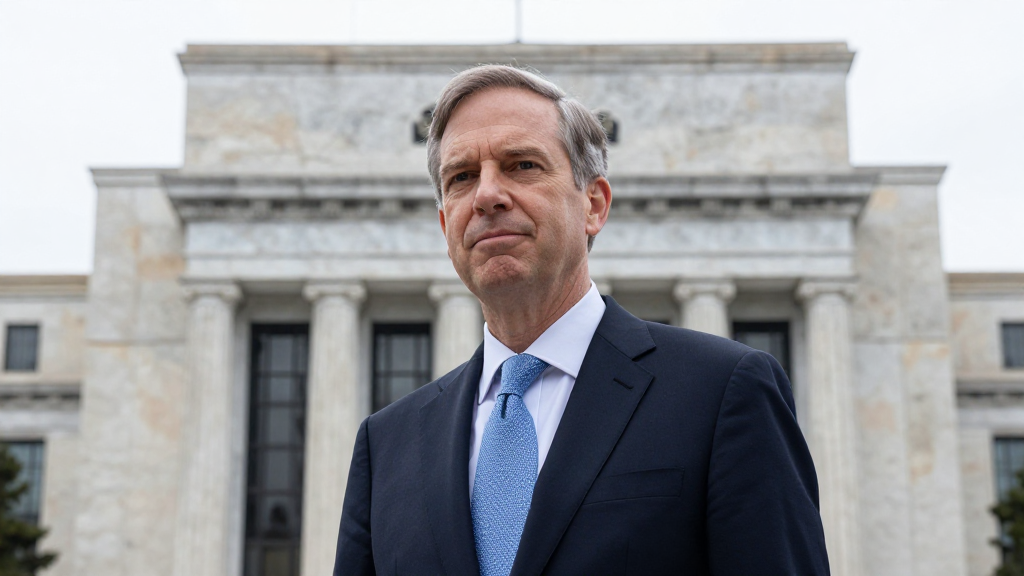
Federal Reserve Chair Kevin Warsh delivered a hawkish signal at his first policy meeting, with the central bank holding interest rates steady while nearly half of its policymakers indicated they could support a rate increase before the end of 2026.
The Federal Reserve held interest rates steady at a range of 3.50 percent to 3.75 percent while nearly half of its policymakers indicated they could support a rate increase before the end of 2026. The outcome, announced at the conclusion of the Federal Open Market Committee’s two-day meeting on June 17, 2026, represented a sharp shift in tone from the prior easing cycle. Nine of the 18 Fed officials now forecast a rate hike this year, according to updated economic projections. The decision itself was unanimous, but the accompanying dot plot revealed a far more divided committee than markets had anticipated.
Speaking publicly at the ECB Forum on Central Banking in Sintra, Portugal, on July 1, 2026, Warsh doubled down on his inflation-focused stance, telling CNBC that the central bank views current price pressures as too elevated. “We’re all in the price stability business, that might not be our only business, but if there was a common thing I heard over the last couple of days, it was open-mindedness on these questions of AI, open-mindedness on productivity, but we’ve all looked around, and we’ve seen that prices are too high,” Warsh said in comments to anchor Sara Eisen. The Fed’s preferred inflation gauge, the Personal Consumption Expenditures price index, showed core inflation at 3.4 percent in May, with the headline all-items index running at 4.1 percent. Warsh also reiterated that the central bank is committed to bringing inflation back to its 2 percent target.
Markets Reprice Rate Cut Expectations After Hawkish Dot Plot
Wall Street responded sharply to the FOMC outcome, with major indices reversing earlier gains once the hawkish projections became public. The S&P 500 fell 0.5 percent on the day, erasing a modest opening advance after the dot plot showed a majority of officials leaning toward tightening rather than easing. The Dow Jones Industrial Average shed 71 points, while the Nasdaq Composite retreated 0.5 percent as rate-sensitive sectors bore the brunt of the selloff. Treasury yields climbed across the curve, with the two-year note yield rising to its highest level in several months. Investors who had been positioning for rate cuts as early as the July meeting rapidly unwound those bets, with futures markets now pricing in a significantly lower probability of any easing before year-end.
The reaction reflected a broader reassessment of the monetary policy path under Warsh’s leadership. Under his predecessor, Jerome Powell, the Fed had cut rates at three consecutive meetings before pausing its easing cycle in January. That pause has now stretched into a full halt, with the Fed signaling it is prepared to go in the opposite direction if inflation does not retreat more decisively. Fed funds futures, which had implied roughly two rate cuts for 2026 as recently as a month ago, shifted to pricing a potential hike as the most likely outcome by year-end.
Inflation Stays Elevated as Labor Market Remains Resilient
The persistence of inflation above the Fed’s target has been driven by a combination of factors that have complicated the central bank’s path back to price stability. Oil prices have continued to trade well above year-ago levels amid the ongoing conflict involving Iran, adding directly to gasoline and energy costs faced by American households. Supply chain costs have shown renewed signs of pressure as geopolitical disruptions have constrained shipping routes and elevated input prices across a range of industries. Housing costs have also remained sticky, with rental inflation only gradually declining as new lease renewals continue to push shelter costs higher than pre-pandemic trends.
The labor market has offered the Fed little reason to rush to ease policy. Job growth has continued at a pace that keeps unemployment low by historical standards, and wage pressures have persisted even as overall hiring has slowed from its post-pandemic pace. That combination — solid employment with elevated price growth — has left the Fed in a difficult position, with its dual mandate pointing in opposing directions. Officials have made clear they are unwilling to declare victory on inflation until they see sustained evidence that price pressures are durably retreating toward 2 percent.
Warsh Charts New Course as Fed Faces Political Pressure
Warsh, who was appointed by President Donald Trump and confirmed in May, has moved quickly to put his stamp on the central bank’s policy framework. At his June press conference — notably shorter and more focused than those under Powell — Warsh declined to offer personal rate projections, telling reporters he preferred to let the data guide decisions. He also announced the creation of five internal task forces examining productivity, inflation frameworks, communications, the balance sheet, and data usage. Leaders for those task forces are expected to be announced the week of July 6, 2026, according to Warsh’s remarks at the ECB Forum.
Despite pressure from the White House for rate cuts, Warsh has remained defiant on the question of central bank independence. “If there were people in household or the business sector, in the financial markets, who thought that this central bank was going to be comfortable with an inflation objective above 2 percent, well, I guess they’d be disappointed,” he told the Sintra audience. “We’re going to deliver price stability in the U.S.” The statement echoed a broader theme he has championed: that inflation is fundamentally a choice rooted in policy decisions rather than an inevitable economic force.
Policy Path Forward Remains Highly Uncertain
The Fed’s next scheduled policy meeting is set for July 29-30, 2026, when officials will receive another round of updated jobs and inflation data before rendering their next decision. Markets are now bracing for the possibility that the committee could vote to raise rates at that meeting if price pressures fail to show meaningful signs of cooling. That prospect would mark a dramatic reversal of the easing cycle that had defined monetary policy over the previous two years. For now, the central bank remains on hold, watching the data and signaling that it is prepared to act in either direction as economic conditions warrant.