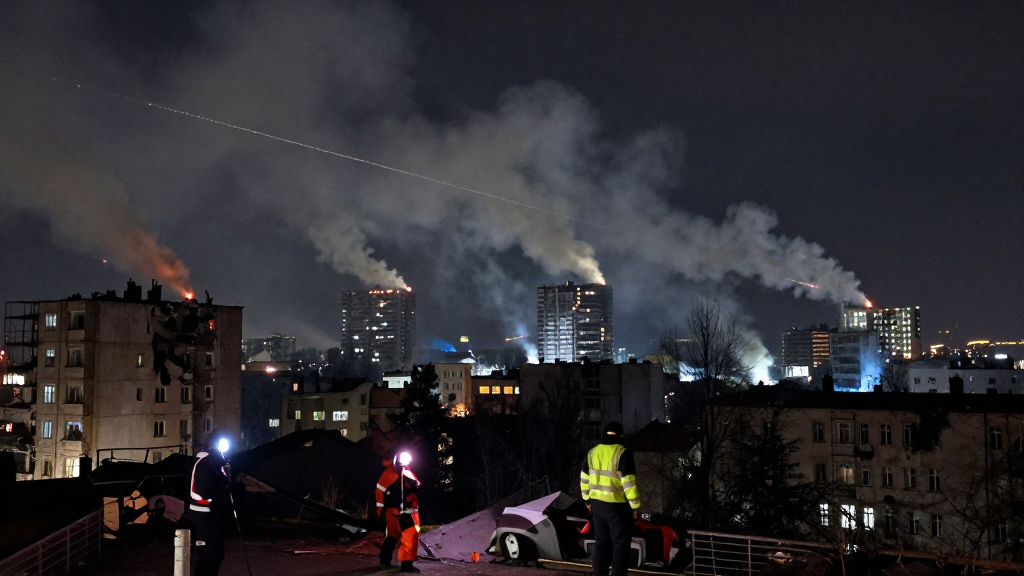
Russian Drone Barrage Targets Kyiv as Front-Line Defenses Buckle
Russian forces launched a massive coordinated drone attack on Kyiv overnight Monday, firing more than 140 Shahed drones across multiple waves in what Ukrainian military officials described as the largest single-night assault since the war’s early months. At least 14 people were killed and 63 injured in the strikes, which targeted residential buildings, a children’s hospital, and energy infrastructure across three districts of the capital. Air defense systems shot down 97 drones, but the remainder punched through, causing fires and structural damage across a wide area.
“The enemy is trying to break our energy grid before winter sets in,” Ukrainian President Volodymyr Zelensky said in a video address from Kyiv. “They are deliberately targeting civilian infrastructure. This is a war crime.” The attacks came as Ukraine’s own drone forces have been scoring increasingly bold strikes deep inside Russian territory, including a successful hit last week on a major oil refinery in Saratov, more than 700 kilometers from the front line.
Ukraine’s Own Drone Brigades Push Deep Into Russian Territory
Ukrainian maritime drones struck a Russian naval vessel in the Black Sea near Novorossiysk on Monday, the Ukrainian military’s Strategic Communications Directorate confirmed. Separately, Ukrainian long-range strike drones hit an oil depot in Russia’s Volgograd Oblast, around 500 kilometers from the front, according to a source in Ukraine’s security services who spoke on condition of anonymity. The strikes underline how the war has shifted into a new phase defined not by armored columns but by cheap, mass-deployed unmanned systems contesting an enormous battlefield.
Ukrainian Defense Minister Rustem Umerov said his forces have tripled domestic drone production this year and are now producing around 2,000 FPV drones per month alongside a growing arsenal of long-range strike models. “Drones have become the main weapon on this battlefield,” Umerov told reporters in Kyiv. “Whoever controls the skies with unmanned systems controls the ground.” Ukraine’s drone program has been boosted by Western technology transfers, including components sourced through intermediaries in Poland and the Baltic states.
Ceasefire Talks Stall as Both Sides Dig In
Any prospect of a negotiated settlement has grown more distant in recent weeks. Russia has demanded that any ceasefire framework recognize its control over roughly 20 percent of Ukrainian territory — a position the Ukrainian government and its Western backers have rejected out of hand. Turkish and Brazilian mediators have floated proposals for a limited ceasefire covering energy infrastructure, but neither side has committed, and officials in Kyiv privately describe the initiatives as largely symbolic.
Russia’s top negotiator, Foreign Minister Sergei Lavrov, dismissed the latest mediation effort at a press conference in Moscow. “There is no diplomatic solution available on terms that Kiev’s sponsors in Washington and London would accept,” Lavrov said. The Kremlin has shown no sign of reducing the tempo of its offensive, with units in the Donetsk region pressing forward around Kurakhove and Velyka Novosilka despite heavy casualties. The Institute for the Study of War estimated Russian daily casualties at between 1,200 and 1,500 personnel per day — figures that Moscow has not disputed.
Western Allies Respond as NATO Ramps Up Arms Shipments
Western allies moved quickly to reinforce Ukraine’s air defenses in response to the strikes. NATO Secretary-General Mark Rutte announced the alliance would fast-track delivery of additional Patriot air defense batteries from Germany and the Netherlands, with the first shipments expected within weeks. The United States authorized a new tranche of HIMARS ammunition and anti-drone electronic warfare equipment valued at roughly $800 million, according to a Pentagon spokesperson.
The European Union imposed a fresh round of sanctions targeting Russia’s drone manufacturing supply chain, including Chinese firms suspected of supplying components used in Shahed drones. “We are making it harder for the Kremlin to sustain this industrial-scale terror,” EU foreign policy chief Kaja Kallas said in Brussels.
What Happens Next
Ukraine is pushing Western partners to authorize long-range strikes using donated Western missiles against military targets deep inside Russia. The Biden administration has so far refused, fearing escalation, but the incoming Trump administration is reconsidering the policy, according to two people familiar with the internal discussions. A decision is expected before the end of the year. If approved, it would mark a significant escalation of Western involvement in the conflict and would almost certainly prompt a strong Russian response, officials in Kyiv and NATO capitals privately warn.
On the ground, the Donetsk front remains the most active, with Russian forces pressing toward Kurakhove and Velyka Novosilka. Ukraine’s General Staff reported 62 engagements on Tuesday alone, underscoring that whatever diplomatic signals emerge from international capitals, the fighting on the eastern steppe shows no sign of letting up.