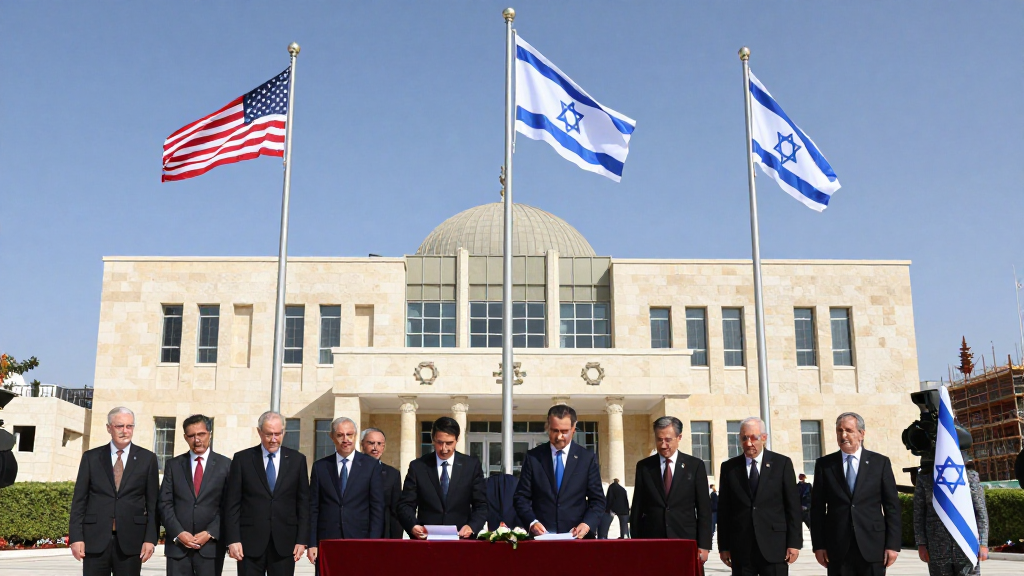
The United States signed a one-dollar annual lease with Israel on Tuesday, formally establishing the legal framework for a permanent embassy compound in West Jerusalem — a move that immediately drew sharp condemnation from the Palestinian Authority and elevated diplomatic tensions at a moment when American mediators are simultaneously pursuing cease-fire talks with both Israel and Iran.
A Formalization of an Established Reality
The agreement, signed in Jerusalem by senior officials from both governments, translates into binding legal terms an arrangement that had existed in practice since the Trump administration relocated the US embassy from Tel Aviv in 2018. Under the terms disclosed by the State Department, Israel will hold a 99-year lease on the compound at a cost of one US dollar per year, a symbolic figure that underscores the arrangement’s political rather than commercial nature. The lease grants the United States full sovereign-equivalent control over the property, effectively making the compound an enclave outside Israeli jurisdiction.
The signing came five months after President Donald Trump’s administration initially announced it would construct a purpose-built permanent embassy complex in the city. Officials told Reuters that the accelerated timeline reflected the administration’s desire to lock in the arrangement before the end of the current fiscal year. State Department spokesperson Jennifer Miller told reporters in Washington that the agreement was “a straightforward real estate transaction” that carried no implications for broader questions of Jerusalem’s final status.
Palestinian Authority Condemns the Agreement
Palestinian President Mahmoud Abbas’s office issued a statement calling the agreement “a flagrant violation of international law and a systematic attempt to entrench the occupation.” The statement warned that the move would “destroy any remaining horizon for a just and comprehensive peace” and reiterated the Palestinian position that East Jerusalem must serve as the capital of a future Palestinian state. Palestinian Prime Minister Mohammed Mustafa described the lease as “an accelerant poured on an open flame,” noting that the Trump administration’s simultaneous push to negotiate separate deals with Israel, Hamas, and Iran had deepened rather than resolved the region’s instability.
Jordan’s Foreign Ministry issued a separate statement expressing “deep concern” and warning that the agreement set a “dangerous precedent” for the status of occupied territories under international law. Amman, which administers the Islamic holy sites in Jerusalem through the Waqf trust, has historically served as a key interlocutor in any Israeli-Palestinian peace process. Senior Jordanian officials told the Associated Press that King Abdullah II had personally raised concerns about the embassy compound during a telephone call with Secretary of State Marco Rubio last week.
Broader Geopolitical Context
The timing of the announcement places additional pressure on the United States’ concurrent diplomatic initiatives in the region. American envoys are currently in Doha for indirect talks with Iranian officials, and separately working to broker a second-generation hostage and ceasefire agreement between Israel and Hamas. Analysts said the Jerusalem announcement risked complicating both tracks. Yossi Kuperwasser, a former director-general of Israel’s Strategic Affairs Ministry, told the Financial Times that the lease agreement was “a strong signal to Tehran that America’s commitment to Israel is unconditional,” while conceding that it would likely be “weaponized” by Iranian officials in the Doha negotiations.
Several European Union member states issued a joint statement calling on the United States to reconsider the arrangement, arguing that unilateral acts altering Jerusalem’s status were inconsistent with the position held by the international community since 1967. The statement recalled United Nations Security Council Resolution 478, which condemned Israel’s annexation of East Jerusalem and declared embassies located there to be non-compliant with international law. The EU’s High Representative for Foreign Affairs declined to comment on whether the bloc would take any retaliatory diplomatic measures.
Israeli Prime Minister Benjamin Netanyahu welcomed the signing in a post on social media, describing the permanent embassy as “the most visible expression of the bond between the United States and Israel.” The prime minister’s office noted that construction of the new compound was expected to begin within 90 days and would take approximately three years to complete, replacing the current interim facilities. Israel Katz, the defense minister, told Israeli Army Radio that the agreement demonstrated “the permanence of America’s partnership with Israel regardless of what deals are being discussed in Doha or anywhere else.”